
24/7 Customer Support

Free returns

Same-day & Next-day Delivery

Quality Guaranteed

Unlock Your Welcome Offers: FREE Delivery | Up to 80% OFF | Free 30-day JoyPlus trial
Download the APP
A kids’ ride-on tractor can provide imaginative play, outdoor activity and a memorable birthday gift. However, product listings often focus on bright colours and realistic details while leaving practical questions unanswered. Will it fit through the shed door? Can your child control it confidently? Is the bucket genuinely usable, or is it merely decorative?
Before buying, look beyond appearance and check the design, age range, dimensions, power source and supervision requirements. The right choice depends less on the most eye-catching feature and more on how your child will use the vehicle at home.
A ride-on excavator toy may look exciting online but prove difficult to store or use in a typical UK garden. Some pedal tractors are compact, while larger electric vehicles need more room to turn and may not pass through narrow gates or doorways.
Measure your intended play area, storage space and access points before ordering. Remember to account for the vehicle’s full length when a trailer or bucket is attached.
A bucket, shovel or trailer can add value when it moves or provides practical storage. But a fixed plastic attachment may offer little beyond appearance. Check whether the front bucket lifts manually, whether the lever is reachable from the seat and whether a trailer can be removed or used for carrying toys.
Also consider the surface. Grass, paving, sand and indoor flooring place different demands on wheels and steering. A pedal tractor for kids may suit firm, level ground, whereas an electric model with suspension can offer more flexibility outdoors.
A vehicle labelled for children does not automatically suit every child in that age bracket. Compare the recommended age, seat measurements and maximum load with your child’s height and weight. A model that feels too large can be difficult to steer or pedal.
Electric vehicles also require direct adult supervision. A parental remote control ride-on can allow an adult to stop or guide the vehicle, but it does not replace supervision or suitable riding space.
The 301-057 model is recommended for children aged 18–48 months and has a 30kg maximum load. This makes it more suitable for younger toddlers than the larger electric models, which are recommended for ages 3–6 and support up to 50kg.
Do not use the maximum load as a target. Clothing, footwear and any passenger all contribute to the total weight. A two-seater ride-on car must only carry two children if the product instructions permit it and the combined load remains within the stated limit.
A manual ride-on digger or pedal tractor is ready to use without charging. This can be convenient for short garden play sessions and avoids battery replacement or charging routines. It also means the child controls movement through pedalling or pushing.
Electric models offer powered movement, music and lighting, but require charging. The 370-239V70 models use a 12V 7AH battery, provide a stated speed of 3–6km/h and list approximately 45 minutes of run time, depending on conditions and use. The first charge is listed as 6–8 hours, with regular charging taking 8–12 hours.
Look for a stable wheelbase, a supportive backrest where appropriate and features that reduce unintended movement. The 301-057 includes an anti-reverse system, textured wheels and a backrest. The 341-033 includes a hand brake and a steel frame with plastic components.
The product details list standards including EN71-1-2-3 for selected manual models and EN71-1-2-3, EN62115, EMC, ROHS and RED for the electric models. These are useful compliance indicators, but buyers should still follow the supplied instructions, check the product label and supervise every ride.
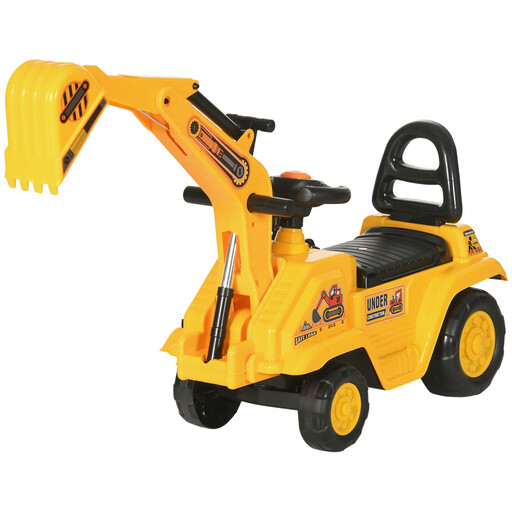
Why This Fits Their Persona: A compact, battery-free option for younger children who are beginning to explore ride-on play in a garden, living room or suitable outdoor area.
Its dimensions are 87L x 28W x 58Hcm, and the manually operated bucket is designed to scoop rather than simply decorate the front.
Pedal-powered operation, under-seat storage, horn and a pull-cart function; listed for ages 18–48 months with a 30kg load limit.
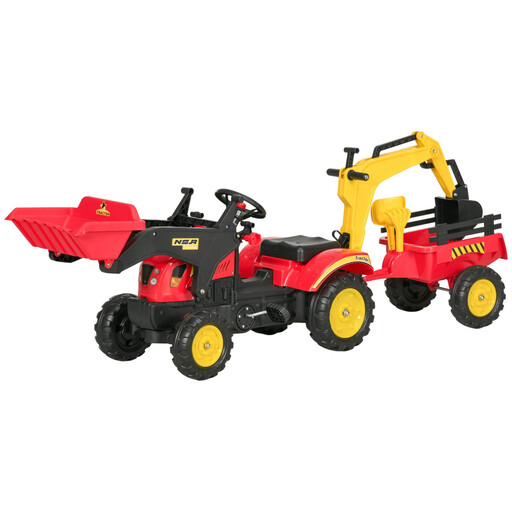
Why This Fits Their Persona: A larger manual construction toy for children aged 3–6 who want a more involved driving and digging experience without a rechargeable battery.
The front bucket moves through a lever, while the rear section is removable, making the functions more than visual styling.
Steel frame, six plastic wheels, steering wheel, pedals, gear lever and hand brake; maximum load is listed as 35kg.
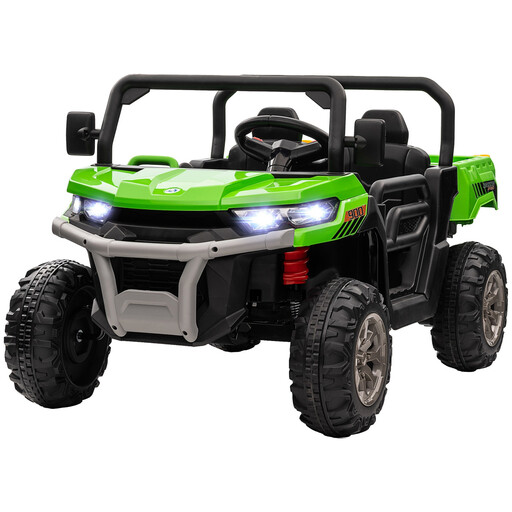
Why This Fits Their Persona: Suitable for families wanting a powered kids’ electric ride-on car with shared seating, remote support and outdoor-oriented features.
The product specifies speed, battery capacity, remote distance and charging times, helping buyers plan use rather than rely on vague power claims.
Two seats, four spring-suspension wheels, manual or remote driving, electronic storage bucket and a 50kg maximum load.
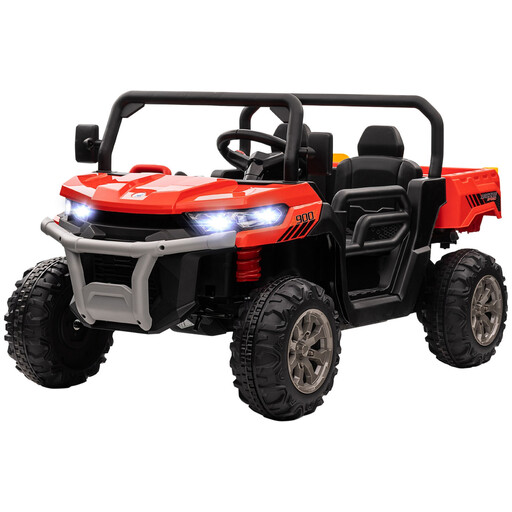
Why This Fits Their Persona: Offers the same listed powered specification as the green version, with a red-and-black finish for buyers choosing a particular colour.
The listing provides measurable details including 121L x 69W x 65.5Hcm dimensions, 3–6km/h speed and a 20m remote range.
Two-seater design, working horn, LED lights, music, toy shovel and parental remote control; recommended for ages 3–6.
We have compiled a complete, real-time list of products that fully satisfy these strict selection criteria and UK safety regulations.
Some compact pedal models are listed for indoor and outdoor use, but the floor must be clear, level and suitable for the wheels. Avoid stairs, wet surfaces and areas near furniture or glass. Larger electric vehicles need considerably more turning and storage space.
The listed 12V models provide approximately 45 minutes of run time, although actual performance can vary with rider weight, surface, speed and temperature. Allow the battery to charge according to the instructions and store the vehicle in a dry place.
Yes. Children should be supervised whenever they use a ride-on vehicle, particularly an electric ride-on excavator or two-seater ride-on car. Choose a traffic-free area, keep the remote control nearby where supplied and follow the manufacturer’s age, load and charging guidance.