
24/7 Customer Support

Free returns

Same-day & Next-day Delivery

Quality Guaranteed

Unlock Your Welcome Offers: FREE Delivery | Up to 80% OFF | Free 30-day JoyPlus trial
Download the APP
Finding the right kids scooter can feel like navigating a maze of different styles, sizes and features. From a child's first set of wheels to a teenager's advanced trick scooter, the options are vast. You want something safe, durable and suited to your child's age and interests, but cutting through the marketing clutter to find it can be a challenge.
This guide is designed to simplify your decision. We will walk you through the key differences between scooter types, highlight important features to look for and present a few carefully selected recommendations to help you find a model that offers both fun and function for your child.
Before looking at specific models, understanding a few key points can help you narrow down your search. Consider the primary use, your child's age and the features that contribute to safety and longevity.
The first question to ask is how the scooter will be used. This will determine whether you need a recreational push scooter or a more specialised stunt scooter.
When comparing models, pay attention to the materials and components.
Here are a few recommendations that cater to different ages and riding styles, whether you're looking for a scooter for boys and girls to ride recreationally or a serious piece of kit for the skate park.
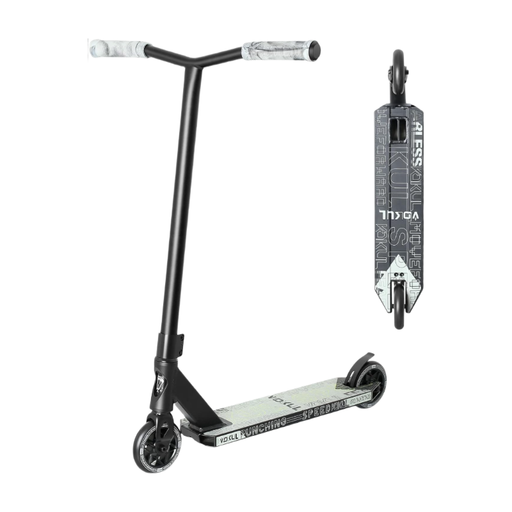
Why It Stands Out: The VOKUL K1 Pro is built for performance. Constructed with a tough T-6061 aluminium alloy deck and solid 110mm alloy wheels, it's designed to handle the demands of intermediate and advancing riders. The combination of ABEC-9 bearings and lightweight handlebars delivers a fast, smooth glide that's ideal for executing tricks.
Pros:
Who is it for?: This is an excellent stunt scooter for kids and teens aged 8 and up who have some experience and are looking to progress their freestyle skills.
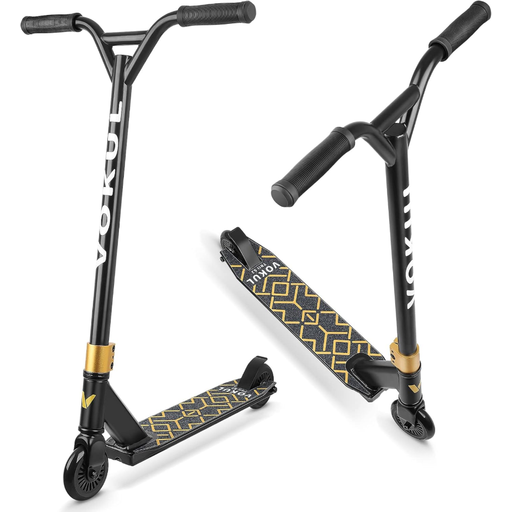
Why It Stands Out: The VOKUL S2 is tailored for those just starting their stunt scooter journey. It balances performance with beginner-friendly features, such as a slightly wider 20”L x 4”W matte non-slip deck for more secure footing. The 100mm high-resilience wheels are designed to offer a softer landing, which can help build confidence when learning new tricks.
Pros:
Who is it for?: A great entry-level trick scooter for teens and children aged 6-12 who are new to freestyle riding and need a stable, forgiving scooter to learn on.
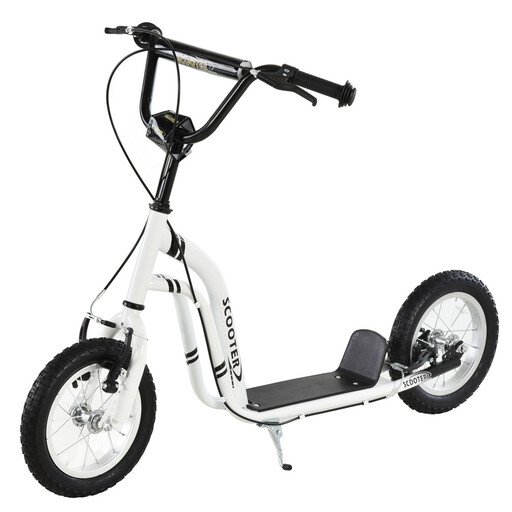
Why It Stands Out: This HOMCOM scooter is a classic recreational model focused on comfort and safety. Its large Φ12" rubber wheels are designed to roll smoothly over pavements and uneven ground. The dual brake system, with levers on the handlebar for both front and rear wheels, offers enhanced stopping power and control.
Pros:
Who is it for?: Perfect for children aged 5 and up who need a reliable and comfortable scooter for outdoor play and getting around the local area.
While these three models cover a range of popular needs, every child is different. If you're searching for different styles, colours or features, there are many other models to consider.
For a wider selection of models, including more advanced options, explore our full range of teen scooter models.
1. What is the difference between a stunt scooter and a regular kids scooter? A stunt scooter is built for tricks with a fixed, reinforced frame, smaller hard wheels and a lightweight design. A regular push scooter is for transportation and recreation, often featuring larger wheels for comfort, an adjustable handlebar and sometimes folding mechanisms for portability.
2. What age is appropriate for a two-wheel scooter? Most children can start learning to ride a two-wheel scooter around the age of 5, once they have developed sufficient balance and coordination. For younger children, a three-wheel scooter is often a better starting point. Always check the manufacturer's recommended age range for a specific model.
3. How do I know which scooter size is right for my child? For a comfortable and safe riding posture, the scooter's handlebars should be roughly at waist or hip height. For an adjustable scooter for children, you can set it to the correct height. For fixed-height stunt scooters, check the product's overall height and compare it to your child's measurements. A scooter that is too tall or too short will be difficult and unsafe to control.