
24/7 Customer Support

Free returns

Same-day & Next-day Delivery

Quality Guaranteed

Unlock Your Welcome Offers: FREE Delivery | Up to 80% OFF | Free 30-day JoyPlus trial
Download the APP
Choosing among kids’ scooters can look simple until you compare wheel layouts, handlebar heights, brakes, weight limits and UK usage rules. A colourful design may attract a child, but it does not necessarily suit their height, balance or riding environment.
Parents, grandparents and gift buyers should look beyond age labels and promotional features. The right children’s scooter should match the rider’s physical development, intended use and storage needs.
“Scooters for kids aged 3-10” covers a wide range of abilities. A three-year-old learning to balance needs a very different platform from a confident ten-year-old. Check the recommended rider height, deck dimensions and maximum user weight as well as the age range.
A three-wheel scooter with lean-to-steer controls can feel more stable for younger children. Older riders may prefer two wheels for faster, more responsive movement.
Many light-up scooters use motion-activated wheel lights, so they do not require batteries. However, lighting is mainly a design and visibility feature; it does not replace adult supervision, protective equipment or suitable riding conditions. Confirm whether the lights are motion-activated and check that the wheels still roll smoothly.
Privately owned electric scooters are illegal to ride in public places in the UK, including roads, pavements, cycle paths, parks and other open public spaces. This applies regardless of the rider’s age. Electric scooters for kids should only be used on private land with the landowner’s permission.
Do not buy an electric model for a child unless you have an appropriate private riding area and can follow the charging and supervision instructions.
3-wheel scooters for toddlers commonly use lean-to-steer movement. The child shifts their weight to turn rather than rotating the handlebar sharply. This can help beginners practise balance and directional control at a manageable pace.
Two-wheel kick scooters for kids are more suitable when the rider can balance independently. They are often lighter and more manoeuvrable, but require greater coordination.
An adjustable-height scooter can remain useful as a child grows, but the adjustment range must suit their height now. A handlebar that is too low may encourage crouching, while one that is too high can make steering less controlled.
For example, some folding inline scooters have three handlebar settings between 74 and 80 cm, while certain electric models offer ranges such as 75-80 cm. Always compare the specification with the child’s height rather than relying only on the age recommendation.
Look for an anti-slip deck, secure grips and a rear foot brake that the child can operate comfortably. Solid polyurethane wheels reduce puncture concerns, whereas larger wheels may roll more easily over minor surface imperfections.
The maximum rider weight is a hard limit, not a suggested target. A scooter rated for 30 kg is not interchangeable with one rated for 50 kg or more. For stunt scooters for beginners, also check the deck width, fixed handlebar, clamp system and whether the frame is intended for tricks rather than general transport.
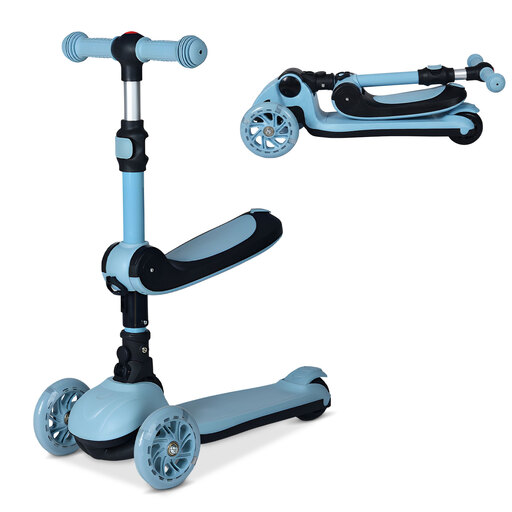
Why This Fits Their Persona: A practical starting point for younger children who want a recreational outdoor ride, with lean-to-steer control and a seat included for added flexibility.
Its stated 3-10 age range, two adjustable heights, flashing wheels and wide deck provide more useful information than appearance alone.
Three-wheel lean-to-steer layout; light-up wheels and a swivel seat for varied play.
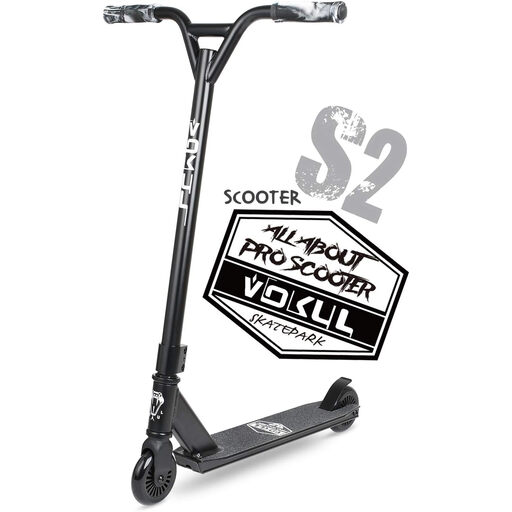
Why This Fits Their Persona: Suitable for children aged 7-14 who want to move from ordinary rides towards freestyle practice at a skatepark or on an appropriate private surface.
The product specifies a reinforced deck, fixed chromoly steel handlebar and triple clamp, rather than relying solely on “pro” wording.
6061 aluminium alloy frame; 4130 chromoly steel fixed handlebar and rear brake.
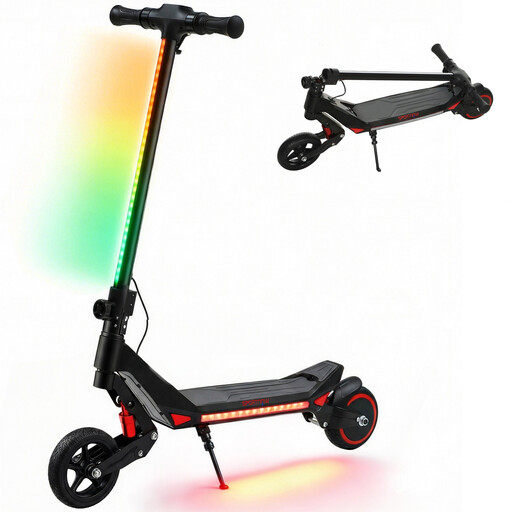
Why This Fits Their Persona: A consideration for families with suitable private land who want powered riding, compact storage and information displayed during use.
The kick-to-start system avoids immediate motor activation, while the stated 50 kg limit and age range make suitability easier to assess.
200W motor with stated speed of up to 16 km/h; front and rear suspension, LED display and foldable frame.
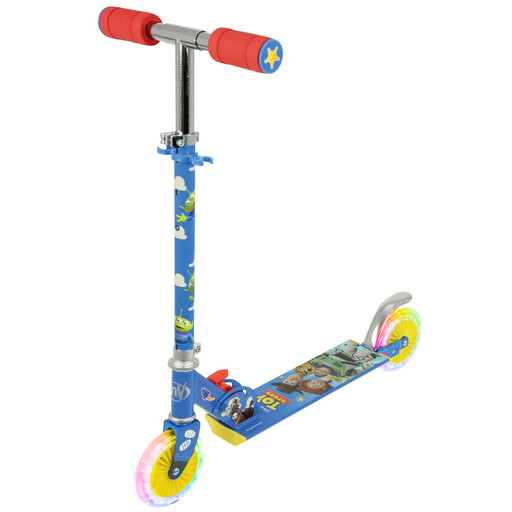
Why This Fits Their Persona: A convenient gift for children from age five whose families need a scooter that can be stored in a car or cupboard.
The listing gives clear details on folding, a 50 kg maximum user weight, three handlebar settings and puncture-proof tyres.
Folding steel frame; motion-activated multicoloured wheels with no batteries required.
We have compiled a complete, real-time list of products that fully satisfy these strict selection criteria and UK safety regulations.
Before the first ride:
For electric models, use only the supplied or approved charger. Charge on a hard, flat surface, never overnight or unattended, and stop using the scooter if the battery or charger is damaged.
It depends on balance, height and coordination. Three-wheel models are commonly designed for younger beginners, while two-wheel scooters may suit children who can already balance independently. Always follow the manufacturer’s age, height and weight guidance.
Lifespan depends on rider weight, surface conditions, storage and maintenance. Regularly checking wheel wear, brake function, clamps and bolts can help identify problems early. Stunt scooters should not be used for tricks unless their construction and instructions specifically support that use.
Privately owned electric scooters cannot legally be ridden in public places in the UK. They may only be used on private land with the landowner’s permission. This restriction applies to children and adults alike.