Parents planning one child’s tea
A smaller, separately sealed can may be easier to use without planning what to do with an opened larger tin. Tesco lists Heinz hoops in a 4 x 205g format.


Choose smaller tinned-pasta multipacks when opening one can for a child matters more than planning leftovers; larger cans make more sense when the meal will be shared or the remainder can be stored and used as directed. Dry pasta and sauce offer more choice over the components but need preparation and separate label checks. For any option, check the current ingredients and nutrition label, particularly if the food may be taken to school under an individual allergy arrangement.
A smaller, separately sealed can may be easier to use without planning what to do with an opened larger tin. Tesco lists Heinz hoops in a 4 x 205g format.
A 400g can may suit several people eating together, or a household prepared to store and use the remainder according to the pack instructions. Tesco also lists this Heinz hoops format as a four-pack.
The checked Heinz hoops and Crosse & Blackwell children’s pasta contain wheat. Read the current pack label and, if the food is going to school, check the child’s individual arrangements and the school’s policy.
First decide whether you want ready-to-heat tinned pasta or will prepare dry pasta with sauce; then match the can size and labels to the meal you intend to serve.
| Concern | What to check | Who this matters to |
|---|---|---|
| One-child portions | Check the amount in each can and whether opening it would leave food unused. | If I am serving one child, I want a sealed can that fits the meal without creating leftovers. About 36% of consumers put portion fit first. |
| Shared meals and leftovers | Check the can size against the number eating and read the opened-food storage instructions. | When several people eat together, I need a can I can use at tea time, or a clear plan for the remainder. Sharing and leftover management are the main concern for about 36% of consumers. |
| Ingredients and nutrition | Read current allergens and compare nutrition per 100g and for the intended serving; check school arrangements where relevant. | If wheat is relevant to my child, or I am comparing what a serving contains, the current label decides whether a product fits. Roughly 28% of consumers make these label checks their primary concern. |
The checked Heinz hoops and Crosse & Blackwell pasta contain wheat. A school’s arrangements for a child with an allergy matter alongside the product label; wheat-containing food is not automatically subject to one blanket school rule.
Read the current ingredients and allergen statement, then check the child’s individual plan and the school’s policy before packing it.
A 400g can may suit a shared tea but can leave opened food when only one child is eating.
Check how much is likely to be served and follow that product’s instructions for storing anything left over.
Unused food may be wasted if it cannot be stored and eaten within the period stated on the pack.
The checked Heinz labels give reference-intake percentages for an average adult. The NHS explains that nutrition labels give figures per 100g and sometimes per portion; the labelled portion may differ from what is served.
Compare products on a per-100g basis, then look at the amount you intend to serve rather than using an adult percentage as a child-specific target.
Tesco’s grocery listings show the checked Heinz hoops multipacks in both 4 x 205g and 4 x 400g formats.
Dolmio is relevant if you plan to make dry pasta with a separate sauce instead of opening a tin of ready-to-heat pasta.
M&S lists a 225g children’s Spaghetti Bolognese meal, an alternative meal format rather than a bulk tinned-pasta multipack.
The Joybuy selection here is a larger-can tinned-pasta multipack for a shared tea or planned leftovers.
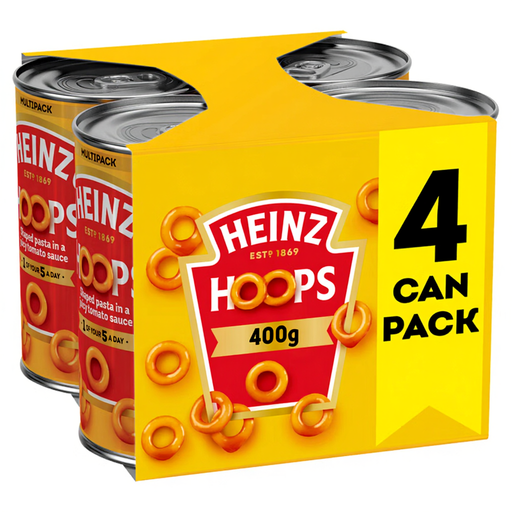 Image unavailable
This larger-can format suits a tea shared between several people or a household with a plan for leftovers. The four-pack contains 400g tins; its ingredients include wheat, and nutrition information is given per 100g and per half-can. Transfer unused contents to a suitable covered container, refrigerate and use within two days. Check the current pack label and any relevant school allergy arrangements before packing it for a child.
Choose the smaller sealed can if you expect to serve one child and do not want an opened remainder. A 400g can is more practical when the meal will be shared or you can follow its instructions for storing what is left.
No. The checked Heinz percentages refer to an average adult, not a child-specific meal target. Compare the nutrition figures per 100g and consider the amount you intend to serve; the NHS notes that labels sometimes also give figures per portion.
Do not assume a blanket ban or blanket permission. For England, the Department for Education says schools must support pupils with medical conditions, including allergies. Check the child’s individual arrangements, the school’s current policy and the food’s on-pack allergen statement.
Follow the instructions on that product’s pack. For example, the checked Crosse & Blackwell children’s pasta instructs you to empty, cover and refrigerate unused contents and use them within two days; instructions for another product may differ.
They can provide a tea-time alternative if you are prepared to cook and assemble the meal, but they are not the same ready-to-heat format. Dry pasta and a separate sauce let you choose the components individually; check the ingredients and nutrition label on each.