
24/7 全天候客户支持

免费退货

当日/次日达

品质保障

开启新人专享福利: 全场免邮 | 低至 2 折 | 免费试用 30 天 JoyPlus 会员
下载 Joybuy
Stepping on a stray building block in the middle of the night is a rite of passage for many parents. As toys, books and art supplies multiply, keeping a child's room or playroom tidy can feel like a constant battle. The right storage solution does more than just clear the floor; it can empower your child to learn responsibility, make independent choices and turn tidying up into a part of play.
As the Joybuy Product Recommendation Officer, my role is to help you find practical and effective solutions for your home. This guide will walk you through the key features to consider when choosing a kids toy storage organiser and highlight a few recommendations to help you create a calm, organised and child-friendly space.
Choosing the right furniture for a child's space involves more than just aesthetics. Here are a few key factors to consider to ensure your choice is safe, practical and encourages good habits.
When it comes to children's furniture, safety is the top priority. Look for units with rounded corners to minimise bumps and scrapes. A crucial feature for any tall piece of furniture is an anti-tip design, which usually involves a strap or bracket to secure the unit to the wall. This prevents it from toppling over if a child attempts to climb it. Also, check for material certifications, such as EN71-1-2-3, which indicates the product meets European safety standards for toys, covering mechanical properties, flammability and migration of certain chemical elements.
A well-designed toy organiser unit can be a valuable tool for a child's development. Storage that is low to the ground allows toddlers and young children to see their toys and access them without needing help. This fosters independence and decision-making.
Many parents are drawn to the principles of a montessori bookshelf, which features forward-facing shelves. This design allows children to see the covers of their books, making them more likely to pick one out and read. Similarly, a toy shelf with bins makes sorting and tidying simple. Children can quickly learn to put blocks in one bin and dolls in another, turning clean-up into a simple matching game.
From sticky fingers to crayon marks, kids bedroom storage needs to withstand daily life. Materials like MDF (Medium-Density Fibreboard) with a smooth, sealed finish are often a good choice as they are robust and easy to wipe clean. Removable plastic bins can also be taken out and washed, which is ideal for containing messes from art supplies or modelling clay.
Based on these principles, here are a few standout options that balance functionality, safety and child-friendly design.
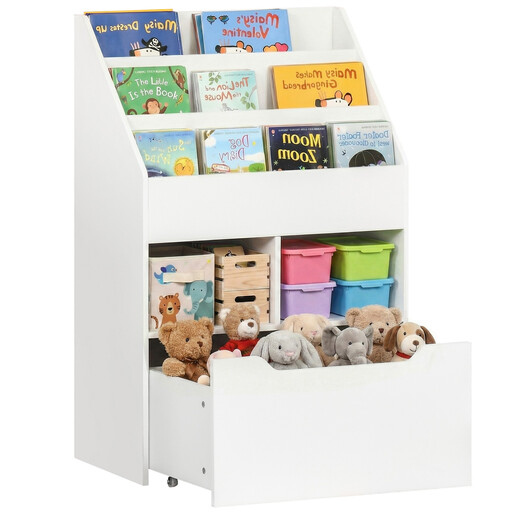
Why It Stands Out: This unit combines multiple storage types in one compact and thoughtful design. It features forward-facing book-ledges, cube compartments and a large bottom drawer on wheels that can be rolled out for easy access.
This book and toy storage solution is particularly well-suited for smaller rooms where versatility is key. The Montessori-inspired design encourages children to engage with their books, while the moveable drawer makes tidying up a more interactive and less daunting task.
Pros:
children's bookcase, cube storage and a rolling toy box.Who is it for? Parents looking for a versatile, all-in-one storage solution for a toddler's bedroom or a small playroom, with a focus on fostering independence.
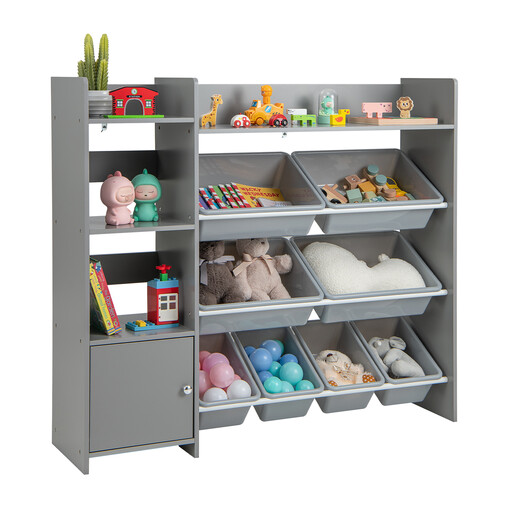
Why It Stands Out: For those dealing with a serious amount of toys, this large-capacity organiser is a game-changer. It offers a systematic approach to playroom storage with eight removable bins, side shelves for books and a top cabinet.
The open, sloped design of the bins allows children to see what’s inside and grab what they want without pulling everything out. This type of classified storage is excellent for teaching organisational skills from a young age.
Pros:
Who is it for? Families needing a high-capacity toy organiser unit to bring order to a busy playroom or shared children's room.
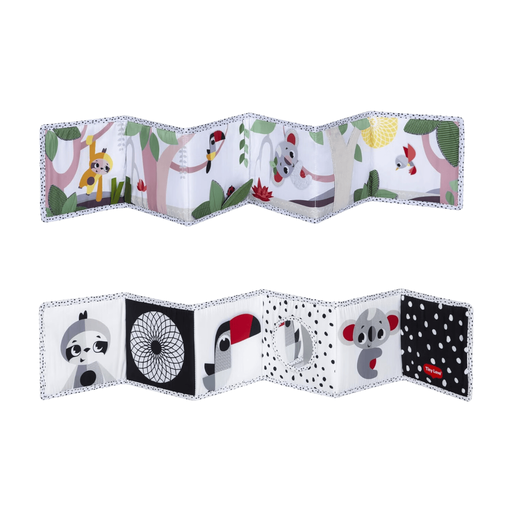
While not a storage unit itself, the Tiny Love Soft Book is the perfect first item to place on your new shelf. Designed for babies from birth, it supports early development and makes tummy time more engaging.
Why It Stands Out: This double-sided soft book grows with your baby. One side features high-contrast black-and-white images for newborns (0-3 months), while the other has colourful textures and characters for older infants. It stands on its own to encourage head-lifting during tummy time and includes loops for attaching to a pram or car seat.
Pros:
Who is it for? New parents looking for a developmental toy that encourages tummy time and sensory exploration and which will look right at home on their new children's bookcase.
If these recommendations aren't quite what you're looking for, or if you're specifically searching for a unit dedicated solely to reading, there are many other styles available.
Explore our full collection of book shelves for babies to discover more solutions tailored to your space and needs.
What is the best way to organise kids' toys? A popular method is to use a system of bins and shelves. Categorise toys (e.g., building blocks, dolls, cars, art supplies) and store them in clearly labelled or colour-coded bins. Rotating a selection of toys every few weeks can also keep children engaged and prevent them from feeling overwhelmed by too many choices at once.
What is a Montessori bookshelf? A montessori bookshelf is a child-sized shelving unit designed to display books with their covers facing forward, rather than their spines. This visual approach makes it easier for young, pre-reading children to recognise and select their favourite books, promoting literacy and independence.
How can you make toy storage look good? Choose a kids toy storage organiser that complements your home's decor. Neutral colours like white, grey, or natural wood can blend seamlessly into a living room or bedroom. Using matching baskets or bins creates a cohesive and uncluttered look. The key is to find a balance between function for the child and form for the home.