
24/7 Customer Support

Free returns

Same-day & Next-day Delivery

Quality Guaranteed

Unlock Your Welcome Offers: FREE Delivery | Up to 80% OFF | Free 30-day JoyPlus trial
Download the APP
A kids’ ride-on tractor can be an engaging present for a toddler, but the wrong design may quickly become difficult to use, awkward to store or unsuitable for the child’s size. Parents, grandparents and gift buyers should look beyond bright colours and realistic sounds before placing an order.
Three common buying pitfalls are worth checking first:
Choosing by appearance rather than age and seat dimensions
A vehicle can look suitable in photographs but still have a seat that is too high, a steering wheel that is difficult to reach or a body that takes up too much room indoors.
Assuming every ride-on vehicle is battery-powered
Many toddler ride-on tractors use foot-to-floor movement or pedal action instead. This can be useful for active play, but it requires enough floor space and may not suit every child. Check whether batteries are included, required only for sounds and lights or not needed at all.
Treating accessories as proof of quality
A horn, shovel or flashing light adds play value, but it does not replace stability, a suitable weight limit or a sensible braking and steering arrangement. A ride-on digger toy should be assessed as a vehicle first and an interactive toy second.
Age guidance is a starting point, not a substitute for adult judgement. The HOMCOM foot-to-floor ride-on models listed here are designed for 12–36 months, with a stated 25 kg maximum load. The larger 301-057 model is specified for 18–48 months and has a 30 kg maximum load.
Compare these figures with the child’s current size and how confidently they can sit, push and steer. Check the seat height, backrest and available legroom. A child should be able to place their feet on the floor comfortably when using a foot-powered model.
For children aged approximately 12–18 months, a toddler walker-style design may be more suitable than a larger ride-on construction toy. The vehicle should still be used with direct adult supervision, particularly while a child is learning to balance and control direction.
A foot-to-floor ride-on toy moves when the child pushes against the ground. This avoids a motorised drive system and gives the child direct control over speed, although it works most effectively on a clear, reasonably smooth surface.
The 301-057 tractor uses foot pedalling and includes a gear lever and manually operated front bucket. It also has a rope attachment for pulling the cart. This makes it more appropriate for children who are ready for additional controls and imaginative construction play.
If you are considering a pull-along tractor, check whether the rope is intended for towing toys or for an adult to pull the child. Product instructions should always determine how the vehicle is used.
Look for a broad base, textured wheels, a supportive backrest and a design that does not encourage sudden backward movement. The 301-057 includes an anti-reverse system, while the 370-173 models list six textured tyres and a mid-rise backrest.
Materials listed for these products include PP, ABS and metal. These descriptions tell you what the main components are, but they do not remove the need to check for sharp edges, loose parts and secure assembly when the toy arrives.
The 370-173 yellow, blue and pink versions list EN71-1-2-3, EN62115, EMC and RoHS information. EN71 relates to toy safety requirements, while EN62115 concerns the safety of electrically operated toys. The 301-057 lists EN71-1-2-3. Treat these details as useful compliance information, while still following the supplied instructions and supervision guidance.
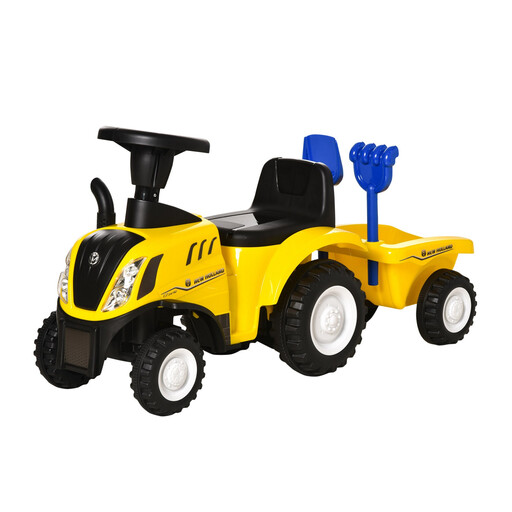
Why This Fits Their Persona: A practical first vehicle for households wanting walker and ride-on functions in one compact design for indoor or outdoor play.
The stated 12–36-month range, 25 kg limit and 25 cm seat height make key sizing details easier to compare before purchase.
Foot-to-floor movement, rear storage, steering wheel, horn, interactive lights, fork and shovel are listed features. Batteries are not included.
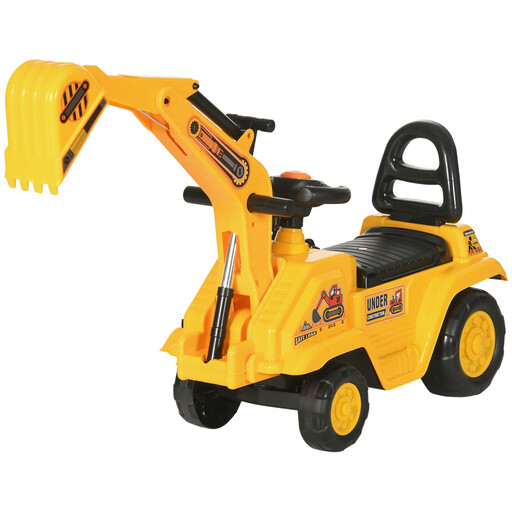
Why This Fits Their Persona: Suitable for buyers seeking more interactive mechanical play, with a digger bucket, pull cart and under-seat storage for larger play sessions.
It clearly states the 18–48-month range, 30 kg limit, assembly requirement and manual, non-battery operation.
A lever-operated bucket, gear lever, anti-reverse system, backrest, textured wheels and under-seat storage are specified.
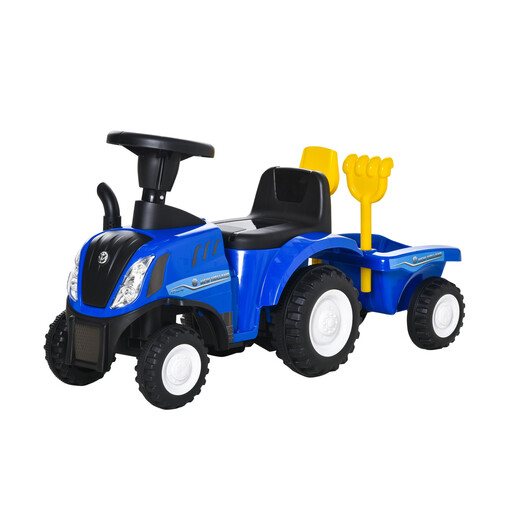
Why This Fits Their Persona: A versatile option for families using a toddler tractor across playrooms, patios or gardens, with storage for small toys and sand-play accessories.
Six textured tyres, a large steering wheel, mid-rise back and no-battery drive mode address stability and control concerns.
Removable rear cargo box, fork, shovel, horn and interactive lights provide several play modes. The stated load limit is 25 kg.
A compact alternative for sound-led play is the VTech Toot-Toot Drivers Bingo Garbage Truck 584203. It is a push-along interactive rubbish lorry toy for children aged 18 months and over, with flashing headlights, sound effects, one song and six melodies. It uses two included AAA batteries. Note the small-parts warning and keep battery compartments and loose components away from younger children.
We have compiled a complete, real-time list of products that fully satisfy these strict selection criteria and UK safety regulations.
Some are. Check the manufacturer’s stated age range, seat height, maximum load and steering design. A 12–36-month foot-to-floor model may suit a smaller toddler, while a larger ride-on digger toy specified from 18 months may require more confident sitting and steering.
Not always. Foot-powered tractors and pull-along designs do not need batteries for movement. Some include batteries only for lights and sounds; for example, the 370-173 models require two AA batteries, which are not included. Always check the product details before buying.
Use it on surfaces recommended in the instructions, avoid exceeding the stated weight limit and inspect wheels, steering parts, fasteners and accessories regularly. Store it dry when it is not in use and supervise children around steps, roads, slopes and other hazards.