
24/7 Customer Support

Free returns

Same-day & Next-day Delivery

Quality Guaranteed

Unlock Your Welcome Offers: FREE Delivery | Up to 80% OFF | Free 30-day JoyPlus trial
Download the APP
Truck play can keep children engaged indoors, in the garden or at the park, but choosing suitable kids truck toys is not simply a case of picking the largest vehicle or the set with the most lights. Parents, grandparents and gift buyers should look beyond the packaging to check age suitability, construction, play space and ongoing running costs.
Music, flashing lights and remote controls can attract attention in a product listing, but they do not always provide lasting play value. A toy with movable parts, loading functions, tracks or role-play accessories may offer more ways to play without relying entirely on electronic effects.
For younger children, simple friction-powered construction truck toys can be easier to use independently. Older children may enjoy more involved controls, such as a remote control monster truck or a building set with a working loading platform.
A large truck may look impressive but become difficult to store in a typical UK home. Ride-on vehicles also need a suitable area for use, with enough clearance around furniture, steps, walls and parked cars. Check the product dimensions before buying and consider whether it will be used on carpet, paving, grass, gravel or sand.
Foldable transport truck toys can help reduce clutter, while smaller engineering vehicle toys are easier to take between rooms or outside.
An age recommendation is only a starting point. Also check for small parts, maximum rider weight, battery requirements, assembly needs and supervision instructions. Building sets may carry choking warnings for children below the stated age, while ride-on vehicles require active adult supervision even when a remote control is included.
For toddlers and preschoolers, look for a clear 3+ age recommendation and chunky components that are comfortable to hold. Sets containing small vehicles, minifigures or accessories may be more appropriate for older children. For example, some LEGO truck sets are designed for ages 5+ or 7+, while more complex sets may be intended for children aged 8 and above.
Never rely on a product title alone. Read the safety section and remove all packaging before giving the toy to a child.
For everyday play, thick ABS plastic, reinforced joints and securely attached wheels are useful features to look for. Large, grippy tyres can be practical for garden play, although no toy should be assumed to work equally well on every surface.
Inspect movable components such as crane arms, dump beds, trailers and ramps. They should move in a controlled manner without creating obvious pinch points. A friction-powered model has no battery to charge, which can make it convenient for spontaneous play.
For a kids ride-on truck, check the voltage, speed range, charging time, running time and maximum load. One 12V model listed for ages 3–5 has a speed range of 3–6 km/h, a stated running time of up to 50 minutes and a maximum load of 25kg. A larger 24V two-seater model is listed for ages 3–8, with three speeds from 3–8 km/h, a 60kg maximum load and up to 45 minutes’ running time.
Look for features such as a slow-start function, seatbelts, parental remote control and a battery indicator. The relevant electrical toy standard, such as EN62115, should be listed where applicable. For general toys, check the stated EN71 information and the CE or UKCA marking on the packaging or product details.
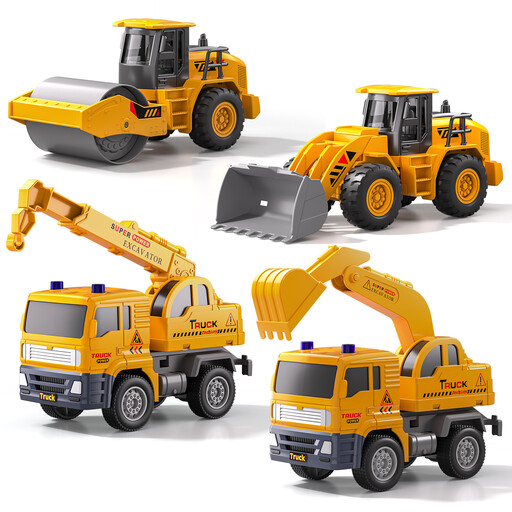
Why This Fits Their Persona: A straightforward option for families wanting several vehicles without charging, batteries or complex controls. It is suitable for children aged 3 and above and works for indoor or outdoor imaginative play.
The friction-powered design avoids battery replacement and setup issues. The pack includes an excavator, crane, bulldozer and road roller rather than relying on one vehicle.
Four vehicles, reinforced wheels and joints, and large non-slip tyres. No batteries are required.
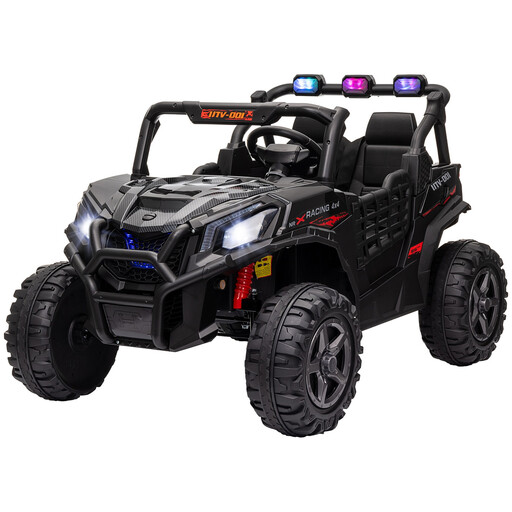
Why This Fits Their Persona: Designed for families with outdoor space and children aged 3–8 who want a more substantial driving experience, with room for a sibling or friend.
The listing provides measurable details, including speed, dimensions, charging time, load limit and remote distance, making it easier to assess suitability before purchase.
Two seats, rear spring suspension, three selectable speeds, seatbelts and parental remote control.
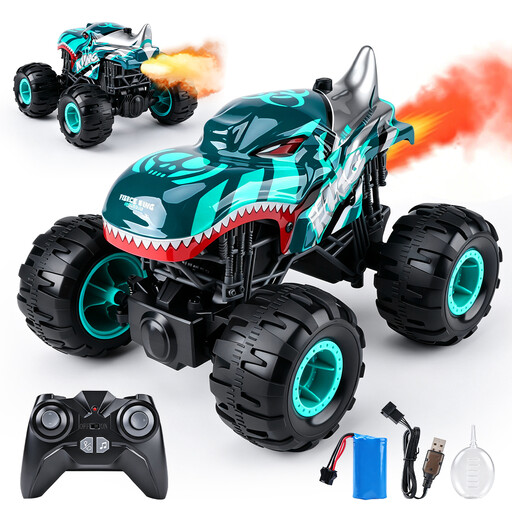
Why This Fits Their Persona: A suitable match for children who enjoy racing, stunts and operating a remote control vehicle across grass, sand or tarmac.
The listing specifies two rechargeable vehicle batteries, a 2.4GHz controller and an estimated play time of up to 50 minutes, rather than leaving operating requirements unclear.
Three lighting modes, music controls, 360° stunt function and rubber tyres for off-road play.
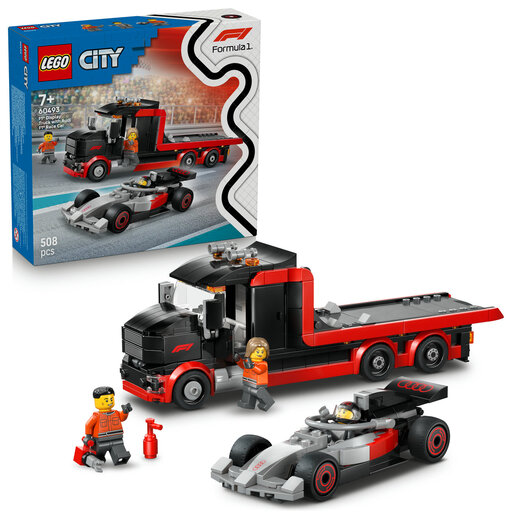
Why This Fits Their Persona: A considered choice for children aged 7+ who enjoy building, motorsport themes and detailed vehicle role-play rather than simple push-along play.
The set states its 7+ suitability, 508-piece count and small-part warning. Buyers can therefore match the build complexity to the child rather than assuming it suits younger toddlers.
Includes a truck, F1 car, lifting platform, storage compartments and three minifigures. No batteries are required.
We have compiled a complete, real-time list of products that fully satisfy these strict selection criteria and UK safety regulations.
Some are suitable from age 3, particularly chunky friction-powered vehicles with no small detachable parts. Always follow the manufacturer’s age label and warning information. Building kits, miniature cars and accessories may not be appropriate for younger toddlers.
Running time varies by model, rider weight, surface, speed and battery condition. The listed 12V AIYAPLAY model states up to 50 minutes, while the listed 24V two-seater model states up to 45 minutes. Charging can take 8–12 hours, so buyers should plan ahead rather than expect continuous use.
Yes. Children should use them in a clear, suitable area away from roads, stairs and fragile objects. Adults should also supervise charging, water or spray functions, and any play involving small accessories.