
24/7 Customer Support

Free returns

Same-day & Next-day Delivery

Quality Guaranteed

Unlock Your Welcome Offers: FREE Delivery | Up to 80% OFF | Free 30-day JoyPlus trial
Download the APP
Kids’ walkie-talkies can turn a garden, campsite or living room into an imaginative adventure. However, a colourful design and a large range figure do not always tell the whole story. Parents and gift buyers should check how the radios are powered, how easy they are to operate and whether the stated range suits the intended setting.
This guide explains the key details to compare before buying children’s walkie-talkies, followed by product recommendations for different types of play.
A stated distance is usually measured in open outdoor conditions. Walls, trees, hills, buildings and weather can reduce the usable range. A pair advertised as long-range walkie-talkies for children may work well across a garden but perform differently inside a house or in a built-up park.
Use the range figure as a comparison point rather than a promise. For hide-and-seek indoors, simple communication between rooms may be sufficient. For larger gardens, campsites or outdoor games, a higher stated outdoor range may be more useful.
Character walkie-talkies are appealing gifts, but decorative features should not make the unit awkward to hold. Check for a large push-to-talk button, a manageable body shape, an accessible power switch and a belt clip or lanyard.
A rigid antenna can provide a defined shape but may be less forgiving if the toy is dropped. Flexible antennas may suit energetic outdoor play. Neither feature replaces sensible supervision, particularly for younger children.
Toy walkie-talkies generally use replaceable batteries, which are often not included. Battery type and quantity can vary considerably: some models use three AAA batteries per unit, while others require more. Include the cost of replacement batteries when comparing prices.
Products marked for ages 3+ may still contain small parts and batteries that require careful handling. Follow the supplied warnings, remove all packaging before use and keep new and used batteries away from children. If a battery is swallowed, seek urgent medical help.
For ordinary play, a straightforward push-to-talk system is usually easier than a toy with multiple menus. Two communication channels can help children switch channels when another device causes interference. The child should be able to press one button to speak and release it to listen.
Remember that walkie-talkies are not private communication devices. Other compatible units nearby may hear transmissions on the same channel.
Read the product listing carefully before checkout. Confirm:
For occasional birthday-party play, replaceable batteries are convenient. For frequent outdoor use, keeping a spare set available can prevent interrupted games.
Look for a compact body that fits comfortably in a child’s hand. Belt clips help children carry the radios while running, while lanyards can be useful when an adult is supervising outdoor play. Check that the antenna and clip are not treated as handles and explain how to carry the units safely.
Age guidance is also important. A product suitable for children from age 3 may not be appropriate for unsupervised use. Always consider the individual child’s ability to follow instructions.
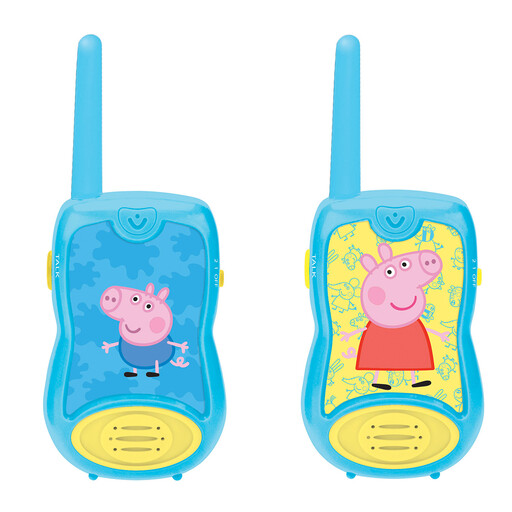
Why This Fits Their Persona: A straightforward choice for younger Peppa Pig fans aged 3 to 8 who mainly play indoors, in the garden or during simple hide-and-seek games.
The large push-to-talk button and compact shape avoid complicated controls, while the stated 120-metre range sets a more realistic expectation for local play.
Flexible antennas, belt clips and a design shaped for small hands. Requires two 9V batteries per product, not included.
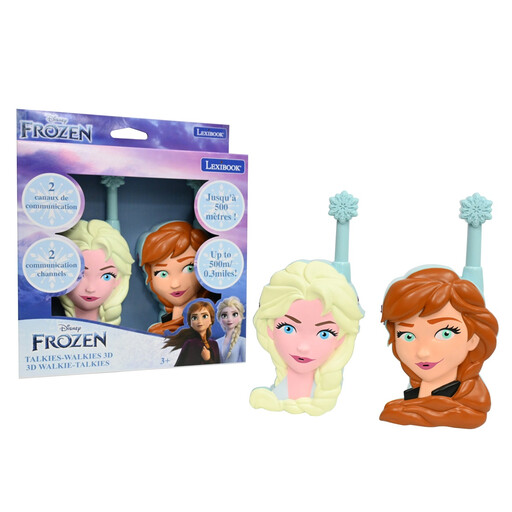
Why This Fits Their Persona: Suitable for Frozen fans who want character styling alongside practical features for playdates, garden games and pretend adventures.
The listing states the outdoor range may vary with terrain and weather, making it easier to plan use without assuming the full distance in every setting.
Up to 500 metres outdoors, two channels, rigid antennas and belt clips. Requires three AAA batteries per unit, not included.
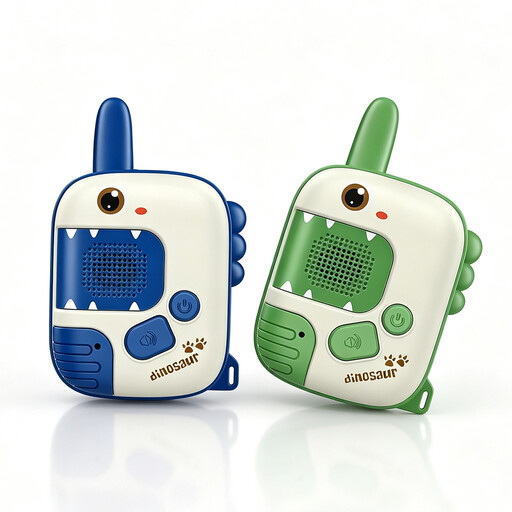
Why This Fits Their Persona: A dinosaur-themed option for active outdoor communication toys, including camping, garden missions and parent-child games.
The product description specifies push-to-talk operation, a back clip and lanyard, helping children carry the radios without relying on decorative features alone.
Dinosaur styling, portable carrying options and one-key communication. The listing states that six AAA batteries are required and not included; check the product information before purchase.
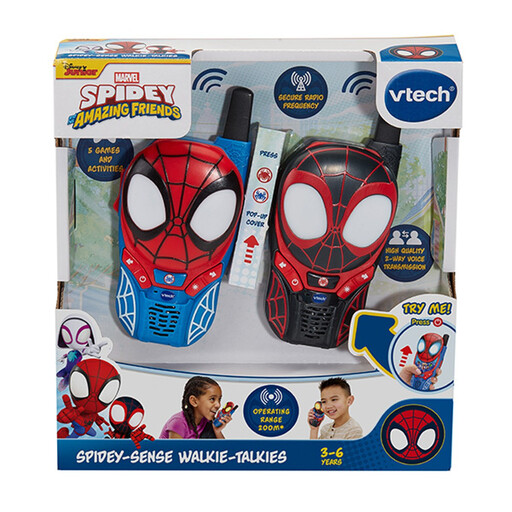
Why This Fits Their Persona: A suitable match for children who want more than basic two-way radio play, with sound effects, lighting choices and built-in themed games.
Its extra features are clearly identified rather than implied: the product includes five themed games, a pop-up cover and selectable light colours alongside communication.
Up to 200 metres, interactive voice and sound effects, five built-in games and age guidance from 3 years. Requires six AAA batteries, not included.
We have compiled a complete, real-time list of products that fully satisfy these strict selection criteria and UK safety regulations.
Insert the correct batteries, switch both units on and select the same channel where a channel selector is provided. Press and hold the push-to-talk button while speaking, then release it to listen. Test the pair at a short distance first, particularly indoors.
Battery life depends on how often children transmit, the battery type and additional features such as lights or sound effects. The plastic casing may last through ordinary play, but antennas, clips and battery covers can be affected by drops or rough handling. Store the radios dry and remove batteries if they will not be used for an extended period.
The main ongoing cost is replacement batteries. Basic models using fewer AAA batteries per unit may cost less to replenish than feature-rich designs requiring six batteries for a pair or more. Rechargeable batteries can reduce waste, but check that their voltage and size match the product instructions.