
24/7 Customer Support

Free returns

Same-day & Next-day Delivery

Quality Guaranteed

Unlock Your Welcome Offers: FREE Delivery | Up to 80% OFF | Free 30-day JoyPlus trial
Download the APP
A kids wooden sandpit can provide hours of digging, building and imaginative play, but the wrong design may quickly become difficult to use. Parents and carers often focus on colour or advertised sand capacity, while overlooking practical details such as cover quality, drainage, available floor space and seat strength.
Before buying a children’s sandpit, watch for these common pitfalls:
Start by measuring the intended area, including space for children to walk around the sandpit. A model measuring approximately 106cm square may suit a smaller garden, but the canopy and access area still need to be considered.
Check the internal sand area, rather than relying only on the overall dimensions. The depth also affects how children play: a deeper area is useful for digging, while a shallower pit may be easier for younger children to access and supervise.
Sand weight matters too. The listed maximum capacity can range from around 90kg to 250kg across different designs. This affects delivery, filling costs and whether the structure is appropriate for your chosen sand. Do not exceed the manufacturer’s stated limits.
A kids sandpit with canopy can provide shade during sunny spells, but the canopy should not be treated as a replacement for supervision or sun protection. Look for adjustable positioning, secure fittings and a design that can cover the sandpit when play has finished.
A garden sandpit with cover helps reduce exposure to rain, leaves and debris. Foldable backrests, detachable seats or a canopy that converts into a lid can be more practical than a separate cover that is easy to misplace.
Even with a cover, avoid leaving wet sand sealed for long periods. Open the pit when conditions allow so air can circulate, and follow the care instructions supplied with the product.
Fir wood is commonly used for an outdoor sandpit because it is relatively light and suitable for garden furniture when properly treated. Look for a smooth surface, secure fixings and rounded or carefully finished edges. Inspect the structure after assembly and periodically during use.
A non-woven liner can help keep sand contained while supporting ventilation and drainage in a bottomless design. It should be properly secured beneath the frame so children cannot pull it loose.
Product documentation may list standards such as EN71-1, EN71-2 and EN71-3, or EN71-8, alongside CE or UKCA markings. These references relate to specified toy safety requirements, but buyers should still read the supplied instructions, observe the recommended age range and check the product and packaging for current compliance information.
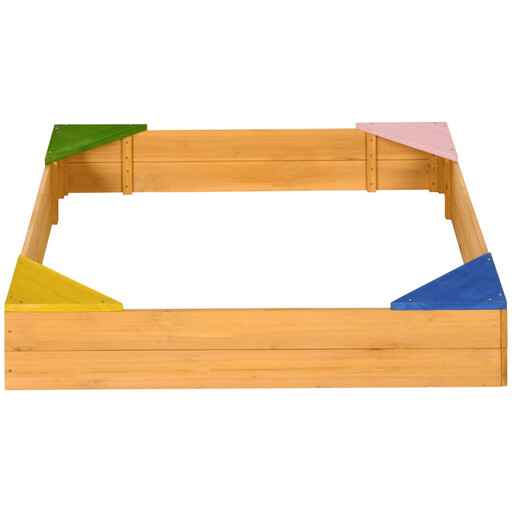
Why This Fits Their Persona: This straightforward four-seat design suits families wanting a simple children’s outdoor playset for garden use, with room for shared play without adding a canopy or house-style accessories.
The 109cm square footprint and stated 18cm sand area make the usable dimensions clear. Its bottomless design includes non-woven fabric to help contain sand and support drainage.
Four corner seats; stated capacity of up to 250kg of sand; suitable for ages 3-8 years.
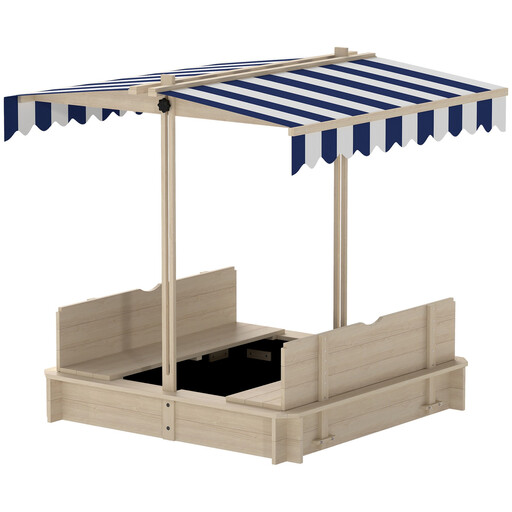
Why This Fits Their Persona: A practical choice for carers who value flexible shade, seating and a cover function in one garden sandpit.
The adjustable canopy can be positioned for shade, while the foldable backrests cover the sand after play. The attached liner is fixed with wooden plates.
Two benches; removable seats and backrest; stated dimensions of 106cm by 106cm by 115cm; suitable for ages 3-7 years.
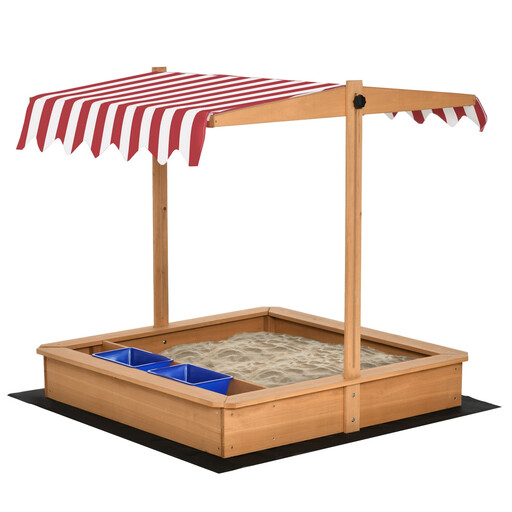
Why This Fits Their Persona: Its larger stated sand capacity and two-child layout may suit families expecting frequent playdates or regular use by siblings.
The canopy angle and height are adjustable, and it can serve as a cover when not in use. The bottomless construction with liner is designed for drainage and sand-depth adjustment.
Stated sand capacity up to 160kg; two plastic basins for storage; adjustable canopy from 18cm to 100cm; suitable for ages 3-7 years.
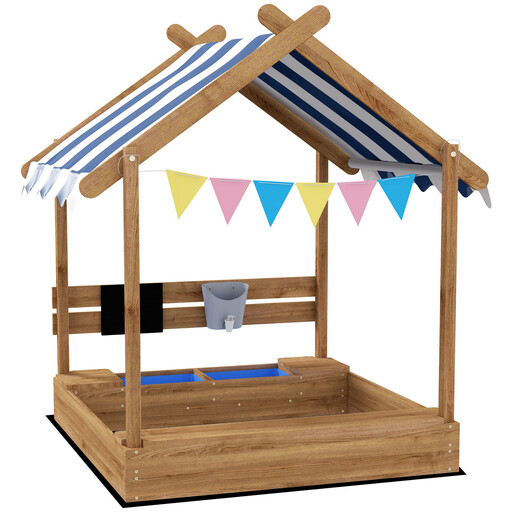
Why This Fits Their Persona: The mini-house format suits children who enjoy role play alongside digging and sandcastle building, provided the garden has room for its taller frame.
The listed sand area is separate from the overall 124cm by 116cm footprint, making planning easier. A bottomless liner design supports drainage, while the canopy provides a cover function.
Includes a sink, bucket, two basins and blackboard; stated sand capacity of 113kg; suitable for ages 3-7 years.
We have compiled a complete, real-time list of products that fully satisfy these strict selection criteria and UK safety regulations.
Choose a level location away from overhanging branches, standing water and hazards such as fencing projections. Leave enough room for adults to supervise comfortably. Assemble the frame on a firm surface and tighten every fitting according to the manual.
Use play sand intended for children, rather than building sand or sand collected from outdoors. Fill gradually and avoid exceeding the stated capacity. Check the liner, canopy and timber before each period of regular use. Remove visible debris, keep the cover secure when the pit is unused and allow damp sand to air before covering it again.
A sandpit is not a substitute for active supervision. Children should follow the manufacturer’s age guidance, and small accessories should be kept away from children who may put objects in their mouths.
Many models are designed for this range, but suitability depends on the individual product. Check the stated age guidance, dimensions and accessibility before buying. The four-seat model listed above specifies ages 3-8, while the canopy designs specify ages 3-7.
Not necessarily, but outdoor storage requirements vary. A cover can reduce exposure to debris and rain, yet it does not remove the need for ventilation, cleaning and timber inspections. If possible, store detachable fabric parts in a dry place during prolonged wet weather.
The amount depends on the internal dimensions and desired depth. Compare the manufacturer’s stated capacity before ordering sand, and add it in stages rather than filling to the maximum immediately. This makes it easier to assess usable play space and keep the sand at a manageable level.