Who is the yoghurt for?
A multipack for a baby’s feeds calls for different checks from one intended for an older child’s lunchbox or an adult’s lunch.
Parents feeding a baby or child under two
The NHS identifies pasteurised, full-fat plain or unsweetened yoghurt as a good choice from around six months, when a baby is ready for solids, and recommends full-fat yoghurt up to age two. Check the exact pack rather than relying on a baby-focused name.
Parents packing an older child’s lunchbox
Choose a pot or pouch the child can manage, then check its serving size, ingredients, allergens and storage directions. Child-focused packaging does not tell you how its sugars compare with another yoghurt.
Parents stocking the family fridge
Match the number and size of portions to who will eat them. Flavour variety may be useful for adult lunches, but check each recipe and whether the household can use the pots within their date guidance.
What should you check before choosing a multipack?
Start with the intended eater and the recipe, then check whether the portion format and storage instructions fit your routine.
| Priority |
What to check |
Your needs |
| Age and recipe |
For a baby ready for solids from around six months, check that the yoghurt is pasteurised, full-fat and plain or unsweetened. The NHS recommends full-fat yoghurt up to age two; a baby-themed name alone does not confirm these details. |
I’m choosing for a baby or child under two, so the yoghurt needs to fit their feeding stage rather than an adult lunch routine. |
| Ingredients and nutrition |
Compare sugars on a per-100g basis, then read the ingredients for added sugar or sweeteners and check the allergens. The NHS explains that nutrition labels give values per 100g and sometimes per portion. |
For an older child or adult, I want to compare different flavours and pot sizes without mistaking a child-focused or organic label for a nutrition comparison. |
| Portion format |
Check the number of pots or pouches and grams in each. Consider whether a separate compote or topping, or a pouch opening, suits the eater and how the yoghurt will be served. |
Individual portions would help with lunches, but a younger child may need a simpler format and supervised feeding. |
| Storage and dates |
Read the exact pack’s storage instructions and date mark before choosing a larger pack. Tesco’s listing for Müller Corner, for example, says to keep that multipack refrigerated. |
If yoghurt is going in a lunchbox, I need a way to follow its storage directions during the journey and use the remaining portions in time. |
Brand and product-line references
These named lines illustrate different yoghurt formats; check the particular pack because a brand name does not establish the recipe of every multipack it sells.
Yeo Valley Organic
Yeo Valley Organic describes its Little Yeos Greek Style Natural six-pack as made with organic whole milk and no added sugar.
- A plain-style, whole-milk line to examine when choosing yoghurt for a young child under NHS guidance.
- Check the exact pack for pasteurisation, allergens and age suitability; the description of this line does not describe every Yeo Valley flavour.
Müller
Tesco lists Müller Corner Strawberry, Peach & Apricot as six 136g split pots with fruit compote.
- Separate pots offer a portioned format for adult lunches or older household members who can manage the compote.
- The listed recipes contain sugar and give 12.0g or 13.4g sugars per 100g, depending on flavour; they are not the same recipe as plain, unsweetened yoghurt.
Onken
Tesco lists Onken Kids Raspberry & Banana Yoghurt as a four-pack of 90g pouches.
- The pouch format is an option to consider for an older child who can use it.
- Check the particular pack’s ingredients, nutrition, allergens and storage directions before putting it in a lunchbox.
Rachel’s Organic
Rachel’s Organic lists Luscious Fruits Bio-Live Yogurt in four 110g pots.
- The fruit-flavoured four-pot format may fit adult lunches or an older child’s snacks.
- Rachel’s Organic lists organic sugar in the reviewed recipe and 12.5g sugars per 100g; organic does not mean unsweetened.
Activia
Tesco lists Activia Peach No Added Sugar Fat Free as four 115g pots containing live cultures and sweeteners.
- A portioned, fat-free recipe to compare for adults or older children when those attributes matter.
- Its 0% fat recipe is not the full-fat yoghurt route the NHS recommends for children under two. Do not use the product’s gut-health wording as a feeding or medical conclusion.
Tesco
Tesco’s yoghurt categories include children’s pouches and pots alongside other multipack formats.
- Its product listings can help distinguish pack counts, portion sizes and recipes when comparing named products.
- Check the exact product label and storage directions rather than assuming that products within one category have the same ingredients or suitability.
Joybuy product options
The Heinz banana-and-yoghurt bundle represents the individually portioned baby-feeding side of this household decision. Compare its pack details with NHS guidance before choosing it as a baby’s yoghurt.
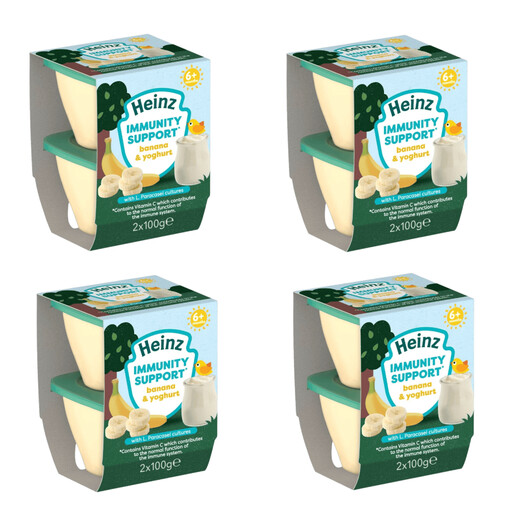 Image unavailable
Heinz Banana & Yoghurt Pot 6+ Months, 8 × 100g
The bundle contains four packs of two 100g pots, offering individual portions for a baby-feeding routine. For a baby ready for solids, check the pack’s pasteurisation, fat level, ingredients and storage directions: the age wording and portion size do not establish that it matches the NHS advice on full-fat plain or unsweetened yoghurt.
View on Joybuy
Yoghurt multipack questions
Can a baby starting solids have yoghurt?
Yes. The NHS says pasteurised full-fat yoghurt is suitable from around six months when a baby is ready for solids, and identifies plain or unsweetened yoghurt as a good choice because it has no added sugars. Breast milk or first infant formula remains the main source of nutrition at this stage.
Should I choose a fat-free multipack for a child under two?
Not as the default yoghurt choice. The NHS recommends full-fat yoghurt and other full-fat dairy products up to age two; check the fat level of the particular multipack rather than judging it by its flavour or packaging.
How can I compare sugar when the pots are different sizes?
Compare the sugars figures per 100g first, then check the grams in each pot and read the ingredients. As the NHS explains, nutrition labels provide values per 100g and sometimes per portion, so the two figures answer different questions.
Are yoghurts marketed to children automatically low in sugar?
No. In its 2021 analysis of 100 children’s yoghurts, Action on Sugar reported that 5% of those with child-targeted designs were rated low in sugar. That result concerns the products surveyed, so check the label of the multipack you are considering.
Can I put yoghurt pots in a lunchbox?
Follow the exact pot’s storage instructions throughout the journey. Tesco’s listing for Müller Corner, for example, says to keep that multipack refrigerated; use suitable chilled storage for a product with that instruction rather than assuming every yoghurt pot can travel at room temperature.


