Who is this choice for?
The useful starting point depends on whether flavour, a ready-portioned serving or avoiding milk is the deciding consideration.
Families trying a less-sweet flavour
Plain unsweetened yoghurt lets you add fruit yourself. The NHS suggests sliced banana with plain yoghurt for young children; Rachel’s Organic describes its natural yoghurt as mild tasting, although that is the brand’s description rather than a comparison with other yoghurts.
Families who prefer individual portions
Small pots avoid serving from a shared tub. Yeo Valley Little Yeos No Added Sugar comes in 42g pots, while Onken Kids Raspberry & Banana comes in 90g pots. Their ingredients and sugars differ, so portion size alone does not settle the choice.
Families managing a milk allergy
Dairy yoghurt is not suitable for a child with a milk allergy. Lactose-free dairy yoghurt can still contain milk; check the current ingredients and look for a product explicitly labelled free-from milk. The Food Standards Agency says that “free-from milk” guarantees the specified allergen is absent.
What should you check?
Choose a flavour and serving format your child will accept, then check the recipe, nutrition label and milk information on the pack.
| Priority |
What to check |
Your needs |
| Mild flavour |
Look for a plain unsweetened base if you want to add fruit yourself. Rachel’s Organic calls its natural low-fat yoghurt mild tasting; that does not establish how it tastes beside other brands. |
I’d like to try a less-sweet base, but still have the option of adding sliced banana or another suitable fruit. |
| Sugars and ingredients |
Compare sugars per 100g and per serving, then read the ingredients for added sugar or sweeteners. “No added sugar” does not mean sugar-free: Tesco Groceries lists naturally occurring sugars in Yeo Valley Little Yeos No Added Sugar and added sugar in Onken Kids Raspberry & Banana. |
A child-friendly label is useful, but I want to know what is in the portion my child will eat. |
| Texture and portion |
Check whether the yoghurt has fruit pieces and whether the pack is a small pot, a pouch or a tub you portion yourself. The listed Little Yeos pots are 42g each; Onken Kids pots are 90g each. |
Fruit pieces can be a sticking point for my child, or a whole larger pot may be more than I intend to serve. |
| Milk allergy |
Read the ingredients and emphasised allergen wording on the current pack. Do not use “lactose-free” as a substitute for “free-from milk” when avoiding milk. |
If my child has a milk allergy, I need a product explicitly labelled free-from milk, not a different type of dairy yoghurt. |
| Age and occasion |
Check the product’s age statement, but distinguish food served as part of a meal from a separate snack. The NHS says children under one should not be given snacks. |
For a child under one, I cannot treat a “6+ months” label as a recommendation to offer yoghurt as a teatime snack. |
Relevant brand examples
These named products illustrate different recipes and formats; a brand name on its own does not establish mildness or suitability for a particular child.
Rachel’s Organic
Rachel’s Organic describes its 450g Natural Low Fat Bio-Live Yogurt as mild tasting. Its stated ingredient is organic low-fat natural yoghurt from milk.
- A plain tub allows fruit to be added when serving.
- It needs portioning and contains milk; the brand’s taste description is not a comparative taste test.
Yeo Valley
Little Yeos No Added Sugar is a fruit-yoghurt option sold in 6 x 42g pots and labelled from 6 months.
- The individual pots provide a stated portion size without added sugar.
- It still contains naturally occurring sugars and milk. The age label does not override NHS guidance against snacks for children under one.
Onken
Onken Kids Raspberry & Banana is listed in four 90g pots; its ingredients include yoghurt, fruit and added sugar.
- A separate 90g pot makes the serving size clear.
- Tesco Groceries lists 6.8g sugars per pot. It should not be treated as interchangeable with plain unsweetened yoghurt.
Müller
Müller Light Strawberry is a 160g fruit yoghurt described by its manufacturer as no added sugar; it is not presented as a children’s product.
- It offers a no-added-sugar strawberry recipe for households considering a sweetened flavour.
- Its ingredients include aspartame, and its label states that it contains a source of phenylalanine.
Activia
Activia Fruits Strawberry is a fruit yoghurt whose listed ingredients include sugar and live cultures.
- The product information gives a serving-level sugars figure for comparison.
- Activia lists 14g sugars per 115g serving; live cultures do not answer the separate question of whether its flavour is mild.
Tesco
Tesco’s children’s yoghurt category lists both fruit-flavoured children’s pots and Tesco Greek Style Plain Yogurt 4 x 90g.
- The listed formats provide examples of portioned fruit and plain options to compare.
- A category listing does not establish the ingredients, current stock or suitability of every pot; check the individual product and pack.
Joybuy fruit-yoghurt options
These are fruit-flavoured yoghurt pouches and pots for children. If your main aim is a plain, unsweetened base, compare them with that option rather than assuming a fruit flavour will taste mild.
 Image unavailable
Ella’s Kitchen Organic Mango Greek Style Yoghurt Pouch, 6+ Months, 90g
The 90g mango yoghurt pouch is a fruit-flavoured option to consider if a pouch suits tea time. Check its current ingredients and sugars per serving if comparing it with plain yoghurt, and avoid it for a child with a milk allergy. The “6+ months” label does not change NHS guidance that children under one should not be given snacks.
View on Joybuy
 Image unavailable
Ella’s Kitchen Greek Yoghurt with Strawberry, 6+ Months, 90g
This 90g strawberry yoghurt is another fruit-flavoured pouch choice. Compare the current pack’s ingredients and sugars per serving with the mango pouch or a plain yoghurt; do not assume either fruit flavour is milder. It contains milk, and its “6+ months” label does not make it a snack for a child under one under NHS guidance.
View on Joybuy
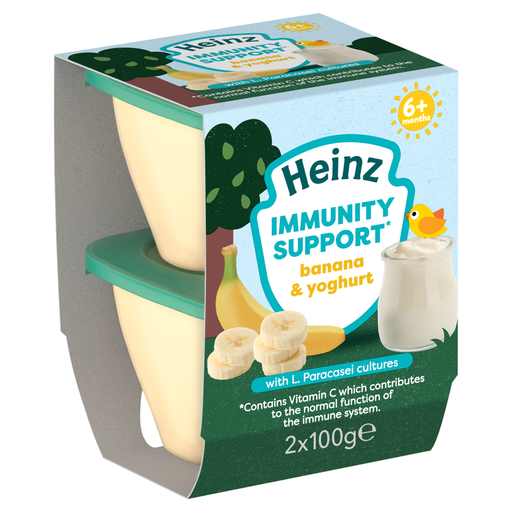 Image unavailable
Heinz Banana & Yoghurt Pots, 6+ Months, 2 x 100g
The two 100g banana-and-yoghurt pots offer an individual-pot format rather than a pouch. Check the current ingredients and sugars information if comparing fruit recipes; do not assume a banana flavour establishes mildness or a no-added-sugar recipe. The pots contain milk, and the “6+ months” label does not override NHS guidance against snacks for under-ones.
View on Joybuy
Questions about children’s yoghurt
Where should I start if my child prefers a milder yoghurt?
Try plain unsweetened yoghurt if your child accepts it, adding sliced banana if you want a familiar fruit flavour. The NHS gives that combination as a snack example for young children. Rachel’s Organic describes its natural yoghurt as mild tasting, but that brand description does not establish which yoghurt your child will prefer.
Does “no added sugar” mean sugar-free?
No. Milk and fruit can contribute naturally occurring sugars even when none is added to the recipe. Tesco Groceries lists 6.2g sugars per 100g for Yeo Valley Little Yeos No Added Sugar; check the serving size as well when comparing it with another pot.
Can a child with a milk allergy have lactose-free dairy yoghurt?
Do not assume so: lactose-free dairy yoghurt can still contain milk. For a child avoiding milk, look for an explicit free-from-milk label and check the current ingredients and allergen information. The Food Standards Agency says a free-from-milk label guarantees that the specified allergen is absent.
Does a “6+ months” label make yoghurt suitable as a snack before age one?
No. The NHS says children under one should not be given snacks. A product’s age statement does not remove the distinction between offering food as part of a meal and offering a separate snack; seek advice specific to the child if you have feeding concerns.
Where can I check whether a yoghurt contains milk?
Check the ingredients on the current pack. The Food Standards Agency says allergens present in prepacked food must be emphasised in its ingredients list; do not rely on a previous pack or assume that a lactose-free dairy product is milk-free.


