
24/7 Customer Support

Free returns

Same-day & Next-day Delivery

Quality Guaranteed

Unlock Your Welcome Offers: FREE Delivery | Up to 80% OFF | Free 30-day JoyPlus trial
Download the APP
A kids scooter can become a favourite outdoor ride-on toy, but choosing the wrong model may mean awkward steering, poor fit or a scooter that stays in the shed after a few weeks. Parents and gift-buyers often focus on colours, light-up wheels or advertised speed while overlooking the specifications that affect everyday use.
Before comparing a children’s scooter, watch for these common buying traps:
Age guidance is a useful starting point, but rider height and maximum load should also be checked. A scooter for toddlers usually has a lower, wider platform and three wheels to support early balance and lean-to-steer movement. A two-wheel scooter is more suitable once a child can confidently balance and steer independently.
For younger riders, a 3-wheel scooter for toddlers with an adjustable handlebar can provide a gradual introduction. Models listed for ages 3–10 may still differ considerably in handlebar range and weight limit, so compare the product specifications rather than relying on the age label alone.
For older children, a fixed-handlebar stunt scooter for kids may be appropriate for controlled trick practice. These scooters are not designed to offer the same adjustability as a general family scooter, so check that the fixed height suits the rider.
A wide, anti-slip deck gives a child more room to position both feet. This is particularly helpful for beginners and younger riders. Wheel type also affects the experience:
A scooter with brakes should have a stopping system that the child can operate naturally. Rear foot brakes are common on smaller models, while some larger scooters include front and rear brakes controlled from the handlebar. Whichever design you choose, check that the child can reach and use it correctly before riding independently.
A folding kids scooter is useful for car journeys, compact hallways and shared storage areas. However, the folding mechanism should lock securely in both riding and storage positions. Check the folded dimensions, not just the product weight, because a scooter may be light but still awkward to place in a boot.
For electric models, also consider charging space. Use only the supplied or manufacturer-approved charger, charge on a hard, flat surface and never leave the scooter charging overnight or unattended.
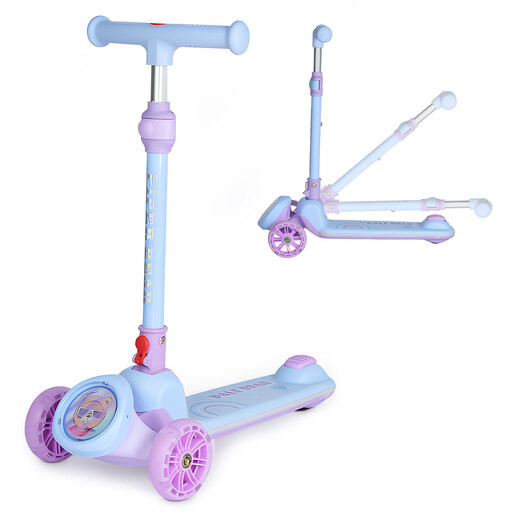
Why This Fits Their Persona: A three-wheel design suits younger beginners aged 3–10 who are learning lean-to-steer movement at home, in private outdoor areas or during family outings.
The three-wheel platform addresses the balance challenge that can make a two-wheel scooter frustrating for a new rider.
Adjustable height, lean-to-steer control, anti-slip deck and light-up wheels.
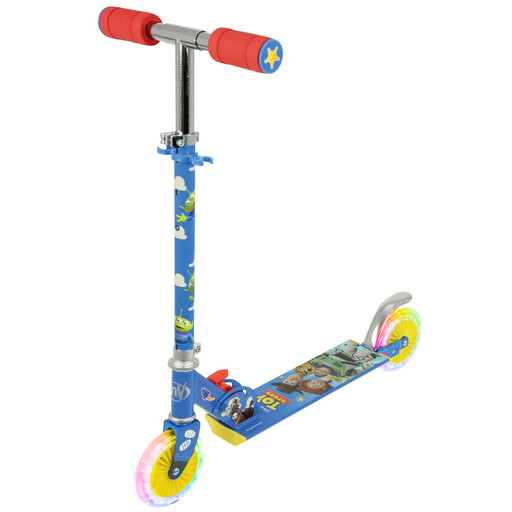
Why This Fits Their Persona: This option suits a child aged 5+ who values a themed design but still needs practical storage and an adjustable riding position.
The folding frame and three-stage 74–80 cm handlebar range add everyday practicality beyond the character graphics.
Steel frame, puncture-proof tyres, anti-slip deck, rear foot brake and motion-activated wheels.
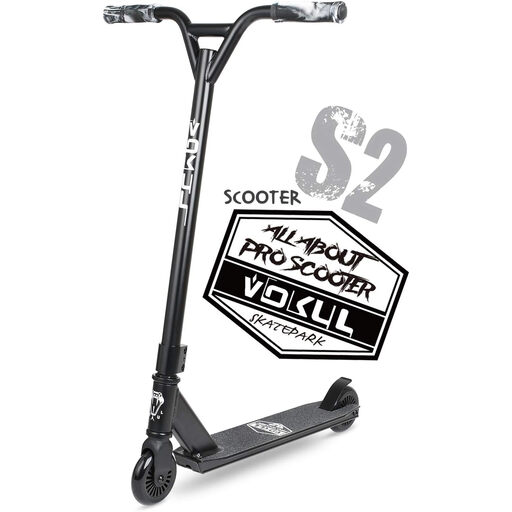
Why This Fits Their Persona: Designed for riders aged 7–14 who want to progress from basic riding towards supervised freestyle practice at a skatepark or suitable private area.
Its fixed freestyle format avoids paying for unnecessary folding features that may not suit trick-focused use.
6061 aluminium frame, reinforced deck, 4130 chromoly steel handlebar, triple clamp and rear brake.
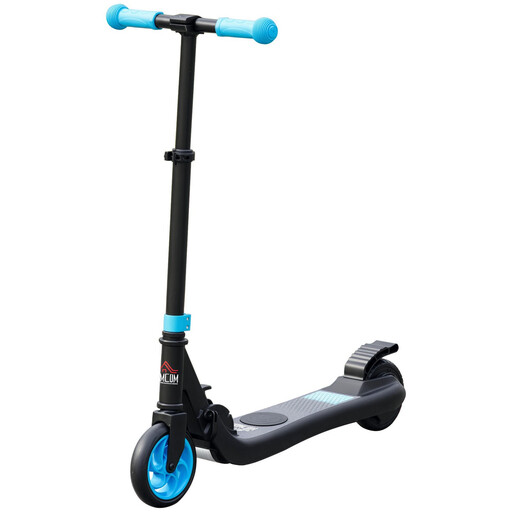
Why This Fits Their Persona: This model is aimed at children aged 6+ who can push off confidently and will use an electric scooter only on private land with permission.
The non-zero start reduces sudden activation, while the legal-use warning makes the required private-land setting clear.
120W motor, maximum speed of 8 km/h, stated range up to 6 km, rear foot brake and 4.8 kg foldable design.
Before the first ride:
We have compiled a complete, real-time list of products that fully satisfy these strict selection criteria and UK safety regulations.
Many three-wheel models are listed from age 3, while two-wheel and electric models commonly start at age 5 or 6. Always check the recommended height, maximum load and supervision guidance alongside the age range.
Lifespan depends on rider weight, surface conditions, storage and maintenance. Regularly inspect wheels, brakes, deck, clamps and folding parts. Replace damaged components and stop using the scooter if the frame or steering mechanism is compromised.