
24/7 Customer Support

Free returns

Same-day & Next-day Delivery

Quality Guaranteed

Unlock Your Welcome Offers: FREE Delivery | Up to 80% OFF | Free 30-day JoyPlus trial
Download the APP
Choosing kitchen bins is less straightforward than it appears. A bin may look suitable online, yet prove awkward when the lid hits a cupboard, the inner bucket is difficult to lift or the stated capacity does not match your household’s waste routine.
UK kitchens also vary widely, from compact rented flats to busy family homes with separate recycling collections. The right choice depends on available floor space, how often you empty the bin and whether food waste needs its own container.
A 50L kitchen bin may reduce how often you change the liner, but its external dimensions and lid clearance still matter. Check the full height, width and depth, then measure the space beside your cabinets. Remember that a pedal bin needs room in front for foot operation, while a lid that opens upwards needs clear space above.
Stainless steel kitchen bins are generally easy to wipe clean, but fingerprints, spills and moisture can still affect the finish. Look for a removable inner bucket and a liner-retaining feature. These make it easier to clean the interior and keep the bag edge from slipping into the bin.
Soft-close technology primarily reduces noise and prevents the lid from dropping suddenly. It does not automatically make a bin odour-sealing. For food scraps, emptying frequency, liner quality and a well-fitting lid remain important. A separate kitchen food waste caddy can help prevent peelings and coffee grounds from sitting in the main rubbish bin.
Capacity should reflect the type of waste you produce rather than simply the number printed on the listing.
Check whether the listed volume is total capacity or the capacity of each compartment. This distinction is particularly important when comparing recycling bins.
Measure the available area before ordering. Include skirting boards, cabinet doors and nearby appliances in your calculation. Check the lid-open height as well as the closed height.
Some products require a small gap from the wall. For example, the 50L JOYFURNOS models specify keeping the rear of the bin approximately 5cm away from the wall. This allows the lid and pedal mechanism to operate without obstruction.
For a narrow kitchen, consider an under-cabinet bin or a slim rectangular design. However, confirm that the cupboard door can close properly and that the mounting position can support the bin securely.
Useful features should solve a specific household problem:
These details are more practical than decorative finishes alone. Also check care instructions: most steel bins should be wiped with a soft, damp cloth and mild detergent rather than abrasive products.
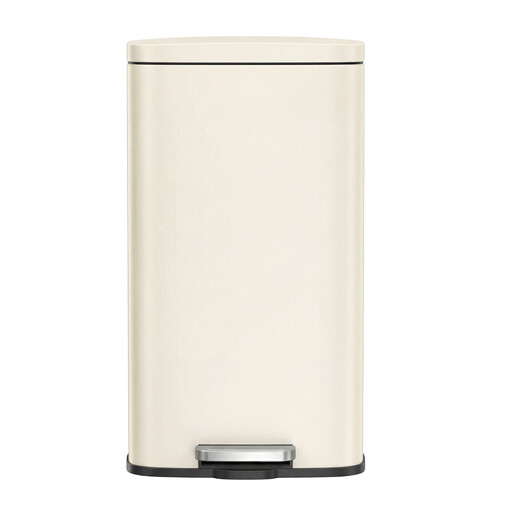
Why This Fits Their Persona: The 30L capacity offers a manageable size for flats, first homes and households that prefer to empty rubbish regularly.
The listing provides external dimensions and includes a plastic inner bucket, reducing uncertainty about space and bag changes.
30L capacity, pedal and manual opening options, soft-close lid and rear handle.
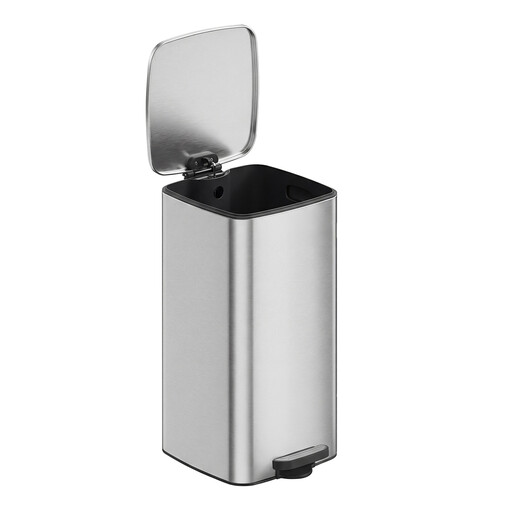
Why This Fits Their Persona: Its silver steel finish suits kitchens where appearance, stability and straightforward cleaning are important.
The dimensions are stated as 34 x 28.5 x 54.4cm, and the inner bucket has handles for more controlled lifting.
Stainless steel body, non-slip pads, removable bucket and soft-close lid.
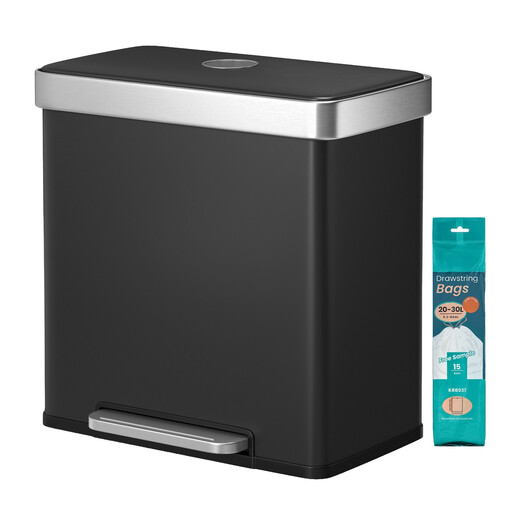
Why This Fits Their Persona: Two 30L compartments suit larger households that separate general waste and recycling at the point of disposal.
The capacity is clearly split into two compartments, rather than presenting a combined volume as two separate bins.
Step operation, two removable inner buckets, soft-close lid and 15 rubbish bags included.
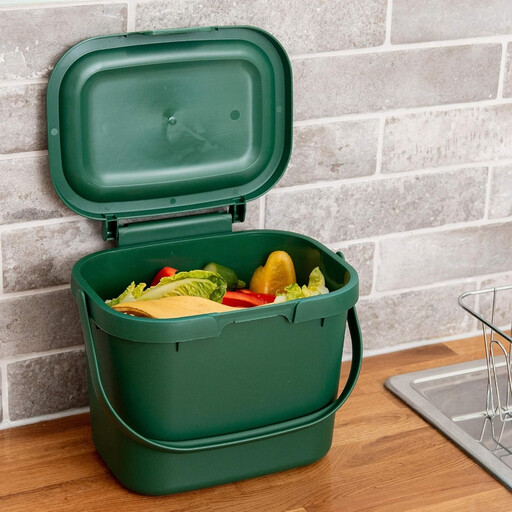
Why This Fits Their Persona: The compact footprint works on a worktop, under a sink or in a utility room for households using food-waste collections or home composting.
Its 4.5L capacity is clearly positioned for daily food scraps, avoiding the expectation that a small caddy replaces a main rubbish bin.
Durable plastic construction, carry handle, wipe-clean surface and 18 x 25 x 19cm dimensions.
We have compiled a complete, real-time list of products that fully satisfy these strict selection criteria and UK safety regulations.
A 50L kitchen bin can provide useful capacity for many family kitchens, particularly where general waste is collected less frequently. A dual-compartment model may be more suitable if recycling is separated indoors. Measure the available space before choosing a larger bin.
Pedal bins enable hands-free opening, which can reduce the need to touch the lid while preparing food. Hygiene still depends on regular emptying, cleaning and correct liner use. A pedal mechanism also needs enough clearance in front for comfortable operation.