
24/7 Customer Support

Free returns

Same-day & Next-day Delivery

Quality Guaranteed

Unlock Your Welcome Offers: FREE Delivery | Up to 80% OFF | Free 30-day JoyPlus trial
Download the APP
A kitchen bin might seem like a simple purchase, but choosing the wrong one can lead to daily frustrations. From lids that slam shut to materials that show every smudge, a poorly designed bin can make a modern kitchen feel unhygienic and disorganised. Many of us have been caught out by marketing promises, only to find our new bin is more trouble than it's worth.
As a Joybuy Product Recommendation Officer, my role is to help you navigate these choices. This guide cuts through the clutter, focusing on the practical features that matter. We will look at the common pitfalls to avoid and the key specifications to check, ensuring your next kitchen bin is a lasting, functional addition to your home.
Before you buy, be aware of these frequent design flaws that can turn a promising purchase into a household headache:
To avoid these issues, focus on a few non-negotiable parameters. Getting these right is the key to finding a bin that is both practical and durable.
The first step is to match the bin's size to your household's needs and your kitchen's layout. Capacity is measured in litres (L).
Always measure the intended space for your bin, leaving a few centimetres of clearance at the back and top for the lid mechanism to operate without hitting the wall or countertop.
The way a bin opens and the material it's made from will define your daily experience with it.
With local councils having different recycling rules, a bin that simplifies sorting is a major advantage. A dual compartment bin allows you to separate general waste from recyclables in one neat unit. For households with more complex sorting needs (e.g., food waste, glass and paper), triple-compartment models are also available, providing a streamlined solution for staying organised and eco-conscious.
Here are a few options that align with different household needs, specifically chosen for their practical design and ability to solve common bin-related problems.
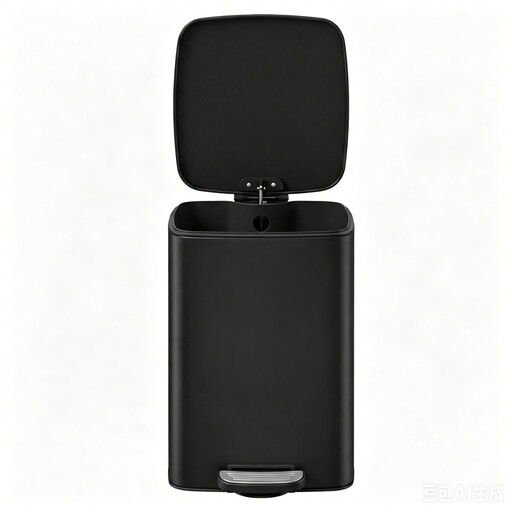
Why This Fits Their Persona: Perfect for smaller kitchens, flats or 1-2 person households where space is at a premium. The 20L capacity is ample for daily waste without taking up excessive floor space, and its slim, rectangular shape allows it to fit neatly against a wall or at the end of a cabinet run.
The steel body and robust pedal are built for longevity, avoiding the flimsy mechanism trap. Its soft-close lid provides a tight seal to contain odours effectively.
Features a stay-open lid function, ideal for longer food prep tasks. The removable inner bucket includes a bag holder to keep liners tidy and prevent slipping.
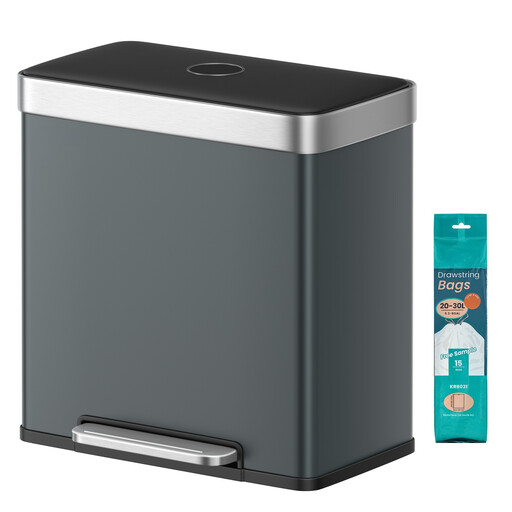
Why This Fits Their Persona: Designed for busy families who want to make recycling simple. The two 30L compartments provide a generous 60L total capacity, perfect for handling both general waste and recyclables without needing multiple bins cluttering the kitchen.
The stainless steel body is easy to clean, and the separate inner buckets help contain odours from different waste types. Its sturdy, wide base and robust pedals are built to withstand frequent family use.
Makes waste sorting effortless with colour-coded pedals. The soft-close lids ensure quiet operation, which is a welcome feature in a busy home.
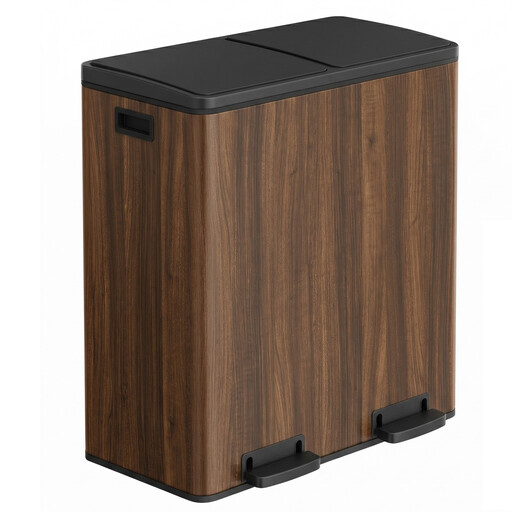
Why This Fits Their Persona: For those who believe functional items should also be beautiful. This bin moves beyond the standard metallic look with a sophisticated dark walnut-effect finish, allowing it to blend seamlessly with modern kitchen cabinetry and warm interior design schemes.
This bin offers style without sacrificing substance. The underlying body is durable steel, and the soft-close lids prevent the noisy slamming that can disrupt a carefully designed, calm living space.
The unique finish provides a high-end aesthetic. It combines this with the full practicality of a dual-compartment recycling system and hands-free pedal operation.
We have compiled a complete, real-time list of products that fully satisfy these strict selection criteria and UK safety regulations.
1. What is the ideal kitchen bin size for a family of four? For a family of four, a bin with a capacity between 40 and 60 litres is generally recommended. A 50L single-compartment bin works well for general waste. However, a 60L dual-compartment model (2 x 30L) is often a more practical choice, as it allows you to manage both general waste and recycling within a single, organised unit.
2. How do I stop my bin liner from slipping inside the bin? This is a common annoyance, but many modern bins have a solution. Look for models with a removable inner bucket that includes a bag-securing hole or a wire handle. You can tuck the top of the liner through this hole or under the handle to hold it firmly in place, preventing it from collapsing into the bin.
3. How can I clean a stainless steel bin without leaving streaks? For routine cleaning, a soft microfibre cloth dampened with warm water is usually all that is needed. Wipe in the direction of the steel's grain. For more stubborn marks, use a small amount of pH-neutral washing-up liquid on the cloth. Dry it immediately with a separate, clean microfibre cloth to prevent water spots and streaks. Avoid using abrasive scourers or harsh chemical cleaners, as they can scratch the surface.