
24/7 Customer Support

Free returns

Same-day & Next-day Delivery

Quality Guaranteed

Unlock Your Welcome Offers: FREE Delivery | Up to 80% OFF | Free 30-day JoyPlus trial
Download the APP
A kitchen bin needs to do more than hold rubbish. It must fit the available floor space, cope with your household’s daily waste and remain easy to empty and clean. Yet product listings can make simple decisions unnecessarily difficult.
The most common buying mistakes are not always obvious. A bin may advertise a large capacity but have a footprint that blocks a cupboard. A soft-close lid may sound appealing, but a weak pedal or awkward inner bucket can make everyday use frustrating. Dual compartments can also appear convenient until you discover that each section is too small for your recycling habits.
This guide explains the practical specifications to check before choosing a kitchen bin, followed by our top recommendations for different UK household needs.
A 60L or 68L kitchen waste bin sounds suitable for a family, but capacity is only part of the picture. A tall bin may be difficult to fit beneath wall cupboards, while a dual-compartment bin divides its total space into two smaller sections.
Check whether the listed capacity is:
For example, a 2 x 30L recycling bin offers 60L in total, but neither section holds 60L independently.
A soft-close bin can reduce lid noise, particularly in open-plan kitchens, but the mechanism should not be forced shut by hand. Likewise, a removable inner bucket is useful only if it can be lifted out without catching on the lid or liner.
Look for bag-fixing holes, retaining rings or handles inside the bucket. These features help prevent the liner from slipping and make emptying less messy.
An odour-control bin with a carbon filter may help neutralise unpleasant smells, but it does not replace regular liner changes or cleaning. Food residue can collect around the lid, rim and inner bucket. A wipe-clean exterior and washable internal parts are therefore more useful than a feature label alone.
A 20L kitchen bin may suit a single occupant, a small kitchen or an office. A 30L rubbish bin offers more room for daily waste without taking up the floor space of a larger model.
For many households, a 50L kitchen bin provides a practical balance between capacity and footprint. Larger families may prefer a 60L kitchen bin or 68L kitchen bin, especially if they want to reduce how often the bin needs emptying. However, measure the area carefully first.
Compare the product’s width, depth and height with the intended space. Remember to allow clearance for:
Several models listed here require approximately 5cm of space behind the bin. A tall pedal bin placed too close to a wall may prevent the lid from opening correctly.
A stainless steel kitchen bin is generally straightforward to wipe clean and can complement modern interiors. Check whether the finish is described as smudge-resistant, fingerprint-resistant or simply coated steel, as these surfaces may have different cleaning requirements.
A pedal mechanism allows hands-free opening, which is convenient when preparing food. Non-slip feet or pads can also help keep the bin stable on hard kitchen flooring. For recycling, dual pedals and separate inner buckets make sorting more direct, but the wider body may require more floor space.
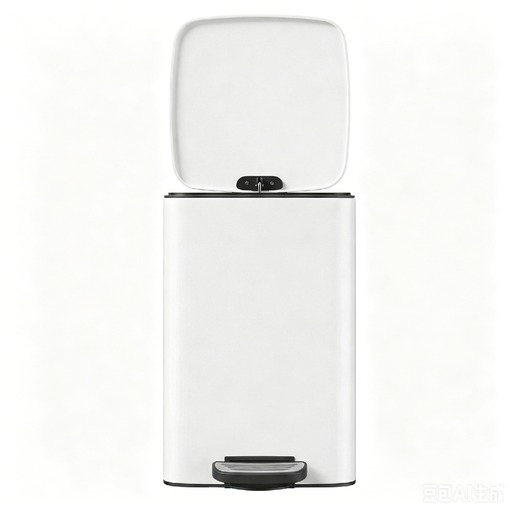
Why This Fits Their Persona: Its 20L capacity and 34.1 x 28.6 x 40.5cm dimensions suit smaller kitchens, flats, bedrooms or home offices where floor space matters.
The compact size avoids paying for unused capacity, while the removable inner bucket helps with liner changes and cleaning.
Stainless steel body, soft-close lid, stay-open function, non-slip base and inner bucket with handles.
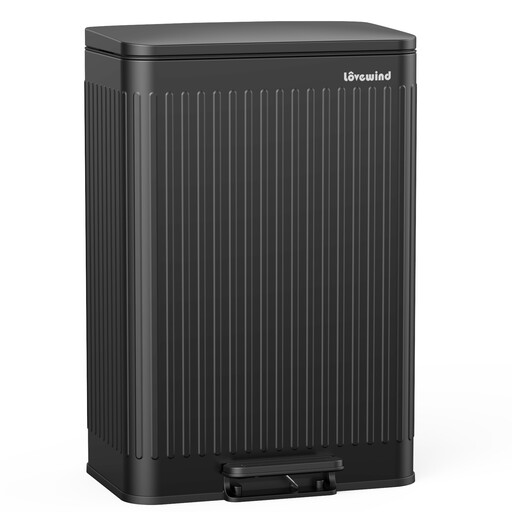
Why This Fits Their Persona: The fingerprint-resistant coated steel body and Roman-texture finish provide a considered appearance for kitchens where the bin remains visible.
Its two removable inner buckets include handles and bag fixers, addressing awkward liner changes and difficult emptying.
60L capacity, soft-close lid, 90-degree stay-open function and removable buckets.
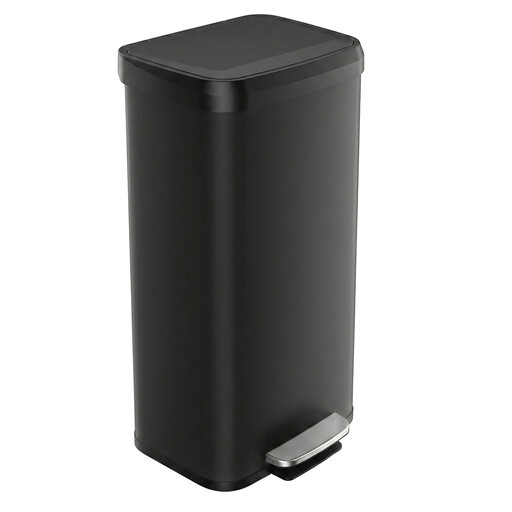
Why This Fits Their Persona: Its tall 68L design is suited to larger households that produce substantial daily waste and prefer fewer trips to the outdoor rubbish bin.
The listing states the bin includes a carbon filter and stay-open lid, while the wide steel pedal supports hands-free access during cooking.
68L capacity, rust-resistant steel construction, soft-close lid, carbon filter and 15 included bin bags.
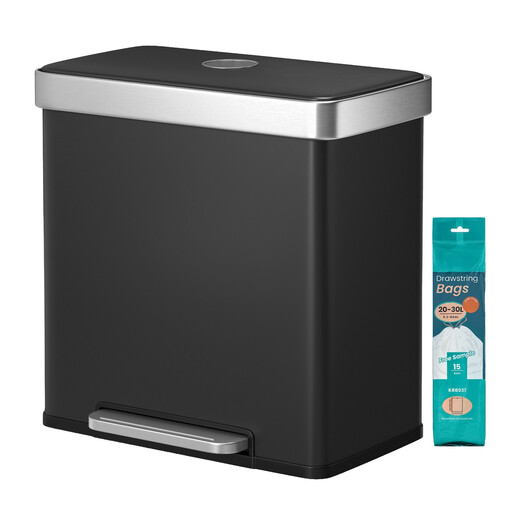
Why This Fits Their Persona: Two 30L compartments give households a straightforward way to separate general waste and recycling in one kitchen waste bin.
The split capacity is clearly stated as 2 x 30L, avoiding ambiguity about how much each side can hold.
Dual pedals, removable inner buckets, soft-close lid, stainless steel body and 15 included rubbish bags.
We have compiled a complete, real-time list of products that fully satisfy these strict selection criteria and UK safety regulations.
A 50L kitchen bin may suit many families, while larger households may prefer a 60L or 68L model. The right choice depends on how frequently you empty the bin, whether food waste is separated and how much floor space is available.
A pedal bin can be opened without touching the lid, which may be useful when your hands are wet or handling food. Hygiene still depends on regular cleaning, correct liner use and avoiding overfilling.
A dual-compartment bin is useful when you want general waste and recycling in one unit. Check the capacity of each compartment and measure the overall width, as split bins are often broader than single-body designs.