
24/7 Customer Support

Free returns

Same-day & Next-day Delivery

Quality Guaranteed

Unlock Your Welcome Offers: FREE Delivery | Up to 80% OFF | Free 30-day JoyPlus trial
Download the APP
A kitchen bin has a demanding job. It must cope with food packaging, cooking waste, overflowing dustpans and frequent opening throughout the day, while still fitting neatly into your room. Choosing by appearance alone can lead to a bin that is awkward to empty, difficult to clean or too small for your household.
The main buying traps are easy to overlook:
The right kitchen bin should match your household size, available floor space, cooking habits and preferred opening mechanism.
For many UK kitchens, a 30-litre kitchen bin is a practical starting point for one or two people, particularly where waste is emptied regularly. Families or households that cook frequently may prefer a large-capacity kitchen bin between 42 and 65 litres.
Capacity should be considered alongside the bin’s footprint and height. A tall, narrow model can suit a compact kitchen, while a wider 60-litre kitchen bin may need more clearance around cupboards and walkways. Always check the product dimensions rather than relying only on the litre rating.
Also consider how often you want to take rubbish outside. A larger bin can reduce emptying trips, but partially filled food waste may need removing sooner for freshness and hygiene.
A soft-touch bin opens when you press the lid mechanism lightly. This can be useful when your hands are occupied, although it still requires contact with the bin.
Touch bins are generally straightforward to operate and do not depend on batteries. Look for a wide opening that allows food packaging or a dustpan to be emptied without catching on the lid. A removable inner bucket is another useful feature, as it can be taken out for cleaning and makes liner changes easier.
Sensor bins, motion sensor bins and other hands-free bin designs use an infrared sensor to open the lid when a hand moves near it. This reduces contact during food preparation, but batteries are an ongoing consideration. Check the required battery type and whether batteries are included. Positioning also matters: a sensor bin placed beside a busy route may activate more often than intended.
Stainless steel kitchen bins are popular for their modern appearance and sturdy outer construction. However, polished surfaces can show fingerprints and water marks. A fingerprint-resistant bin or coated finish may reduce visible smudges, but it will still benefit from regular wiping with a soft, damp cloth.
Check whether the bin has:
Some products include sample liners, but this does not necessarily mean replacements will be widely available. Confirm the recommended liner code or dimensions before buying.
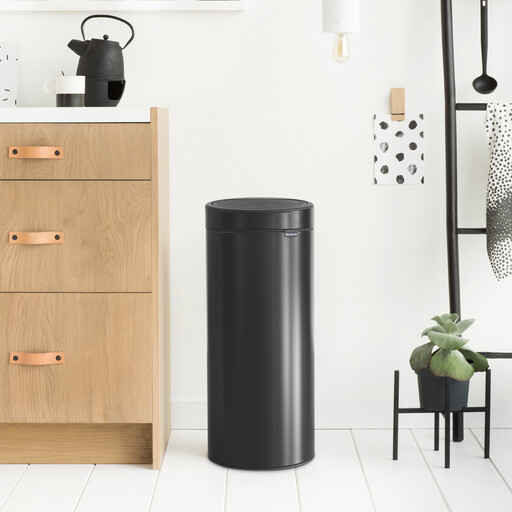
Why This Fits Their Persona: The 30-litre capacity suits smaller households and kitchens where floor space is limited. Its soft-touch lid avoids battery costs and the matt black finish offers a simple, understated appearance.
The removable plastic inner bucket makes liner changes and cleaning more manageable than a fixed-container design.
Soft-touch opening, ventilation holes in the inner bucket, back grip and a stated 10-year guarantee.
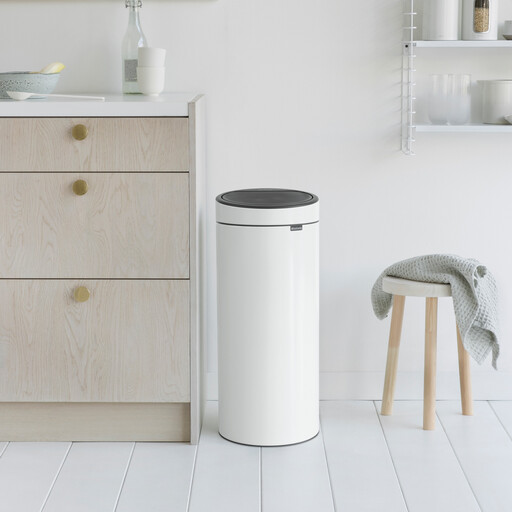
Why This Fits Their Persona: This 30-litre model is suited to shoppers prioritising a coordinated kitchen appearance and convenient daily handling without switching to a battery-powered sensor system.
The large opening and removable inner bucket address two common frustrations: awkward disposal and difficult cleaning.
Protective base, sturdy back grip, soft-touch operation and a stated 10-year guarantee.

Why This Fits Their Persona: A 42-litre capacity provides more room for a busy household, while touchless opening is useful when preparing food or handling messy packaging.
The secure retaining ring helps keep liners in place, avoiding the loose-bag problem found with some open containers.
Automatic sensor opening, polished stainless steel construction and a 42-litre capacity. It requires four AA batteries, which are not included.
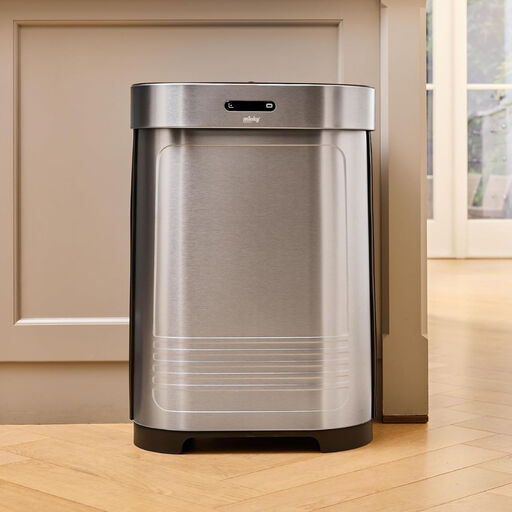
Why This Fits Their Persona: The 55-litre size is designed for households that produce substantial daily waste and want to reduce emptying frequency during cooking and cleaning.
The manual-open option helps keep the lid open during longer tasks, while the fingerprint-resistant exterior addresses visible marks.
Touch-free sensor operation, soft-close function, 55-litre capacity and 20 included bin liners.
We have compiled a complete, real-time list of products that fully satisfy these strict selection criteria and UK safety regulations.
The main running cost is replacement batteries, as well as bin liners. Battery life varies according to the model, usage and sensor activity. A soft-touch bin avoids battery replacement, while a sensor bin may offer greater convenience during food preparation.
A 42-litre model may suit a typical family kitchen, while households that cook frequently or produce more packaging may prefer a 55- or 60-litre kitchen bin. A 65-litre model can reduce emptying trips further, but it requires more floor space. Measure the intended area before ordering.