
24/7 Customer Support

Free returns

Same-day & Next-day Delivery

Quality Guaranteed

Unlock Your Welcome Offers: FREE Delivery | Up to 80% OFF | Free 30-day JoyPlus trial
Download the APP
Choosing between kitchen bins can seem straightforward until you compare capacity, opening mechanisms, materials and liner arrangements. A bin that looks suitable online may be too wide for a narrow kitchen, difficult to clean or unable to contain everyday food odours.
Before buying, look beyond colour and headline capacity. The right kitchen rubbish bin should suit your available floor space, household size, disposal habits and local food-waste arrangements.
A 50L kitchen bin may reduce emptying frequency, but capacity does not tell you whether it will fit beside a cupboard, island or appliance. Check the complete dimensions, including the space required for the lid to open.
This is particularly important in flats, galley kitchens and narrow utility areas. A slim bin can be more practical than a wider model with the same approximate capacity.
A pedal bin gives foot-operated access, while a sensor bin opens when movement is detected. Both reduce the need to touch the lid, but they suit different routines.
Sensor bins require batteries and may open when you do not intend them to if placed near a busy walkway. Pedal bins need clear floor space in front and should be used on a stable, level surface. For longer preparation tasks, a manual stay-open function can also be useful.
An odour-sealing bin may help limit smells when the lid is closed, but it cannot make food waste suitable for storage over long periods. Wet scraps, meat packaging and other organic waste should be emptied according to your household routine and local council guidance.
For peelings, coffee grounds and tea bags, a separate food waste caddy or compost caddy bin can make collection easier and reduce the amount left in the main bin.
Use household size and emptying frequency as a starting point:
Always compare the measurements in centimetres rather than relying on labels such as “slim”. For example, a 30L model measuring 34.8 x 29.7 x 63.3cm may fit a different space from a 50L bin measuring 43.2 x 37.1 x 63.2cm.
A stainless steel kitchen bin usually offers a wipe-clean exterior and a firm structure. Coatings can affect how visible fingerprints, grease and marks are, so check the care instructions and avoid abrasive cleaners where a coated finish is specified.
Plastic is often a lightweight choice for a food waste caddy. A smooth, non-porous surface is convenient for wiping after emptying. Regardless of material, look for a removable inner bucket or liner-retaining feature if you want easier cleaning and more secure bag fitting.
A soft-close bin can reduce lid noise, which is useful in open-plan kitchens or at night. A pedal mechanism supports hands-free disposal, while a sensor bin offers touch-free opening but needs batteries.
A removable inner bucket makes changing liners and dealing with spills simpler. Some bins also use a retaining ring or bag-fixing holes to hold the liner in place and conceal excess material. Check whether the product requires clearance from the wall or should not be closed forcefully by hand.
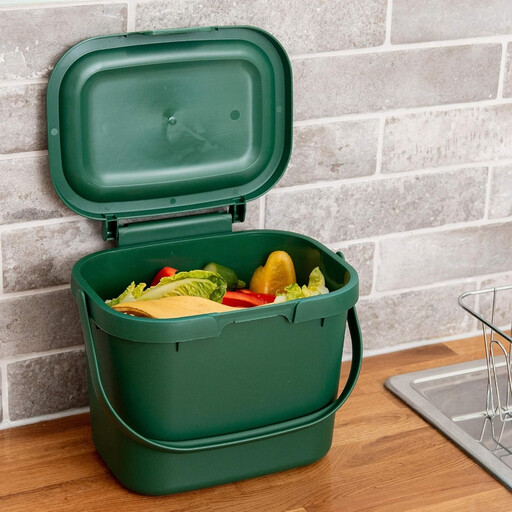
Why This Fits Their Persona: This compact 4.5L caddy suits renters, students and smaller households needing a dedicated place for daily food scraps without using valuable floor space.
Its stated dimensions are 18 x 25 x 19cm, so buyers can assess the worktop or under-sink fit instead of relying on a vague compactness claim.
Plastic construction, an integrated carry handle and a wipe-clean finish support straightforward daily use.
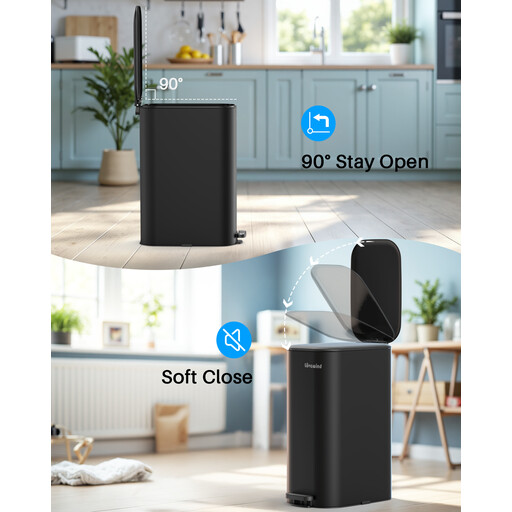
Why This Fits Their Persona: Its 30L format and black stainless steel finish suit kitchens or home offices where appearance, cleaning and controlled access all matter.
The product information specifies a soft-close lid, removable inner bucket and stain-resistant coating rather than relying only on exterior styling.
The pedal provides hands-free opening, and the lid is described as staying open at a 90° angle for longer tasks.
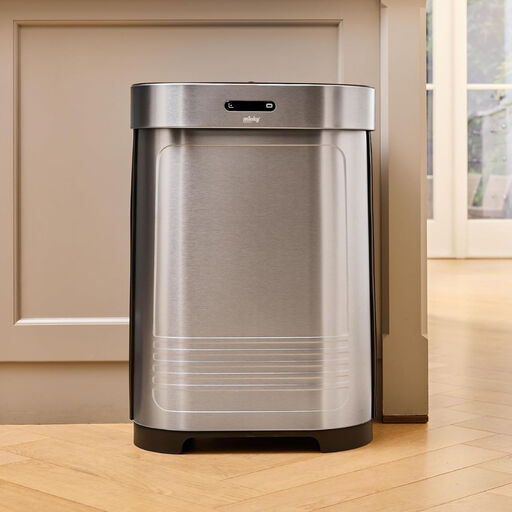
Why This Fits Their Persona: The 55L capacity is suited to busy families and households that prefer fewer trips to the outside bin.
The listing states the sensor bin needs no hand contact for opening, while also providing manual control for extended cooking or cleaning tasks.
It has a stainless steel exterior, a stated soft-close function and 20 bin liners included.

Why This Fits Their Persona: A 42L square format offers a middle ground for family kitchens that want sensor opening without moving to a larger 55L bin.
The product details clearly identify the opening mechanism as a motion sensor and state that four AA batteries are required, with batteries not included.
Its retaining ring is designed to hold rubbish bags in position, while the coated alloy-steel body can be wiped with a damp cloth.
We have compiled a complete, real-time list of products that fully satisfy these strict selection criteria and UK safety regulations.
A 42L to 55L kitchen bin can suit a busy family, depending on how often the household empties waste and whether recycling or food scraps are separated. Check the external dimensions before choosing a larger capacity.
A sensor bin generally needs replacement batteries over time. Running cost depends on the battery type, opening frequency and the model’s power requirements. A pedal bin does not require batteries but needs enough clear space for foot operation.
For many households, yes. A removable inner bucket can make liner changes, spill management and routine cleaning more convenient. Check how it is lifted and whether the liner can be secured without slipping inside the bin.