
24/7 Customer Support

Free returns

Same-day & Next-day Delivery

Quality Guaranteed

Unlock Your Welcome Offers: FREE Delivery | Up to 80% OFF | Free 30-day JoyPlus trial
Download the APP
A chopping board is used for nearly every meal, yet it is easy to buy one based on appearance alone. That can lead to a board that slides across the worktop, holds unpleasant odours or becomes awkward to clean after only a short period.
For UK households, the right choice depends on how you prepare food, how much storage space you have and whether the board will also be used for serving. Below, Joybuy’s Product Recommendation Officer outlines the common buying traps, the specifications worth checking and a selection of kitchen chopping boards matched to different household needs.
A compact board may fit neatly beside the sink, but limited surface area makes it difficult to prepare several ingredients at once. Chopped food can spill over the edges, while raw meat and vegetables may end up sharing the same crowded area.
For most everyday cooking, look for a board of approximately 28 x 40 cm or larger. Measure your worktop and storage space first, particularly if you have a smaller UK kitchen.
Some plastic or stainless steel boards can go in a dishwasher, but wooden chopping boards and many bamboo designs generally require hand washing. Product descriptions can also contain inconsistent care information, so check the specific maintenance instructions before ordering.
A board that is not dishwasher-safe is not necessarily unsuitable. However, it must be easy to rinse, dry thoroughly and store in a well-ventilated place to reduce moisture build-up.
A glossy board without non-slip edging can move during chopping. A very hard surface, such as untreated stainless steel, may also feel less comfortable under a knife than wood or bamboo.
Look for non-slip borders, textured surfaces, handles or a suitable board weight. These features can make a practical difference when slicing, dicing or carving.
For any board that comes into contact with food, check the listing for clear food-contact material information and follow the manufacturer’s care instructions.
A double-sided chopping board or reversible cutting board can provide distinct preparation areas. This is useful for households that want one side for raw meat and fish and another for vegetables, fruit or bread.
However, two sides do not remove the need for good food hygiene. Wash the board after each use, dry both surfaces and avoid using the same side for raw and ready-to-eat foods without cleaning it first.
A chopping board with juice groove can help contain liquid from tomatoes, fruit or meat, reducing spills on the worktop. Groove depth and placement vary, so a deep perimeter groove is more practical for carving or preparing juicy ingredients.
A chopping board with handles is easier to lift and carry. Integrated cut-outs can also improve grip, while a separate hanging hole may help with storage and air drying. Check that handles do not reduce the useful cutting area too much.
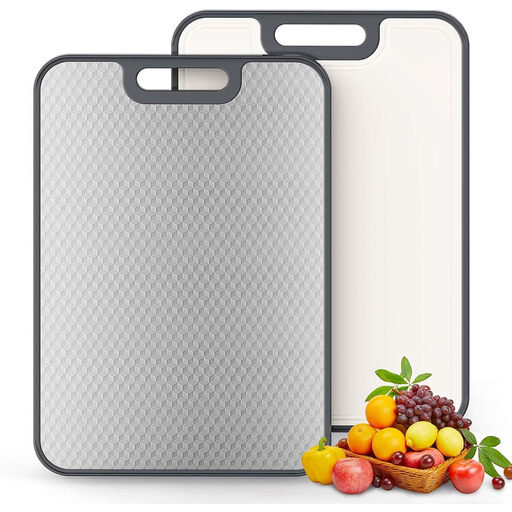
Why This Fits Their Persona: The 17 x 12 inch format gives new households a generous everyday workspace, with stainless steel and wheat straw PP sides for different food-preparation tasks.
Its textured surface is designed to improve traction, while the reversible format helps separate meat and vegetable preparation. The listing states that it is dishwasher-safe, but both sides should be dried thoroughly afterwards.
Double-sided construction; waterproof and oil-resistant surfaces; suitable for busy kitchens.
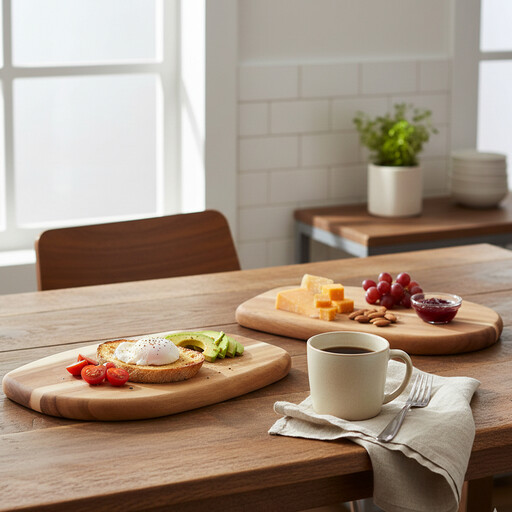
Why This Fits Their Persona: Entertainers can prepare ingredients on the acacia wood boards and take them directly to the table for cheese, bread or appetisers.
The set provides two boards rather than forcing preparation and presentation onto one surface. Hand washing and prompt drying help address the care limitations of wooden boards.
Two acacia wood boards; curved edges; dual-purpose preparation and serving design.
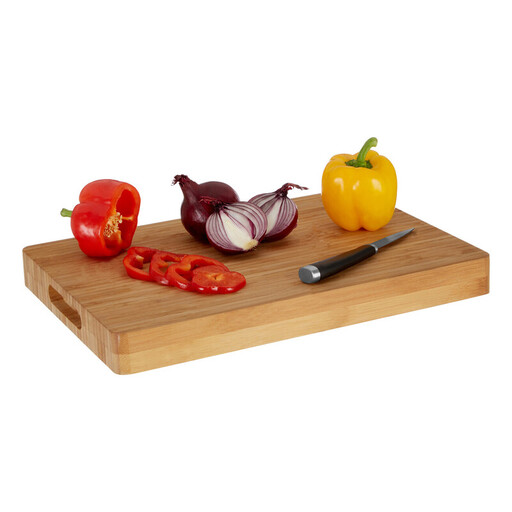
Why This Fits Their Persona: Frequent cooks needing a substantial 28 x 40 cm board may value its thick bamboo construction and integrated end handles for lifting.
Its larger, sturdy format avoids the cramped workspace problem. As with other bamboo boards, hand washing and thorough drying remain important.
Large working area; built-in handles; designed for chopping and serving.
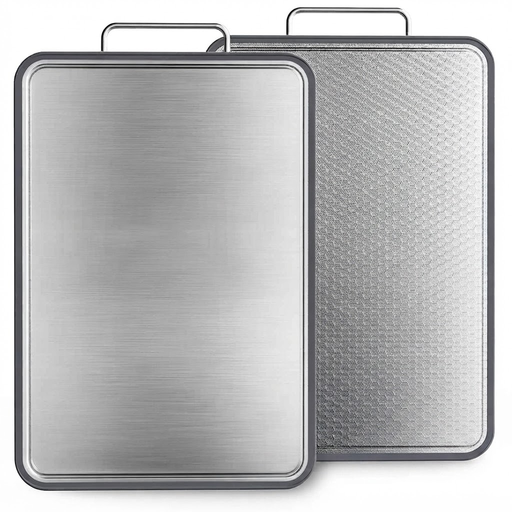
Why This Fits Their Persona: Its 435 x 281 mm format, reversible design and integrated handle suit households preparing meat, vegetables and fruit regularly.
The non-porous stainless steel surface is designed to resist stains and odours, while the groove helps contain liquids. The listing specifies hand washing, despite other care wording, so follow the hand-wash instruction.
304 stainless steel construction; juice groove; reversible preparation areas; integrated handle.
We have compiled a complete, real-time list of products that fully satisfy these strict selection criteria and UK safety regulations.
They can be suitable when cleaned promptly and dried thoroughly. Use separate boards or clearly separate sides for raw and ready-to-eat ingredients. Deep cuts and cracks can make any board harder to clean, so inspect the surface regularly.
Lifespan depends on material, knife use, cleaning and storage. A solid acacia wood, bamboo or stainless steel board may remain useful for a long time when maintained correctly, but visible damage is a practical reason to replace it rather than relying on age alone.
They are particularly useful for juicy fruit, tomatoes and carving meat because the recessed channel helps contain liquid. A groove does reduce the flat cutting area slightly, so compare the overall dimensions with the usable central surface before buying.