
24/7 Customer Support

Free returns

Same-day & Next-day Delivery

Quality Guaranteed

Unlock Your Welcome Offers: FREE Delivery | Up to 80% OFF | Free 30-day JoyPlus trial
Download the APP
Cooking creates more than visible steam. Frying releases grease, boiling adds moisture and strong ingredients leave lingering odours. The right extractor hood can help manage these by-products, but choosing one based on appearance alone can lead to poor airflow, difficult installation or unnecessary running costs.
This guide explains the specifications that matter when comparing kitchen extractor hoods, including width, extraction rate, ventilation method, noise, lighting and filter maintenance.
A cooker hood should generally be at least as wide as the hob beneath it. A 60cm extractor hood is suitable for many standard UK hobs, while a 90cm extractor hood may be more appropriate for a wider hob or a cooking area with several active zones.
A hood that is narrower than the hob may leave the outer areas less protected from rising steam and grease. Always measure the available wall or cabinet space, rather than relying only on the product name.
Maximum extraction figures are usually measured at the highest or boost setting. This setting can be useful during frying, but it may also create more noise. Look at the full specification, including lower-speed airflow and noise levels, before making a decision.
For example, a hood rated at 600m³/h may offer useful flexibility, but its everyday performance depends on the duct route, outlet diameter, installation height and whether it is used in ducted or recirculating mode.
A low purchase price may become less attractive if the hood requires frequent replacement filters or additional installation parts. A washable grease filter can be rinsed or cleaned regularly and reused. However, recirculating installation usually requires a carbon filter to help reduce odours, and replacement intervals vary by usage.
Check whether the product includes carbon filters, ducting components, brackets and a mounting template. For electrical connections and external ducting, follow the manufacturer’s instructions and use an appropriately qualified installer where required.
A 60cm wall-mounted extractor hood is a practical match for many standard gas, induction and electric hobs. The CDA ECP62BL, for example, is 60cm wide and designed for installation above a 60cm hob. Its adjustable height range is listed as 40–55cm, so the final position should be checked against the appliance instructions and hob type.
For larger cooking zones, a 90cm hood can provide broader coverage. The CDA ECP92BL measures 90cm wide and is designed for 90cm hobs. Before ordering, measure the wall, chimney space and surrounding cabinets to ensure the larger canopy will fit comfortably.
Airflow is listed in cubic metres per hour, shown as m³/h. Higher airflow can be useful for frequent frying or open-plan kitchens, but it should not be considered separately from acoustic performance.
The CDA ECP62BL lists airflow up to 600m³/h in boost mode, with noise ranging from 49dB at low speed to 65dB on boost. The 90cm CDA ECP92BL lists up to 700m³/h in boost mode, with noise from 52dB to 68dB. These figures show why a hood with several speed settings can be more practical than one that relies on a single high setting.
A ducted extractor hood sends air outside through a suitable duct. This can be useful where an external wall or existing ventilation route is available. The duct should be installed as specified, with unnecessary bends avoided where possible.
A recirculating cooker hood filters grease and passes air back into the room. It can suit flats, rented properties and kitchens where external ducting is not practical, but carbon filters need periodic replacement or maintenance. Convertible models support both approaches, giving homeowners more installation flexibility.
Other useful features include cooker hood with LED lighting, touch or push-button controls, dishwasher-safe filters and a smooth surface that can be wiped clean. An angled extractor hood may provide more headroom, while a curved glass extractor can create a softer visual profile above the hob.
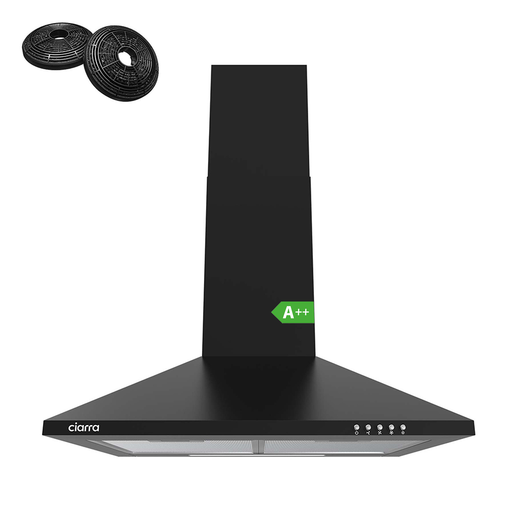
Why This Fits Their Persona: A practical 60cm option for standard UK kitchens, compact renovations and homeowners seeking straightforward controls without a complex interface.
Its stated 60cm width suits standard cooking zones, while ducted and recirculation modes help accommodate different kitchen layouts.
Push-button control, two washable aluminium filters and stated maximum airflow of 367m³/h.
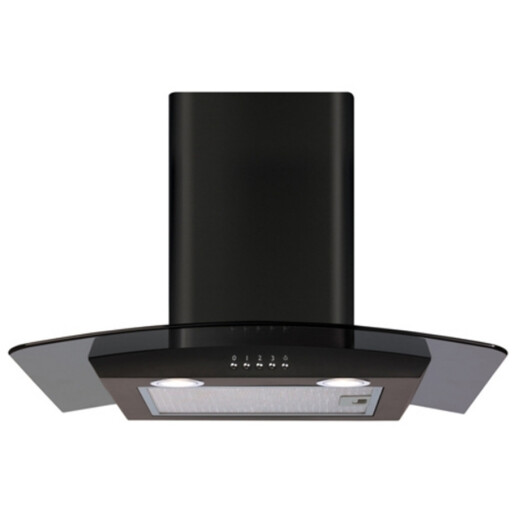
Why This Fits Their Persona: Suits a contemporary kitchen where a black curved glass finish, integrated lighting and touch controls are important alongside everyday ventilation.
It provides three standard speeds plus boost, so high extraction does not have to be the only operating setting.
Tempered curved black glass, two LED lights, touch controls and washable reusable grease filters.
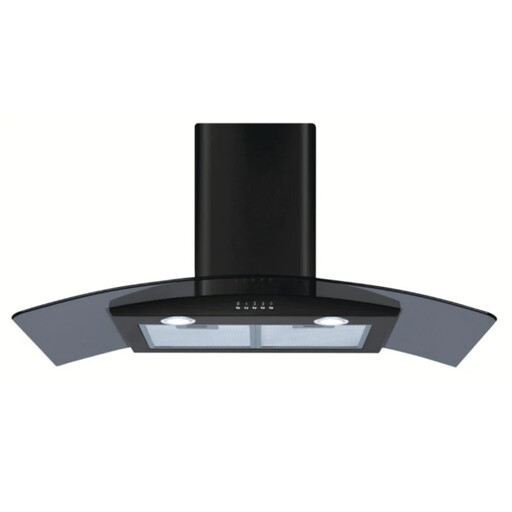
Why This Fits Their Persona: Designed for larger hobs, frequent frying and multi-zone cooking in spacious or open-plan UK kitchens.
Its 90cm width is intended to match a wider hob, while adjustable speeds allow users to reduce noise during less intensive cooking.
Up to 700m³/h boost airflow, two LED lights and ducted or recirculation operation with a carbon filter included.
We have compiled a complete, real-time list of products that fully satisfy these strict selection criteria and UK safety regulations.
Before buying, confirm the following:
A ventilation appliance may not be legally required in every kitchen in the same form, but adequate ventilation is important when planning or renovating a kitchen. Requirements can depend on the property, room design and local building work. Check current UK guidance and consult a qualified installer where necessary.
Ducted extraction sends air outside and avoids relying on carbon filters for odour reduction, but it needs a suitable external route. Recirculation is more flexible for flats and rented homes, although filters require ongoing maintenance. A convertible cooker hood gives you the option to change approach if your kitchen layout changes.
Running cost depends on motor power, usage time, lighting and energy tariff. Using a lower fan setting when cooking gently, switching off the hood after steam clears and choosing efficient LED lighting can help limit electricity consumption. Always compare the appliance’s stated energy information rather than relying on airflow alone.