
24/7 Customer Support

Free returns

Same-day & Next-day Delivery

Quality Guaranteed

Unlock Your Welcome Offers: FREE Delivery | Up to 80% OFF | Free 30-day JoyPlus trial
Download the APP
Managing food scraps is a daily reality in every UK kitchen. While separating waste for your council collection or home compost is a great step, the wrong container can turn a simple task into a messy, smelly chore. A good kitchen food waste caddy should make your life easier, not harder.
However, many find themselves with a caddy that just doesn't work. Before you buy, it's worth knowing the common pitfalls that lead to buyer's remorse:
This guide will help you sidestep these issues by focusing on the practical features that truly matter for a hygienic and efficient kitchen.
To find a reliable food scrap bin for kitchen use, focus on these three non-negotiable parameters.
The right size depends on your household and cooking habits. For many, a 4.5L food caddy strikes the perfect balance. It's large enough to hold a day or two's worth of peelings, tea bags and leftovers without needing constant trips outside, yet small enough to ensure you empty it before odours develop.
Before adding to your basket, measure the intended space. Whether you plan to keep it on the worktop as a worktop compost bin or tuck it under the sink, check the product's dimensions (Length x Width x Height) to ensure a neat fit. A compact footprint is essential for keeping your kitchen workspace clear and uncluttered.
The material of your indoor compost bin is crucial for long-term hygiene. Look for caddies made from durable, non-porous plastic. This type of material has several key advantages:
Some modern options are even made from recycled plastics, offering a more sustainable choice without compromising on durability.
These two components determine how easy the caddy is to use day-to-day. A well-fitting lid is your first line of defence against odours. It doesn't need to be airtight (some air circulation can reduce moisture build-up), but it should sit securely to contain smells.
Equally important is a sturdy, comfortable carry handle. You'll be using it frequently to transport waste to your main council food waste bin or compost heap. A robust, integrated handle makes this task quicker, easier and reduces the risk of spills.
Based on these practical criteria, we've matched some excellent options to different household needs.
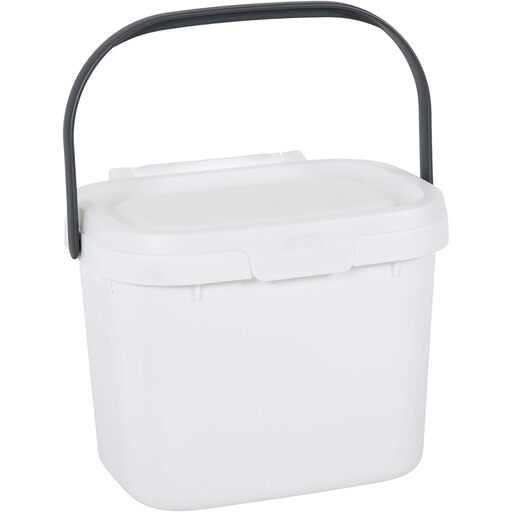
Why This Fits Their Persona: For those who value aesthetics as much as function, this caddy's clean white and metallic silver finish blends seamlessly into modern, minimalist or contemporary kitchen designs. It's a functional tool that doesn't compromise your home's style.
The smooth, non-porous plastic interior directly counters the 'cleaning nightmare' trap. It resists stains and odours and can be wiped clean effortlessly, maintaining its smart appearance.
Practical 4.5L capacity is ideal for daily use in singles or couples' households. The integrated handle ensures easy transport for emptying.
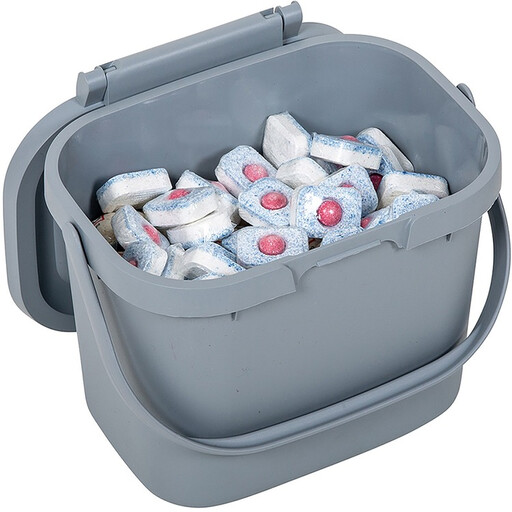
Why This Fits Their Persona: This caddy is made from recycled household plastic and manufactured in the UK, making it a great choice for families looking to make more sustainable purchasing decisions. It's a practical tool that aligns with eco-friendly values.
It avoids the 'wrong size' trap with its 4.5L capacity, which is well-suited for the daily food prep waste of a small family, ensuring it's emptied regularly before smells become an issue.
The primary advantage is its construction from recycled materials. It's also robust, easy to clean and features a strong handle for carrying to the outdoor bin.
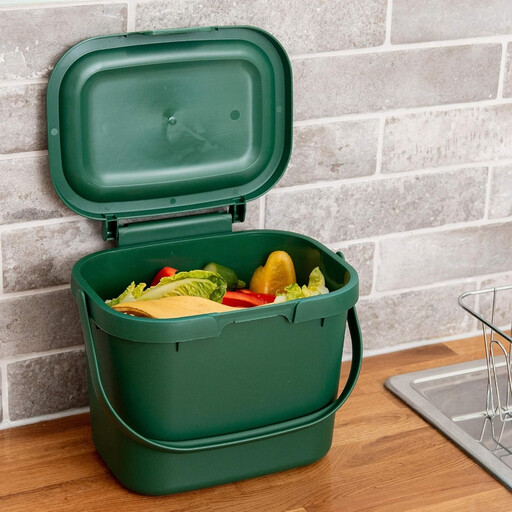
Why This Fits Their Persona: Perfect for those in flats or with limited storage, this caddy's multi-purpose design adds extra value. Beyond being a great **small kitchen bin**, it can be used as a utility caddy for cleaning supplies, gardening tools or craft items.
Its compact, space-saving shape and secure handle make it highly practical, avoiding the trap of a bulky, inconvenient design. It fits neatly on a worktop or under a sink without getting in the way.
The key advantage is its versatility. The durable plastic and carry handle make it just as useful for organising cleaning products as it is for collecting food scraps.
We have compiled a complete, real-time list of products that fully satisfy these strict selection criteria and UK safety regulations.
For a typical 4.5L caddy, it's good practice to empty it every 1-2 days or whenever it's full. This prevents food from decomposing indoors, which is the primary cause of odours. In warmer weather, you may want to empty it daily.
This depends on the specific product. Many durable plastic caddies are dishwasher-safe, but always check the manufacturer's care instructions. For example, the Addis Everyday caddy in Air Blue is listed as dishwasher-safe. If in doubt, a quick wash with warm, soapy water is always a safe and effective cleaning method.
Most UK councils that provide a small indoor caddy typically offer one between 5 and 7 litres. A privately purchased 4.5L caddy is perfectly compatible and often preferred for its more compact, worktop-friendly size. It's simply a holding container to collect scraps before you transfer them to the larger outdoor council food waste bin for collection.