
24/7 Customer Support

Free returns

Same-day & Next-day Delivery

Quality Guaranteed

Unlock Your Welcome Offers: FREE Delivery | Up to 80% OFF | Free 30-day JoyPlus trial
Download the APP
A blunt kitchen knife can make everyday preparation slower and less controlled, but buying the first kitchen knife sharpener you see may create more problems than it solves. Home cooks, chefs, gardeners and DIY users all need different sharpening approaches, while attractive product descriptions can leave out important details.
The following guide highlights common buying traps, the specifications worth checking and our top recommendations for different users.
A pull-through manual knife sharpener may be convenient for standard kitchen knives, but it may not suit serrated blades, very thin edges or ceramic knives. A tool designed for axes may also use a different groove or angle from one intended for a chef’s knife.
Check the product’s intended blade types before buying. If you own Japanese-style knives, outdoor tools or ceramic blades, look for clearly stated compatibility rather than relying on a general “multi-purpose” description.
A multi-stage knife sharpener may include coarse, fine or honing slots. These stages are not interchangeable. A coarse abrasive can remove more material and may be intended for repairing a noticeably dull edge, while a fine or ceramic stage is generally used for refinement or routine maintenance.
Some listings do not explain the abrasive material, sharpening angle or purpose of each slot. If the instructions are unclear, the apparent versatility may not offer much practical value.
A fast knife sharpener can be useful when preparing several knives, but speed should not replace stability and control. Repeatedly pulling a blade through a poorly supported slot, or applying excessive pressure, can produce an uneven edge or remove unnecessary metal.
A stable base, visible cutting grooves and straightforward instructions are often more useful for home use than a product that simply promises rapid results.
The sharpening surface determines how the tool interacts with the blade. Ceramic grind stones are commonly used for maintenance and edge refinement, but their suitability depends on the design and the blade material. A ceramic knife sharpener is not automatically suitable for every ceramic blade.
For standard stainless-steel kitchen knives, look for a sharpener that states whether it is intended for routine honing, edge restoration or both. For axes and outdoor blades, choose a tool that specifically identifies those uses.
The angle controls how the edge contacts the abrasive surface. A fixed-angle kitchen knife sharpener can be easier for beginners because it reduces the need to judge the angle manually. However, the fixed setting may not suit every knife profile.
Clearly indicated grooves can make a handheld knife sharpener easier to use. Where a product provides separate knife and axe slots, use the correct groove rather than treating the tool as a single general-purpose opening.
A sharpener should remain steady while the blade is moved. A suction cup knife sharpener can be practical on a smooth, clean worktop, although suction performance depends on the surface. Single-handle designs can also be convenient, but the grip should feel secure and the tool should be stored away from children.
Compact dimensions matter if the sharpener will be kept in a kitchen drawer, toolbox or gardening kit. After use, follow the supplied care instructions and wipe away filings or residue before storage.
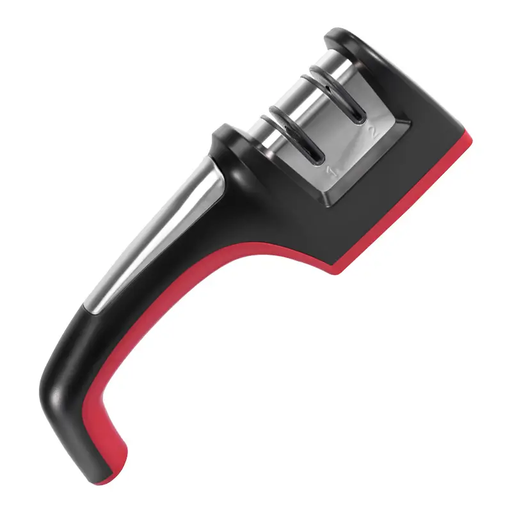
Why This Fits Their Persona: A straightforward option for home cooks who want a compact kitchen knife sharpener for regular household knife maintenance without selecting a separate stone and angle guide.
Its listed use focuses on kitchen knives, helping avoid buying an axe-oriented tool for ordinary food preparation.
Compact format; designed for a quick, repeated draw-through sharpening routine.
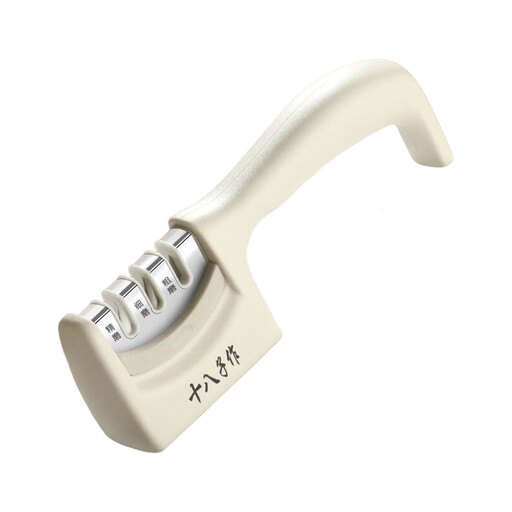
Why This Fits Their Persona: Suitable for shoppers who prefer a multi-stage knife sharpener and want separate stages rather than a single sharpening slot.
The three-stage format encourages users to distinguish between sharpening steps instead of applying one abrasive process to every knife.
Three-stage configuration; single-handle household design.
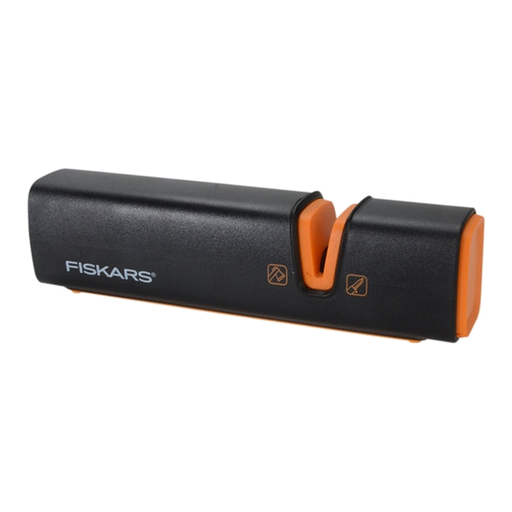
Why This Fits Their Persona: A practical match for gardeners, outdoor users and DIY households maintaining both kitchen knives and axes.
It identifies separate knife and axe grooves, reducing the uncertainty found in vague multi-purpose listings.
Ceramic grind stone; 165 mm compact length; dual-function axe and knife design.
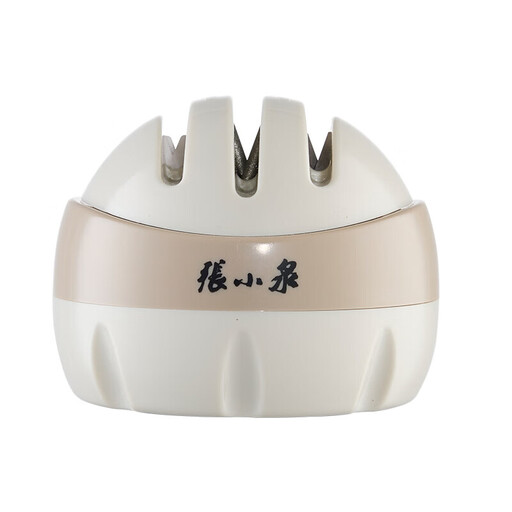
Why This Fits Their Persona: Designed for users who want a single-handle, space-conscious kitchen knife sharpener for a home worktop.
The suction-cup format addresses the stability concern, provided it is placed on a suitable smooth, clean surface before use.
Suction-cup base; single-handle household format; multifunctional listing.
We have compiled a complete, real-time list of products that fully satisfy these strict selection criteria and UK safety regulations.
Before sharpening, clear the worktop and check that the blade is clean and dry. Place the sharpener on a stable surface, or activate the suction base if the model provides one. Hold the handle firmly and keep fingers away from the blade edge.
Use light, even pressure. Pull the knife through the correct groove in one direction, following the supplied instructions. Avoid sawing backwards and forwards unless the manufacturer specifically permits it. Do not sharpen a blade while holding the tool in your hand.
Afterwards, wipe the blade carefully and inspect the edge. Store both items securely, away from children. If a knife has a chipped, bent or severely damaged edge, a basic handheld sharpener may not be the appropriate tool.
Frequency depends on how often the knife is used, the cutting board and the blade material. Occasional home cooks may only need routine maintenance when cutting feels less controlled. Frequent users may prefer a light honing or refinement stage rather than repeatedly using a coarse abrasive.
Not automatically. Ceramic blades require a compatible sharpening method, and many standard manual sharpeners are designed for steel knives. Check the product instructions and the knife manufacturer’s guidance before use. If compatibility is not clearly stated, choose another method rather than risking damage.
Only when the product specifically states that it supports axes. A dedicated axe and knife sharpener, such as the Fiskars Xsharp, provides separate indicated grooves for these uses. Do not assume that a kitchen knife sharpener can handle a thicker outdoor blade.