
24/7 Customer Support

Free returns

Same-day & Next-day Delivery

Quality Guaranteed

Unlock Your Welcome Offers: FREE Delivery | Up to 80% OFF | Free 30-day JoyPlus trial
Download the APP
Finding the right kitchen recycling bin can feel surprisingly complicated. With council recycling rules becoming more specific and our kitchens serving as the hub of family life, a simple bin is no longer enough. You need a solution that is practical, hygienic and doesn't clash with your kitchen's design.
However, the market is filled with options that look great online but fail to deliver in a real, busy household. Before you invest in a new waste separator bin, it's crucial to understand the common pitfalls that lead to buyer's remorse.
To ensure your new kitchen recycling bin is an asset rather than an annoyance, focus on these core functional aspects.
The first step is to match the bin's configuration to your local council's recycling requirements and your family's size.
The opening and closing mechanism is a defining feature of a quality bin. Look for a soft close kitchen bin. This feature uses a damper to ensure the lid closes gently and silently, preventing loud clanging noises that can be a nuisance in an open-plan living space. More importantly, it reduces stress on the hinge and pedal system, contributing to a much longer operational life. A sturdy, wide foot pedal is also a sign of a well-constructed bin designed for daily use.
The material of your bin affects its durability, appearance and ease of cleaning.
We've filtered through the options to identify models that align with specific UK household needs, focusing on durable construction and practical design.
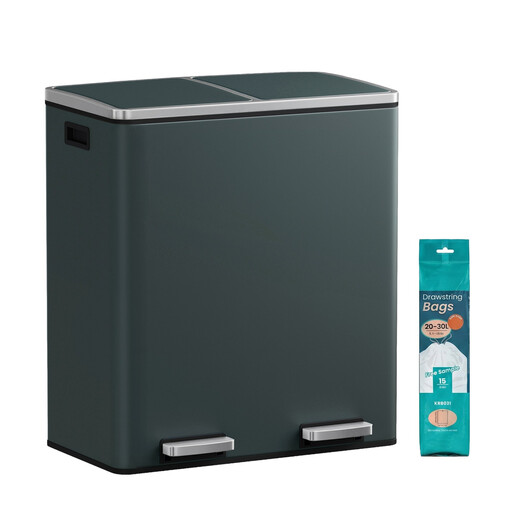
Why This Fits Their Persona: With a total 60L capacity, this bin is built for a family. The two 30L compartments are ideal for separating a large volume of general waste and recyclables, reducing the number of trips to the outside bins.
The large, square inner buckets avoid the "false capacity" flaw by maximising usable space and fitting standard liners securely. Its sturdy metal pedal mechanism is built for frequent use.
Features a quiet soft-close lid to maintain a peaceful kitchen environment. The removable inner buckets have metal handles, making them easy to lift out and clean.
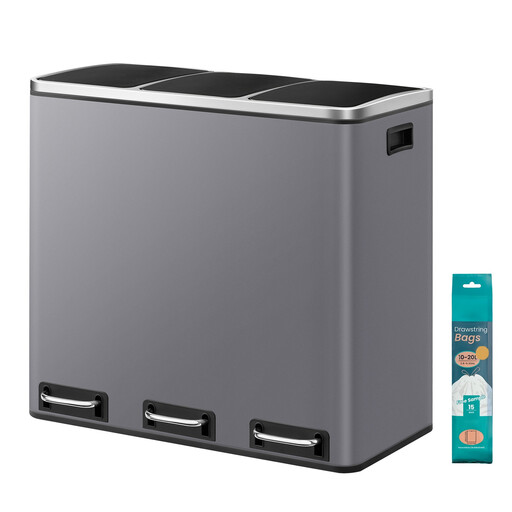
Why This Fits Their Persona: Perfect for those in modern flats or kitchens who need to sort multiple waste streams (general, recycling and food) without clutter. The sleek, single-unit design keeps everything organised and visually tidy.
The powder-coated steel body resists fingerprints and smudges better than basic stainless steel, avoiding the "smudge magnet" problem. Each compartment has its own robust pedal and soft-close lid.
Offers a complete waste separation solution in one compact footprint. The colour-coded pedals can help family members quickly identify the correct compartment.

Why This Fits Their Persona: This bin offers a generous 40L capacity for general waste in a simple, no-fuss design. Made in the UK from 100% recycled plastics, it's a functional and sustainable choice for those who prioritise practicality and environmental impact.
As a single-compartment bin, it avoids the issue of poorly designed inner buckets. Its hard-wearing plastic construction is simple, durable and sidesteps the "fragile pedal" trap of more complex, low-quality metal bins.
Extremely easy to wipe clean and lightweight. The 10-year guarantee offered by Addis provides significant peace of mind about its long-term durability.
We have compiled a complete, real-time list of products that fully satisfy these strict selection criteria and UK safety regulations.
For a family of four in the UK, a bin with a total capacity between 50 and 60 litres is generally recommended. A popular configuration is a 60L model split into two 30L compartments—one for general waste and one for mixed recycling. This size is usually sufficient to avoid needing to empty the indoor bin more than a couple of times a week.
The key is regular cleaning and proper waste management. For food waste compartments, using compostable liners is essential. For all compartments, ensure you wipe out the inner buckets with a disinfectant or a solution of vinegar and water each time you change the bag. Sprinkling a small amount of bicarbonate of soda at the bottom of the bin can also help absorb odours between changes.
This depends on the quality of the finish. Basic, shiny stainless steel shows every fingerprint and water spot. However, models advertised with a fingerprint-proof or brushed steel finish are specifically treated to resist these marks. They are significantly easier to maintain and can be kept looking smart with a simple wipe from a damp microfibre cloth.