
24/7 Customer Support

Free returns

Same-day & Next-day Delivery

Quality Guaranteed

Unlock Your Welcome Offers: FREE Delivery | Up to 80% OFF | Free 30-day JoyPlus trial
Download the APP
A kitchen rubbish bin needs to fit your room, your waste habits and your cleaning routine. Yet product listings can make straightforward decisions surprisingly difficult. A large capacity may look useful until the lid hits a cupboard, while a stylish steel finish may still show fingerprints after every use.
Before buying a kitchen rubbish bin, look beyond appearance and headline capacity. The following guide explains the common buying traps, the specifications worth checking and suitable options for different UK households.
A 30L kitchen bin can suit a flat, office or smaller household, while a 50L rubbish bin may be more practical for a busy family. However, litres alone do not tell you whether the bin will fit.
Check the full width, depth and height, plus the clearance needed behind the bin. Some pedal bins need around 5cm between the rear and the wall, while a lid that opens fully may require additional overhead space. Measure the intended position, including nearby cabinet doors and walkways.
A soft-close lid is designed to lower gradually rather than slam. It can reduce noise, but it does not remove the need for careful use. Several models advise against forcing the lid shut by hand, as this may damage the closing mechanism over time.
Also check whether the lid has a stay-open function. This is useful when scraping plates, changing liners or cleaning the refrigerator. A pedal-operated lid is convenient for hands-free use, but manual opening can be more practical during longer tasks.
A bin liner that slips inside the container can leave untidy edges or make removal difficult. A removable inner bucket with handles gives you a separate section to lift out and clean. A rear bag hole or liner-retaining feature can also help keep the bag in place.
For a dual-compartment bin, confirm the capacity of each section rather than relying only on the combined figure. A 40L double kitchen bin usually provides two 20L compartments, which may be suitable for general waste and recycling but less suitable if one waste stream is much larger than the other.
Use your household’s waste volume as a starting point:
Remember that capacity is not the only measurement. A tall, narrow shape may save floor space, while a wider model may offer easier access but occupy more of a walkway.
A stainless steel kitchen bin or painted steel model is generally straightforward to wipe clean. Look for a smooth exterior and a removable plastic inner bucket, as food residue can collect around the base or liner edge.
Steel does not make a bin maintenance-free. Wipe spills promptly with a soft, damp cloth and follow the care instructions. Avoid abrasive cleaning products that may mark the finish. Colour is also practical: black and dark finishes can disguise some marks, while lighter colours may make dust and smudges more visible.
A hands-free waste bin with a pedal helps reduce contact with the lid during food preparation. A soft-close lid can also help contain everyday smells when properly closed. For stronger odour control, check whether the model includes a carbon filter rather than assuming that every sealed-looking lid has one.
If recycling is part of your routine, a recycling bin with clearly separated compartments can reduce sorting later. However, each compartment will be smaller, so consider whether your local collection arrangements require separate paper, packaging, glass or food waste storage.
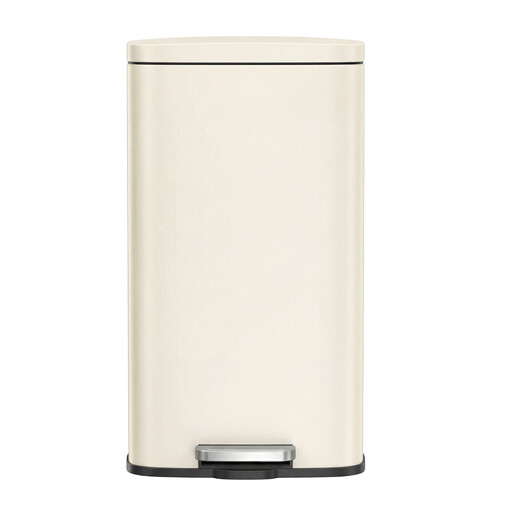
Why This Fits Their Persona: Its 30L capacity and 34.8 x 29.7 x 63.3cm dimensions suit smaller UK kitchens, flats and offices where floor space matters.
The product information states the dimensions clearly and includes a PP plastic inner bucket to support tidier liner changes.
Steel body, pedal and manual opening options, soft-close lid, rear carry handle and removable inner bucket.
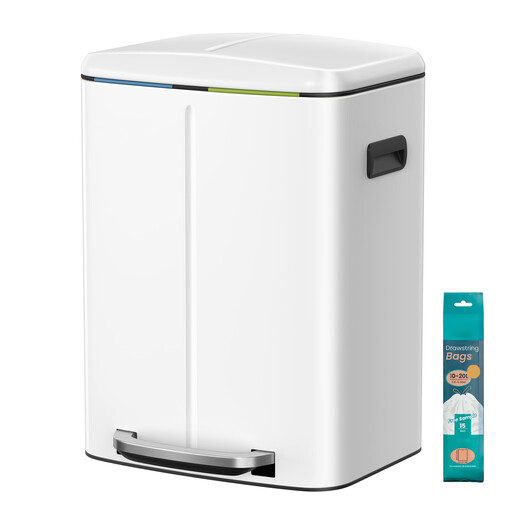
Why This Fits Their Persona: It is designed for households that want a coordinated waste and recycling station without placing two separate bins in the kitchen.
The listing identifies two removable buckets and a 40L total capacity, making the internal layout easier to assess before purchase.
Two compartments, soft-close lids, 90-degree stay-open position, removable inner buckets and 15 included rubbish bags.
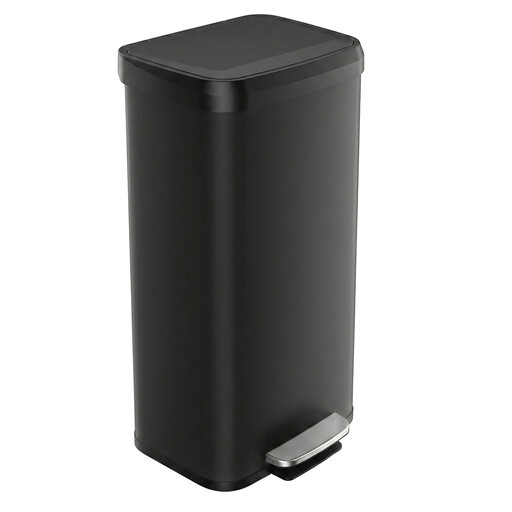
Why This Fits Their Persona: The 68L capacity is intended for larger households that generate substantial kitchen waste and have space for a taller bin.
Its stated 40.5 x 38.1 x 77.1cm dimensions help shoppers check height and floor area before committing to a high-capacity design.
Wide steel pedal, soft-close and stay-open functions, carbon filter and 15 included bin bags.
We have compiled a complete, real-time list of products that fully satisfy these strict selection criteria and UK safety regulations.
Use this checklist before placing an order:
It depends on cooking habits, recycling arrangements and how frequently you empty the bin. A 30L model may suit a small family that separates recycling or empties waste regularly. Larger families may prefer a 50L or 68L rubbish bin to reduce liner changes.
A pedal bin allows you to open the lid without touching it, which can be convenient when handling food waste. It still needs regular cleaning, and the pedal mechanism should not be overloaded or operated roughly.
Follow the product instructions. Several models specify approximately 5cm of rear clearance so the lid and hinge can operate correctly. Also measure the space above the bin, particularly if it is positioned beneath wall cabinets or shelving.