
24/7 Customer Support

Free returns

Same-day & Next-day Delivery

Quality Guaranteed

Unlock Your Welcome Offers: FREE Delivery | Up to 80% OFF | Free 30-day JoyPlus trial
Download the APP
A kitchen rubbish bin has a demanding job. It needs to fit your available floor space, cope with food packaging and household waste, and remain easy to clean. For many UK households, it may also need to support recycling without creating extra clutter.
However, product descriptions can make similar bins sound very different. Before buying a kitchen rubbish bin, look beyond colour and headline capacity. The details below can help you avoid common purchasing mistakes and select a bin that suits your household routine.
A 50L or 60L kitchen waste bin may reduce how often it needs emptying, but capacity alone does not show whether it will fit beneath a worktop or beside a cabinet. Check the full width, depth and height, including clearance for the lid and pedal.
A tall 68L kitchen bin, for example, may be suitable for a large family but less practical beneath low cupboards. A slim 30L kitchen bin can work well in a flat or office kitchenette, provided the smaller capacity matches the amount of waste produced.
A soft-close rubbish bin uses a cushioning mechanism to slow the lid. This can reduce slamming noise, but the mechanism still needs sensible use. Forcing the lid down by hand, overloading the bucket or allowing moisture to build up around the pedal may affect operation.
Look for clear instructions, a stay-open function for food preparation, and a design that allows the inner bucket to be removed without wrestling with the liner.
A dual-compartment bin is useful when you regularly separate general waste and recyclable materials. Yet two smaller compartments may fill at different speeds. If one section is consistently unused, a single large kitchen bin plus a separate recycling container could use space more efficiently.
Also check your local council’s collection guidance. Accepted materials and sorting requirements vary between UK areas, so a recycling and waste bin should support your routine rather than dictate it.
Use capacity as a practical guide rather than a guarantee:
For a dual-compartment bin, always confirm whether the stated capacity is the total or the capacity of each section. A “2 x 30L” model provides 60L in total, not 60L per compartment.
A stainless steel bin or coated steel outer body is generally straightforward to wipe clean. Fingerprint-resistant finishes can reduce visible marks, although no surface eliminates the need for regular cleaning. Avoid abrasive cleaners and steel wool, which may scratch a coated finish.
A removable inner bucket is especially useful for changing liners and dealing with leaks. Bag-fixing holes, retaining rings or concealed liner edges can help keep bags secure and improve the appearance of the bin.
A pedal bin or step-on bin allows hands-free opening, which is convenient when preparing food. Check whether the pedal opens one lid or two separate lids, and whether the lid can remain open at approximately 90 degrees for larger cleaning tasks.
An odour-sealing bin may help contain smells when its lid closes properly. Some models use a carbon filter, while others rely on a close-fitting lid and inner bucket. These features do not replace regular emptying, particularly for food waste.
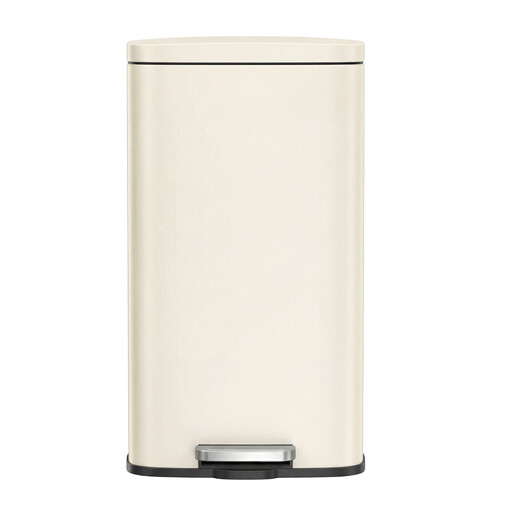
Why This Fits Their Persona: Its 30L capacity and compact 34.8 x 29.7 x 63.3cm dimensions suit smaller UK kitchens, offices and households that prefer frequent emptying.
The stated dimensions make space planning easier, while the removable inner bucket supports simpler liner changes and cleaning.
Steel outer body, soft-close lid, hands-free pedal and manual opening option.
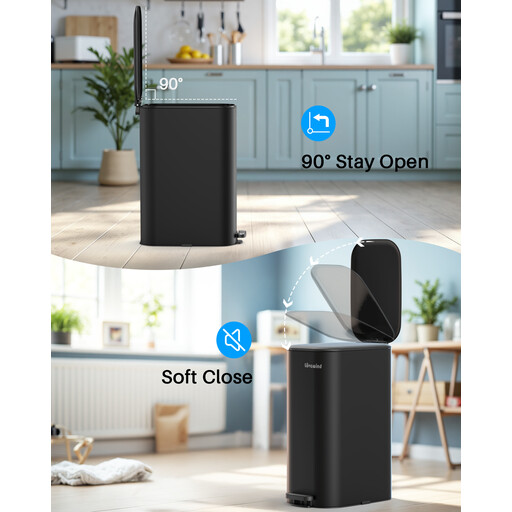
Why This Fits Their Persona: The black stainless-steel finish suits contemporary kitchens and home offices where appearance and easy wipe-clean care are priorities.
The slim 30L format avoids buying a larger bin that may dominate a compact room, while the removable bucket addresses messy liner changes.
Stainless-steel body, stain-resistant coating, 90-degree stay-open lid and soft-close operation.
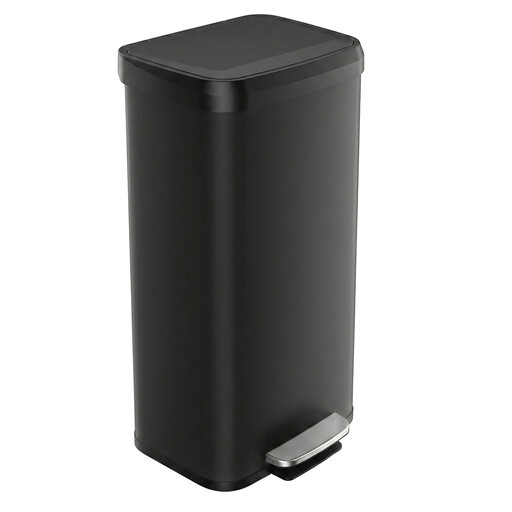
Why This Fits Their Persona: The 68L capacity is suited to larger households that produce substantial indoor waste and want to reduce emptying frequency.
Its listed 40.5 x 38.1 x 77.1cm size highlights the need to measure vertical clearance before purchase. The carbon filter is a defined odour-control feature rather than an unspecified promise.
68L capacity, carbon filter, soft-close lid, stay-open function and included liners.
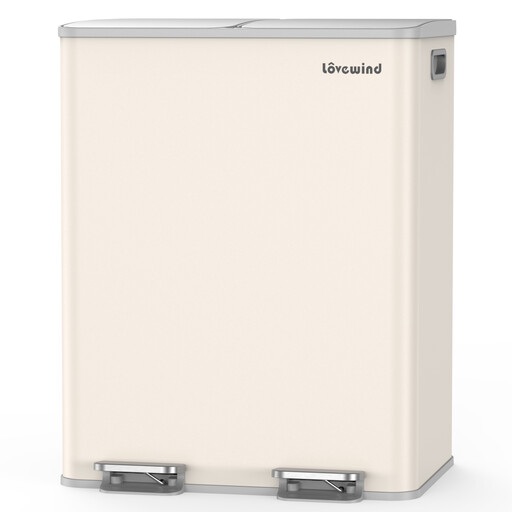
Why This Fits Their Persona: Two 30L compartments provide a clear place for general waste and recyclable materials in a busy family kitchen or shared office.
The split capacity is stated clearly, helping shoppers compare it with a single 60L bin. Separate pedals and fixing rings support daily sorting and liner management.
Dual 30L inner buckets, dual pedals, stainless-steel exterior, soft-close lid and 90-degree stay-open function.
Place the bin on a flat, stable surface and leave the manufacturer’s recommended gap behind it. This is particularly important for models with rear hinges or a lid that needs to open fully.
Secure liners around the inner bucket’s fixing points rather than allowing the bag to sit loose inside the body. Empty wet food waste promptly, wipe spills with a soft damp cloth and keep the pedal mechanism dry. Do not place hot ashes, flammable materials or hazardous waste in an indoor household bin.
For dual-compartment models, choose liner sizes that match each bucket. A correctly fitted liner is less likely to slip into the bin or interfere with the lid.
We have compiled a complete, real-time list of products that fully satisfy these strict selection criteria and UK safety regulations.
A pedal bin allows hands-free opening, which can reduce contact with the lid during food preparation. Hygiene still depends on regular cleaning, prompt emptying and correct liner fitting.
This depends on capacity, household size and the type of waste inside. A 30L bin may need frequent emptying in a family kitchen, while a 50L, 60L or 68L kitchen bin can hold more general waste. Food waste should not be left for long periods simply because the bin has spare capacity.
The bin itself does not use electricity, so there is no routine power cost. Ongoing expenses usually include replacement liners and, where fitted, carbon filters. Check the required liner dimensions before buying to avoid relying on expensive custom bags.