
24/7 Customer Support

Free returns

Same-day & Next-day Delivery

Quality Guaranteed

Unlock Your Welcome Offers: FREE Delivery | Up to 80% OFF | Free 30-day JoyPlus trial
Download the APP
Choosing among kitchen rubbish bins can seem straightforward until a lid stops closing properly, a liner slips into the bucket or the bin takes up more floor space than expected. UK kitchens also vary considerably, from compact rented flats to busy family homes, so capacity and shape matter as much as appearance.
The Joybuy Product Recommendation Officer’s practical filter focuses on the details that affect everyday use rather than relying on decorative finishes or vague marketing language.
A 30L kitchen bin may fit neatly under a worktop, while a 50L kitchen bin can reduce emptying frequency for a family. However, litre capacity does not show the bin’s full footprint. A wide pedal, rear clearance and the space needed to open the lid can all affect placement.
Always check:
For example, a 50L model measuring 43.2 x 37.1 x 63.2cm needs more floor space than a compact 30L model measuring 34.8 x 29.7 x 63.3cm, even though both are a similar height.
A soft-close rubbish bin is designed to slow the lid during closure, helping reduce slamming. It does not mean the mechanism cannot make any sound, particularly if the lid is forced down or obstructed. Do not manually push a soft-close lid shut and avoid placing heavy items on it.
A stay-open setting is also useful when scraping plates, cleaning the fridge or changing a liner. Check whether it is operated manually or through a separate catch point.
A removable inner bucket is more practical than a fixed cavity when a bag leaks. Look for handles, a liner-securing hole or another method that keeps the bag edge from slipping. Without these details, the liner may fall inside the bin, leaving waste against the outer shell.
Odour control also depends on regular emptying and cleaning. An odour-sealing bin can help contain smells when the lid is closed, but it is not a replacement for suitable liners or hygienic maintenance.
A 30L pedal bin is often a sensible option for couples, smaller kitchens, bathrooms or home offices. It can also suit households that empty waste frequently. A 50L household waste bin is more suitable where several people produce daily food and packaging waste, provided there is enough room for the larger footprint.
For recycling, a dual-compartment recycling bin allows general waste and recyclable material to be separated at the point of disposal. Check the capacity of each compartment rather than looking only at the combined figure.
A stainless steel kitchen bin or painted steel bin offers a wipe-clean exterior and a structured shape. Rust-resistant steel is useful in kitchens, although the bin should still be kept indoors and wiped dry after cleaning. Plastic inner buckets are lighter to remove and can be cleaned separately.
Avoid abrasive cleaners, which may mark the finish. Do not use indoor bins for hot ash, liquids that could damage the material or hazardous waste. Follow local council guidance for separating food, glass, batteries and other restricted materials.
A pedal bin or step-on bin permits hands-free opening, which is useful while preparing food. A stable base and non-slip pads can reduce movement across hard floors. Measure the position of the pedal as well as the bin body and check the open-lid height before placing it beneath shelving.
For a narrow galley kitchen, a slim kitchen bin may be easier to position than a wider model. For a busy office, utility room or commercial area, an open-top 40L bin can provide quick access, although it offers less odour containment than a lidded design.
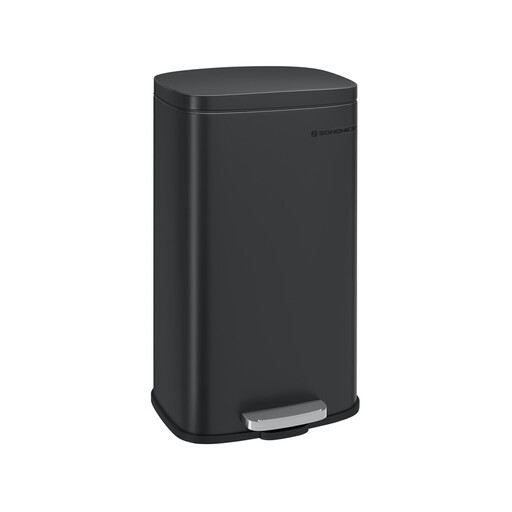
Why This Fits Their Persona: Its 30L capacity and relatively compact footprint suit smaller UK kitchens, rented accommodation and home offices where space is limited.
The listed dimensions make it easier to assess fit, while the removable bucket helps prevent liner and spill problems.
Steel exterior, PP plastic removable inner bucket, foot pedal and soft-close, odour-sealing lid.
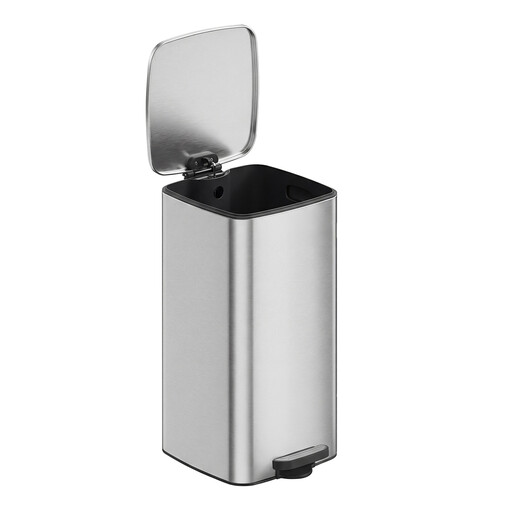
Why This Fits Their Persona: A silver stainless steel finish works well in coordinated kitchens where appearance, stability and convenient bag changes are priorities.
The product listing provides a 34 x 28.5 x 54.4cm footprint and specifies non-slip pads, rather than relying only on style-led descriptions.
Stainless steel body, removable inner bucket with handles, stay-open lid position and soft-close operation.

Why This Fits Their Persona: Two separate compartments support households that want to sort general waste and recycling at the kitchen worktop.
Its two removable buckets address spill-cleaning concerns, while the listed open-lid height helps with placement planning.
Two 30L compartments, soft-close mechanism, removable buckets and 15 included rubbish bags.
We have compiled a complete, real-time list of products that fully satisfy these strict selection criteria and UK safety regulations.
Lifespan depends on the steel or plastic body, lid mechanism, pedal use and cleaning routine. Avoid forcing the lid, overloading the bucket or using abrasive products. A removable inner bucket can also make routine cleaning easier and help protect the outer shell from leaks.
A 50L kitchen bin generally allows more waste between emptying, making it practical for larger households. A 30L model may be easier to position in a compact kitchen and can be suitable if waste is emptied frequently. Measure the available area before choosing based on capacity alone.