Batch pastry cooks
If you add butter, flour and other ingredients to one bowl, check the total weighing capacity and whether you can zero the display between additions.


For weighing butter and other pastry ingredients in one bowl, start with a 5 kg scale with 1 g increments and a tare function, provided the bowl and full batch stay within its limit. If your bowl hides the display, look for a design that keeps the reading visible; a separate fine-measurement platform is useful only when your recipes call for very small additions.
If you add butter, flour and other ingredients to one bowl, check the total weighing capacity and whether you can zero the display between additions.
If your mixing bowl is broad, you need to see the reading without lifting it. The scale also needs to fit where you store it between batches.
If you make pastry alongside bread or pizza dough, you may need to weigh a large batch and measure very small additions separately.
Start with the weight of your bowl and largest batch. Then decide whether display visibility or fine measurement changes the scale you need.
| Concern | What to check | Who this matters to |
|---|---|---|
| One-bowl weighing and capacity | Check for tare or add-and-weigh, and a maximum that covers the bowl plus every ingredient. | If I add ingredients one after another, I want to zero the scale without changing bowls and still have room for the full batch. Around 44% of consumers put that one-bowl need first. |
| Display and storage | Compare your bowl's footprint with the platform and display; check how the scale stores. | A broad bowl makes weighing awkward if I cannot read the display, and I need to put the scale away afterwards. Display and storage are the first concern for around 33% of consumers. |
| Fine measurement | Check the maximum and increment for each platform separately if you need small additions as well as large batches. | When I make dough as well as pastry, tiny additions need their own measurement range alongside my main batch. That is the primary need for around 23% of consumers. |
The stated maximum applies to everything on the scale. Beurer specifies 3 kg for the KS 25, while Salter and Joseph Joseph specify 5 kg for the models discussed here.
Allow for your heaviest bowl and complete batch before choosing a capacity.
A broad mixing bowl may make the reading difficult to see during repeated additions.
Check your bowl against the scale's dimensions. Joseph Joseph describes the Vision Compact's sliding design as a way to keep its LCD visible with larger bowls.
Ooni's Dual Platform Digital Scales pair a 1 g large platform with a separate 0.1 g platform for small additions. The second platform serves a different need from weighing ordinary amounts of butter.
Check whether your regular recipes actually require measurements below 1 g before choosing a dual-platform design.
A scale used to determine the final quantity sold to a customer is a different use from weighing pastry ingredients at home. Business Companion's UK guidance addresses requirements for weighing equipment used for legal and trading purposes.
If you plan to sell food by weight, check the requirements for that use before relying on a domestic scale for the final quantity.
These examples illustrate different scale designs; check the particular model rather than assuming every scale from a brand has the same features.
Salter's Aquatronic 5KG is a conventional option for weighing several ingredients in one bowl.
The Vision Compact addresses the problem of reading a scale beneath a larger mixing bowl.
Ooni's Dual Platform Digital Scales serve dough makers who need two weighing ranges.
The KS 25 is an option if you want a scale with its own removable bowl.
These choices cover kitchen scales for pastry ingredients, a scale-equipped food processor and a higher-capacity scale. Check each product's weighing functions against your usual bowl and batch.
 No image available
For pastry weighed in a bowl, check whether this Calibra 1L variant has the capacity and tare function your batches require.
Black-glass finish.
 No image available
For one-bowl pastry weighing, check its maximum load, tare function and display position against your mixing bowl.
Stainless-steel variant.
 No image available
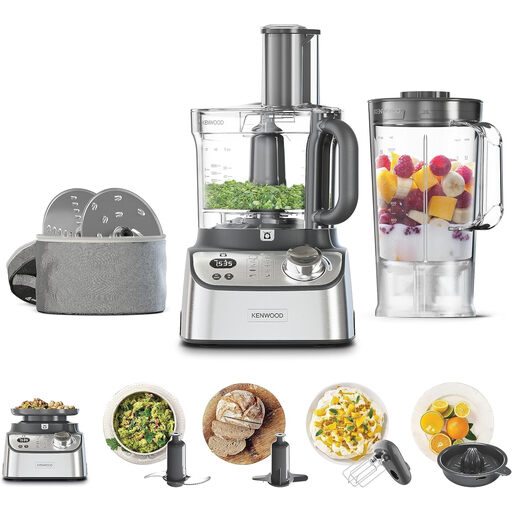
Consider this if you want food-processing functions as well as an integrated digital scale, rather than a standalone kitchen scale.
The product name specifies 3L capacity, 1000W and eight accessories. Check the scale's weighing limit for your intended batch.
 No image available
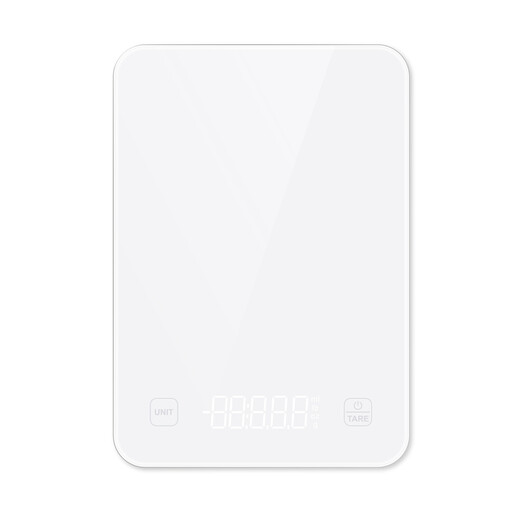
For a bowl and batch that exceed a smaller scale's limit, consider its stated 10 kg capacity, while checking that the display remains visible in your setup.
The product name specifies 1 g increments, multiple units, a tempered-glass surface and app integration. Check for tare if you add ingredients successively.
A 5 kg scale is a practical starting point if your bowl and all the ingredients together stay below its stated maximum. Salter's Aquatronic 5KG and Joseph Joseph's Vision Compact both specify 1 g increments; for a heavier load, check a higher-capacity model such as Ooni's 10 kg large platform.
Tare lets you zero the reading with a bowl on the scale, then weigh the next ingredient without changing containers. Salter describes Add & Weigh for this purpose on its Aquatronic 5KG; check the function on the exact scale you intend to buy.
Follow the care instructions for the exact model rather than assuming the scale is dishwasher-safe. Ooni says its Dual Platform Digital Scales must not be submerged or put in a dishwasher; Joseph Joseph instructs owners to wipe the Vision Compact with a damp cloth.
Do not assume a domestic baking scale is suitable for determining the final quantity sold to a customer. Business Companion's UK guidance distinguishes trade weighing from ingredient weighing during production; check the requirements for your particular selling use before relying on the scale.