
24/7 Customer Support

Free returns

Same-day & Next-day Delivery

Quality Guaranteed

Unlock Your Welcome Offers: FREE Delivery | Up to 80% OFF | Free 30-day JoyPlus trial
Download the APP
By Joybuy Product Recommendation OfficerPublished on 26 August 2026
The kitchen sink is the heart of daily clean-ups, but it can quickly become a cluttered, damp and unhygienic space. A good kitchen sink organiser promises to restore order, but the market is flooded with options that often fail to deliver. Many UK households find their new purchase becomes a source of frustration, either by rusting, creating more mess or simply not fitting the space.
Before you buy, it's worth knowing the common design flaws that lead to disappointment. By understanding these pitfalls, you can make a more informed choice that genuinely improves your kitchen organisation.
To find a durable and practical solution, focus on a few core features rather than marketing hype. These are the non-negotiable details that determine whether a kitchen sink organiser will be a help or a hindrance.
The material of your sink organiser is the single most important factor for its longevity. To avoid the rust trap, look for products made from 304-grade stainless steel. This specific grade contains a higher chromium and nickel content, offering superior corrosion resistance that stands up to constant water exposure.
For plastic models, opt for durable, non-porous materials like ABS plastic. These are not only immune to rust but are also simple to wipe clean, preventing the build-up of limescale and grime. A well-made plastic sink tidy can be a very hygienic and long-lasting choice.
An effective organiser must manage water efficiently. Look for designs with these key features:
cutlery drainer from sitting in a puddle.sponge holder for sink that is raised on small feet allows air to circulate underneath, keeping your worktop dry.UK kitchens vary greatly in size, so measuring your sink area is a crucial first step. Consider which type of organiser best suits your needs and available space.
sink caddy is versatile and sits beside the sink. Ensure it has a stable, non-slip base.over the sink drainer or extendable rack is a brilliant solution for small kitchens, as it uses the vertical space above the sink and allows dishes and utensils to drip-dry directly, keeping your worktops completely clear.We have filtered through the options to find products that address the common pitfalls and match different household needs.
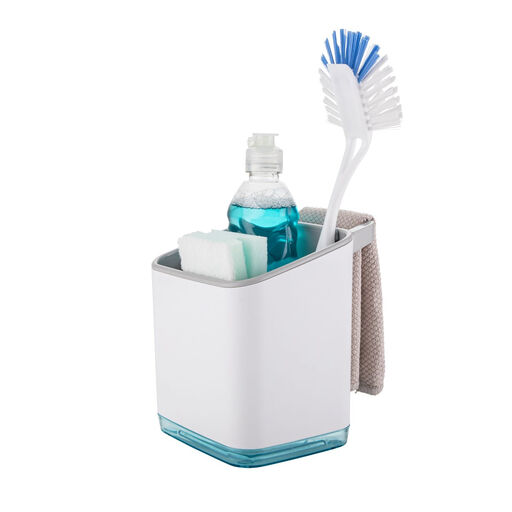
Why This Fits Their Persona: Ideal for those in flats or with minimal worktop space. This compact unit organises all the daily essentials—sponge, brush and washing-up liquid—without dominating the sink area. The integrated rail for hanging a dishcloth is a particularly practical touch for small spaces.
It is made from durable ABS plastic, completely avoiding the rust pitfall. Its clever design includes a removable drip tray with a drainage spout, directly solving the problem of pooled, stagnant water.
Features two compartments, a cloth rail and a self-draining tray in one compact, easy-to-clean unit. It is a complete, freestanding solution that requires no installation.

Why This Fits Their Persona: For those who value aesthetics as much as function. This caddy's sleek, minimalist design and polished finish complement modern kitchen décor. It is for the user who wants a long-term, high-quality accessory, not a temporary plastic fix.
Constructed from 304 stainless steel, it directly counters the primary pitfall of rusting. The open-wire design ensures maximum airflow and drainage, preventing any moisture build-up.
Offers genuine rust-proof durability combined with a stylish, modern aesthetic. The integrated soap dispenser helps to further de-clutter the sink area for a clean, unified look.
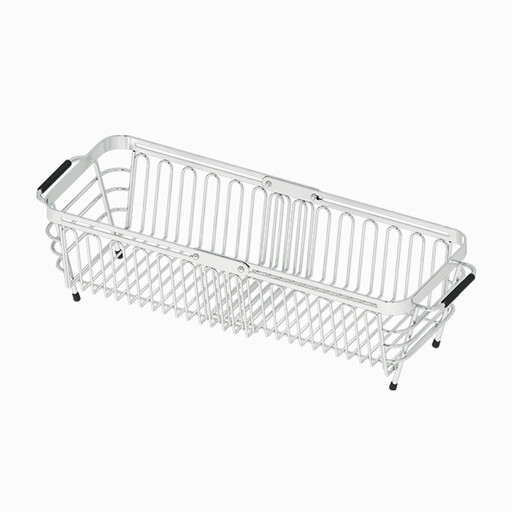
Why This Fits Their Persona: Perfect for busy family kitchens that handle large volumes of washing-up. This versatile basket can be used as a `dish drying rack` over the sink, a colander for washing vegetables or an in-sink caddy. It maximises utility without taking up any precious counter space.
Its extendable design (29-44cm) eliminates the risk of buying the wrong size. As an over-sink rack, it guarantees perfect drainage directly into the sink, and its 304 stainless steel construction prevents rust.
Highly versatile and space-saving. The adjustable length provides a custom fit for most standard UK sinks, making it a flexible and practical tool for kitchen organisation.
We have compiled a complete, real-time list of products that fully satisfy these strict selection criteria and UK safety regulations.
The most effective way is to choose the right material from the start. Look for organisers explicitly made from 304-grade stainless steel, which is highly resistant to corrosion. If you have a different type of metal caddy, ensure it has a thick, undamaged protective coating. To prolong its life, especially in hard water areas, wipe it dry periodically to prevent mineral deposits that can encourage rust.
A hygienic organiser is one that promotes fast drying and is easy to clean thoroughly. Models with perforated bases, open-wire construction and removable drip trays are ideal. In terms of materials, non-porous options like 304-grade stainless steel and smooth ABS plastic are preferable as they are less likely to harbour bacteria compared to materials like wood. For good practice, dismantle and clean your sink tidy at least once a week.
This depends entirely on the manufacturer's guidance. Many simple plastic or solid stainless steel organisers are top-rack dishwasher safe. However, you should always check the product information first. Items with special coatings, moving parts or suction cups should almost always be washed by hand with warm, soapy water to avoid damaging the finish or the suction mechanism.