
24/7 Customer Support

Free returns

Same-day & Next-day Delivery

Quality Guaranteed

Unlock Your Welcome Offers: FREE Delivery | Up to 80% OFF | Free 30-day JoyPlus trial
Download the APP
A kitchen strainer can handle everything from rinsing rice to draining pasta, filtering sauces and lifting fried food from hot oil. However, choosing the wrong design often leads to wasted money: a fine mesh sieve may clog when used with chunky ingredients, a small colander may not fit over your sink, and a decorative utensil may lack the heat resistance needed for everyday cooking.
Before buying, look beyond broad claims such as “multi-purpose” or “heavy duty”. The useful details are usually found in the material, mesh or hole size, dimensions and cleaning instructions.
A kitchen sieve or fine mesh sieve is intended to catch small particles. It is useful for flour, icing sugar, loose-leaf tea, grains and smooth sauces. A colander or draining basket usually has larger holes, allowing water to escape quickly from pasta, vegetables and fruit.
Using a fine mesh sieve for large quantities of pasta can be slow, while using a wide-hole colander for flour or small grains may allow ingredients to escape. Match the opening size to the food you prepare most often.
Product photographs can make a strainer appear larger than it is. Check the listed diameter, length and height before ordering. A compact 8cm sieve is convenient for single portions, but it will not replace a large pasta strainer. Conversely, a wide draining basket may be awkward in a small Belfast, inset or rented-kitchen sink.
For adjustable models, check that the basket is fully extended and stable before adding heavy food or water.
“Stainless steel” describes a broad group of materials. Some products specify 304 stainless steel, while others simply state stainless steel or metal construction. Finish and care instructions also matter. Salt, acidic food residue and prolonged soaking can affect the appearance of metal utensils, so prompt rinsing and thorough drying are sensible habits.
Avoid abrasive cleaners and steel wool unless the manufacturer specifically permits them. Handles can also become hot during cooking, even when they are described as heat-resistant or hollow.
For a stainless steel strainer used with boiling water or frying, look for clearly stated material information. Several products in this range specify 304 stainless steel, also known as 18/8 stainless steel. This is a commonly used food-contact metal, but the product should still be cleaned according to its instructions.
A one-piece or securely joined construction can reduce areas where food residue collects. Rolled or polished edges are useful practical details, particularly when the item is handled frequently.
Choose according to the ingredients:
Dense mesh can filter small particles but may require more rinsing after use. Evenly distributed holes generally provide faster drainage for larger ingredients.
A draining basket with integrated handles is easier to lift from a sink. A telescopic model may help in a compact kitchen, provided it is fully extended and stable. For utensils, a hanging loop or hole keeps a slotted spoon or skimmer accessible without taking up drawer space.
If you cook with hot oil or boiling water, consider handle length and grip shape. A longer handle may provide more distance from splashes, but it can also need more storage space.
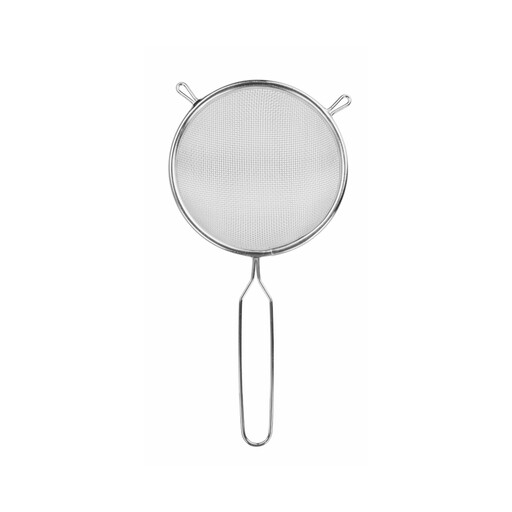
Why This Fits Their Persona: A straightforward option for UK households needing one sieve for rinsing pulses, draining canned food, washing fruit and handling everyday preparation.
Its listed 16cm diameter gives a clearer idea of capacity than an image alone, while the fine mesh is suited to small particles and grains.
Fine mesh, long handle and a built-in rest for positioning over a bowl or pan.
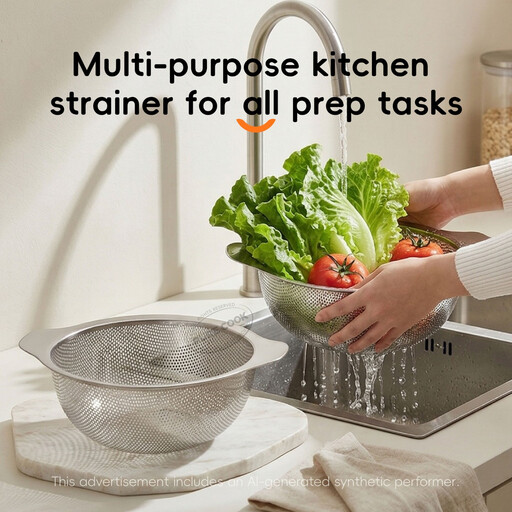
Why This Fits Their Persona: Suitable for shoppers who want a sizeable, coating-free basket for regular vegetable washing, rice rinsing, fruit storage and meal preparation.
The stated 27.3 × 22.6 × 9.1cm dimensions and integrated handles make capacity and carrying requirements easier to assess before purchase.
Food-grade 18/8 stainless steel, dense drainage holes and dual integrated handles.
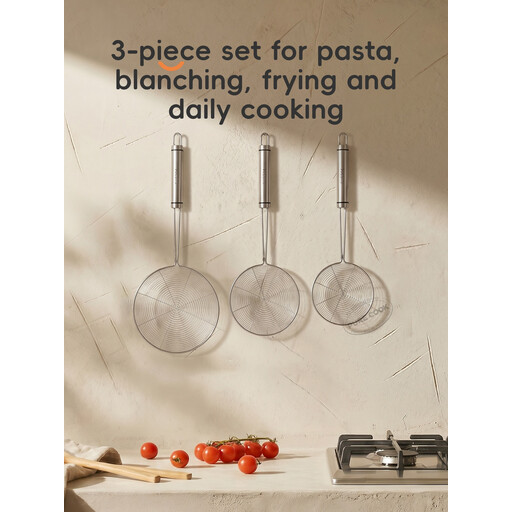
Why This Fits Their Persona: A practical match for households that regularly cook noodles, dumplings, blanch vegetables, hot-pot meals or fried food.
The three listed sizes—12 × 35.5cm, 13.2 × 39cm and 15.5 × 40.5cm—provide task-specific choice rather than relying on one oversized utensil.
304 stainless steel, dense woven mesh and hanging holes for storage.
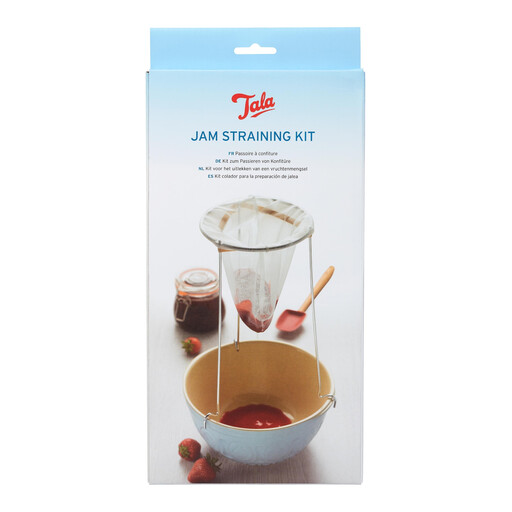
Why This Fits Their Persona: Designed for home preservers making jam, jelly, chutney or fruit sauces who need a dedicated setup rather than an improvised cloth and bowl arrangement.
The set includes both a stainless steel stand and a fine-weave nylon bag, so the support components are specified rather than assumed.
Dedicated pulp-and-seed filtering bag, stable stand and listed 11 × 11 × 17cm dimensions.
We have compiled a complete, real-time list of products that fully satisfy these strict selection criteria and UK safety regulations.
A kitchen strainer is a broad term covering sieves, mesh strainers, slotted spoons and draining baskets. A colander normally has a larger bowl and drainage holes for pasta, vegetables and fruit. A fine mesh sieve is more suitable for flour, small grains and filtering sauces.
A suitably sized colander or stainless steel skimmer can be used for pasta, depending on the design. Check the handle, hole size and heat warnings first. A small fine mesh sieve may not provide enough capacity for a full pan.
There is no fixed replacement period. Replace it when the mesh is torn, the rim becomes sharp, joints loosen, rust-like spots cannot be removed, or the basket no longer sits securely. Regular cleaning and drying can help preserve the material and finish.