
24/7 Customer Support

Free returns

Same-day & Next-day Delivery

Quality Guaranteed

Unlock Your Welcome Offers: FREE Delivery | Up to 80% OFF | Free 30-day JoyPlus trial
Download the APP
A kitchen thermometer can remove guesswork from roasting, baking, preserving and frying, but choosing the wrong type may leave you with an expensive gadget that rarely gets used. A probe thermometer is useful for meat, for example, but it will not tell you whether your oven is running hot. An infrared model can measure a pan surface, but it does not measure the temperature inside a joint of meat.
Before buying, consider the cooking task first, then check the thermometer’s temperature range, construction and reading method. This guide explains the common buying traps and highlights practical options for UK kitchens.
Temperature measurement methods are not interchangeable. An oven thermometer sits inside the oven and monitors the surrounding air. A meat thermometer uses a probe inserted into food. A jam thermometer or confectionery thermometer is designed to remain in hot liquid while sugar or preserves reach a particular stage.
An infrared thermometer measures surface temperature without contact. This can be useful for a pizza stone, frying pan or barbecue grate, but it does not measure the internal temperature of food. If a product is marketed as a universal solution, check precisely what it can measure.
A quick digital reading is convenient, but speed alone does not make a thermometer suitable for your recipe. Check the full operating range in Celsius and whether it covers the temperatures you need.
For example, frying oil may require a thermometer that reaches around 180–200°C, while confectionery tasks can require readings at the upper end of that range. A basic food temperature gauge may be sufficient for roasting, but not for caramel, toffee or deep-frying.
A thermometer can only provide useful information when positioned correctly. An oven model should be visible and placed where it is not touching the oven wall or heating element. A probe should reach the centre of the food without touching bone or the cooking tray. A liquid thermometer should be submerged to the manufacturer’s marked level.
Also inspect the materials. Stainless steel is practical for regular kitchen use, while glass sections require careful handling. For frying, choose a design that can be clipped securely to the pan and keep the display or handle away from hot oil.
Look for a temperature range suited to your cooking habits. A dual Celsius and Fahrenheit scale is useful if you follow recipes from different sources. For preserving and confectionery, clear stage markings such as soft ball or soft crack can be more helpful than a bare numerical scale.
An oil temperature thermometer should be readable while the pan is on the hob. For oven monitoring, a large dial may be easier to check through the door than a small digital screen.
A stainless steel kitchen thermometer should have a finish suitable for repeated kitchen use. Check whether the probe is food-safe, whether the unit is dishwasher-safe and whether the sensing area must be protected from water.
A clip, stand or hanging hook can make a considerable difference. It keeps the thermometer stable and leaves your hands free, particularly when preparing jam or hot sugar. For infrared devices, check the distance-to-spot ratio and emissivity adjustment if you intend to measure different surfaces.
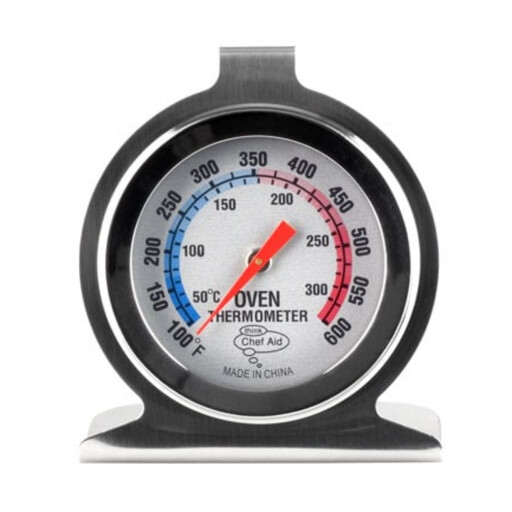
Why This Fits Their Persona: A straightforward choice for UK households that want to check an oven’s internal temperature without batteries or complicated controls.
It is designed specifically for oven-air readings rather than presenting itself as a substitute for a meat or surface thermometer.
Large colour-coded dial, Celsius scale up to 240°C, stainless steel construction and hang-or-stand positioning.
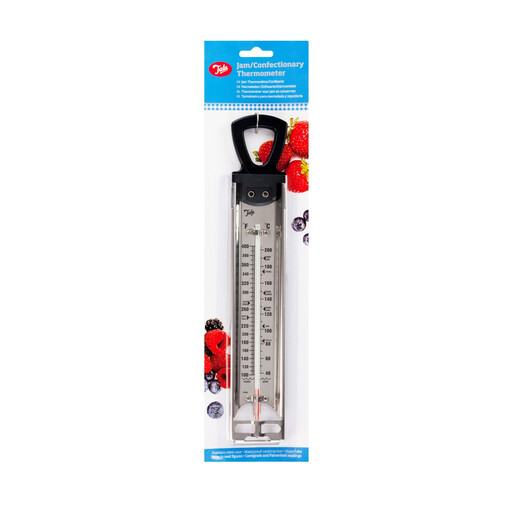
Why This Fits Their Persona: Suitable for home preservers, bakers and confectionery makers who need marked stages rather than a basic temperature display.
Its 40°C–200°C range and dedicated jam and sugar-stage markings make the intended use clear.
Food-safe stainless steel and glass, mercury-free construction, dual Celsius/Fahrenheit scale and a practical pan clip.
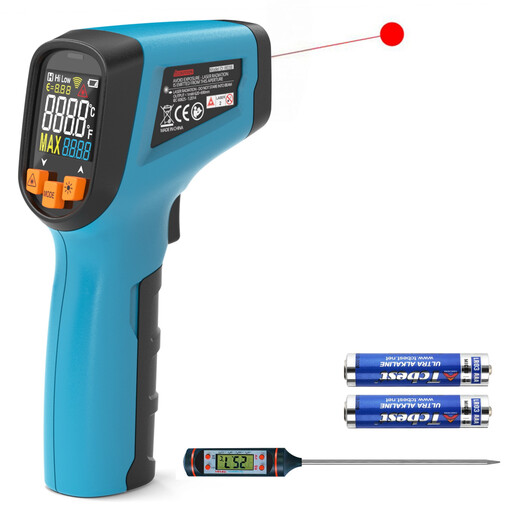
Why This Fits Their Persona: A multi-purpose option for barbecue users, pizza oven owners, DIY users and cooks who regularly check hot surfaces from a distance.
The stated surface-measurement function is paired with an included meat thermometer, clarifying that internal food readings require the probe.
-50°C to 600°C range, adjustable emissivity, 12:1 distance-to-spot ratio, backlit colour display and temperature alerts. It is not for humans or animals.
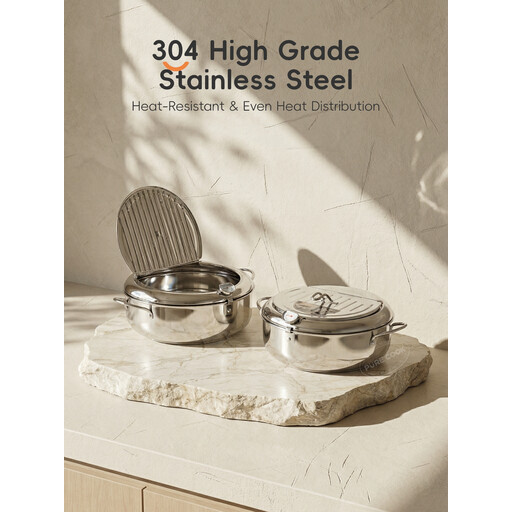
Why This Fits Their Persona: Designed for cooks who fry regularly and prefer an integrated oil temperature thermometer rather than a separate loose tool.
The built-in Celsius probe is positioned for real-time oil monitoring, while the deep design helps contain oil during use.
304 stainless steel body, 24cm diameter, induction-compatible composite base and dishwasher-safe construction. Follow the supplied frying safety guidance.
We have compiled a complete, real-time list of products that fully satisfy these strict selection criteria and UK safety regulations.
Keep hot oil, sugar syrup and heated cookware away from children and use long utensils where appropriate. Do not rely on an infrared thermometer for internal food temperature. For an analogue glass thermometer, check it for cracks before use and follow the cleaning instructions.
When checking meat, insert the probe into the thickest part and avoid contact with bone. Clean the probe between foods, especially when moving from raw to cooked ingredients. If you are using a frying thermometer, avoid overfilling the pan and allow oil to cool completely before cleaning.
It can be useful if you regularly check meat, bread or rapidly changing temperatures. A digital probe usually offers a quick numerical reading and is easy to use for spot checks. For monitoring an oven or a pan of jam, an analogue model with a stand or clip may be more suitable.
Lifespan depends on construction, storage and cleaning. Stainless steel models can remain useful for many years when kept dry and handled carefully. Digital thermometers also require battery replacement and should be protected from water unless specifically marked as water-resistant.
A battery-free oven thermometer does not require electricity. It simply provides an independent reading while the oven is operating. It may help you identify whether the oven dial needs adjustment, but it does not alter the oven’s energy consumption by itself.