
24/7 Customer Support

Free returns

Same-day & Next-day Delivery

Quality Guaranteed

Unlock Your Welcome Offers: FREE Delivery | Up to 80% OFF | Free 30-day JoyPlus trial
Download the APP
A reliable temperature reading can make the difference between crisp pastry and a soggy centre, properly set jam and a runny preserve, or evenly cooked food and an overdone exterior. However, buying kitchen thermometers is not simply a matter of choosing the widest temperature range.
Home cooks, bakers and BBQ users can waste money on products that look versatile but are unsuitable for the job. Before choosing an infrared thermometer gun, oven thermometer or meat thermometer, check how it measures temperature, where it can be used and whether its construction suits repeated kitchen use.
A thermometer that measures from very low to very high temperatures may appear convenient, but its format still matters. An infrared thermometer reads the surface temperature of an object without contact. It does not measure the temperature at the centre of a joint of meat, a loaf or a pan of jam.
For internal food readings, choose a probe-based cooking thermometer. For checking hot oven walls, pizza stones, grills or workshop surfaces, a non-contact infrared model may be more practical.
Infrared readings can vary according to the material and finish being measured. Shiny metal, reflective trays and polished surfaces may produce less dependable readings if the thermometer is not configured correctly.
An adjustable emissivity thermometer allows the user to alter the emissivity setting for different surfaces. This does not remove the need for sensible positioning, but it provides more control than a fixed-setting model. Always follow the product instructions and avoid treating an infrared reading as an internal food temperature.
A cheap-looking dial may be difficult to read through an oven door, while a long jam thermometer without a secure clip can move around in a deep pan. Consider whether the thermometer can stand, hang or clip in the position required.
For food-contact products, look for clearly stated food-safe materials. Stainless steel probes are a practical choice, while glass sections should be handled carefully and checked for damage before use.
A meat thermometer, baking thermometer or confectionery thermometer uses a probe that must be inserted into the food or liquid. This is the appropriate design for checking the internal temperature of roasts, bread mixtures, sugar syrup, frying oil and preserves.
An infrared thermometer gun is suitable for fast surface checks, such as a pizza oven floor, BBQ grate, frying pan exterior or radiator. It should not be used to measure humans or animals unless the product is specifically designed and approved for that purpose.
Match the range to the task rather than paying for unused capacity:
A dual Celsius and Fahrenheit display can be helpful in UK kitchens when following recipes from different sources.
For infrared models, the distance-to-spot ratio indicates how large the measured area becomes as the thermometer is held further away. A 12:1 ratio, for example, measures a smaller area from a given distance than a lower ratio. Aim at a broad, consistent surface where possible.
Response time is useful when checking several areas quickly, but it should not be confused with guaranteed accuracy in every situation. Also check the stated accuracy, battery type, display visibility and whether the thermometer switches off automatically.
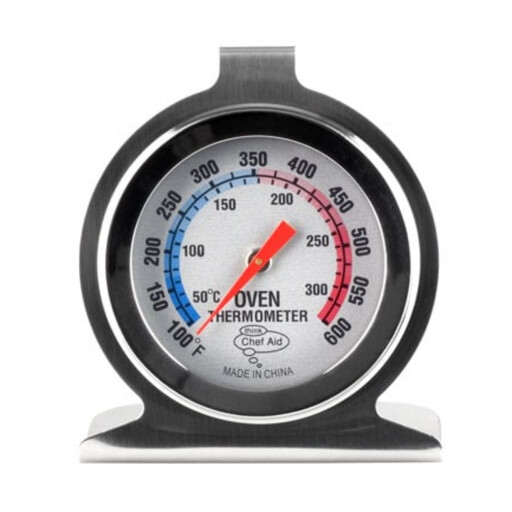
Why This Fits Their Persona: A straightforward choice for UK households that want to check a fan, gas or electric oven without adding batteries or complicated settings.
Its independent analogue display helps reveal whether the oven dial is running hotter or cooler than expected, while the hanging or standing design makes positioning simple.
Battery-free operation, stainless steel construction and a colour-coded dual Celsius/Fahrenheit dial reaching 240°C.
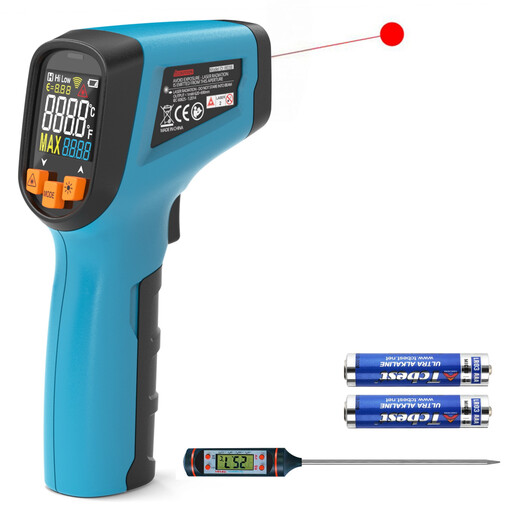
Why This Fits Their Persona: Suits cooks, pizza makers, BBQ users and DIYers who want rapid surface readings across the kitchen, garage or workshop.
The adjustable emissivity range of 0.1–0.99 addresses different surface finishes, while the separate probe handles internal food readings that infrared cannot provide.
Listed range of -50°C to 600°C, 12:1 distance-to-spot ratio, Celsius/Fahrenheit switching, backlit display and a 30-second auto-off function.
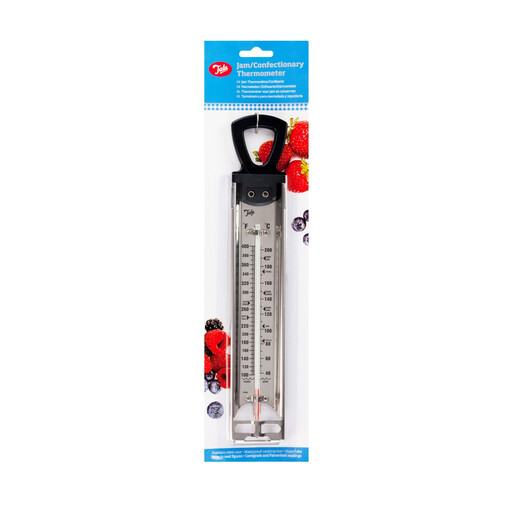
Why This Fits Their Persona: Designed for preserving enthusiasts, sweet makers and home cooks who regularly work with jam, caramel, toffee or frying oil.
Its clip helps keep the thermometer positioned in the pan, and the marked confectionery stages reduce reliance on vague visual estimates.
40°C–200°C range, dual Celsius/Fahrenheit scale, mercury-free construction, stainless steel components and jam, sugar and frying guidance.
Place an oven thermometer near the centre of the oven, away from direct contact with an element or flame. Allow the oven to reach temperature before comparing the reading with the control dial. For repeated checks, use the same shelf position so that results are easier to compare.
When using a probe thermometer, insert the tip into the thickest part of the food without touching bone, the pan or a hot surface. Clean the food-contact probe after every use, following the manufacturer’s care instructions. Do not immerse electronic housings unless they are specifically described as waterproof.
For infrared readings, keep the lens clean, hold the device at the recommended distance and aim at a flat area. Steam, smoke, reflective metal and uneven surfaces can affect readings.
We have compiled a complete, real-time list of products that fully satisfy these strict selection criteria and UK safety regulations.
A mechanical oven thermometer can remain useful for years if its dial, glass and casing stay intact. Digital models depend on batteries, switches and display components, so their lifespan varies with storage and use. Replace any thermometer that has cracked glass, a damaged probe or readings that cannot be reconciled with a known reference.
They are useful for measuring surface temperatures, including BBQ grates, pizza oven floors and pans. They are not suitable for confirming the internal temperature of meat or other food. Use a separate probe meat thermometer for internal readings.