For black tea in a holiday cottage, choose a digital countdown timer that is easy to set and read, with an alarm you will notice. The UK Tea & Infusions Association recommends a 3–4-minute infusion for black tea, so a 99-minute-59-second range is ample; adjustable volume and flexible placement matter more if you might leave the kitchen, while extended timing is useful only if you have other tasks for it.
Who needs which features?
Tea drinkers who want a straightforward countdown
If you mainly want to stop watching the clock, look for a short countdown that is quick to set and easy to read. The UK Tea & Infusions Association recommends 3–4 minutes for black-tea infusion; Salter describes a 99-minute-59-second range on its Big Button timer.
Guests who might miss the alarm
If you step away from the kitchen or share a noisy space, consider an audible alert suited to those surroundings. Salter specifies three volume levels for its Loud Digital Kitchen Timer, while Lakeland describes its Extra Loud model as having an extra-loud beep.
Guests with limited worktop space
If the cottage kitchen has little room beside the kettle, a timer that stands freely or attaches to a suitable metal surface gives you placement options. Check that you can see it from where you prepare the tea.
What to check when choosing
Start with a countdown you can set and read comfortably, then consider the alarm, where the timer will sit and how its battery is secured.
| Concern | What to check | Who this matters to |
|---|
| Quick, legible timing |
Check for a countdown mode, a readable display and controls you can set comfortably for a short infusion. |
When making a pot of tea, I want to set a few minutes without struggling to read the controls. Around 36% of consumers put quick, legible timing first. |
| Alarm audibility |
Look for a clearly described audible alert; check for volume adjustment if a fixed loud alarm could disturb other guests. |
If I leave the kitchen while tea brews, I need to notice the alert without making it intrusive for everyone else. Hearing the alarm is the main concern for around 29% of consumers. |
| Placement and portability |
Check whether the timer stands freely or has a magnetic back, and whether your intended location is stable, dry and visible. |
In an unfamiliar kitchen, I want somewhere I can see the timer without losing preparation space. Flexible placement comes first for around 21% of consumers. |
| Battery and child safety |
Check the battery type and compartment design; keep any spare or used button batteries out of children’s reach. |
If children are staying in the cottage, I want the battery compartment secure before leaving the timer within reach. Around 14% of consumers place battery management and child safety first. |
Common buying mistakes
-
Choosing a long timing range for a short brew
The UK Tea & Infusions Association’s 3–4-minute black-tea guidance does not call for a multi-hour timer. Extra modes can make a simple countdown less straightforward.
Prioritise a readable countdown and an alarm; consider extended timing or extra reminders only if you will use them for other tasks.
-
Assuming a loud alarm has volume controls
An alert you can hear away from the kitchen may be disruptive in shared accommodation if its volume is fixed.
Check the exact model’s controls. Salter specifies three volume levels for its Loud Digital Kitchen Timer, but a loud alarm does not necessarily mean adjustable volume.
-
Relying on a magnet without checking the surface
Magnetic placement requires a suitable metal surface in a location where you can see the timer.
If you do not know the cottage layout, consider a timer that can also stand on a stable, dry worktop.
-
Overlooking the battery compartment
Loose button batteries present a serious ingestion hazard for children.
Check that the compartment is intact and secure, and keep spare and used button batteries out of children’s reach. The UK Office for Product Safety and Standards says used button batteries should go to a collection point, not household rubbish.
Relevant brands to consider
Salter
Its kitchen-timer range includes straightforward digital models and timers with more prominent alarms or longer ranges.
- Salter describes a 99-minute-59-second countdown and magnetic or freestanding placement for its Big Button model.
- Its Loud Digital Kitchen Timer has three stated volume levels; check the exact model rather than assuming those controls are shared across the range.
Lakeland
Its own-brand Extra Loud Digital Kitchen Timer is aimed at buyers who want an easy-to-read timer with a prominent alert.
- Lakeland describes count-up and countdown operation to 99 minutes 59 seconds, plus magnetic or freestanding placement.
- The extra-loud beep is Lakeland’s product description, not a measured comparison of alarm volume.
Heston Blumenthal Precision by Salter
The cited 3-in-1 timer is intended for longer cooking sessions and outdoor use as well as short kitchen tasks.
- Salter specifies IPX5 water resistance and a timing range up to 99 hours 59 minutes 59 seconds for this model.
- Those additional functions are unnecessary for an ordinary tea infusion and introduce more modes to learn; water resistance does not mean the timer can be immersed.
Joybuy product choices
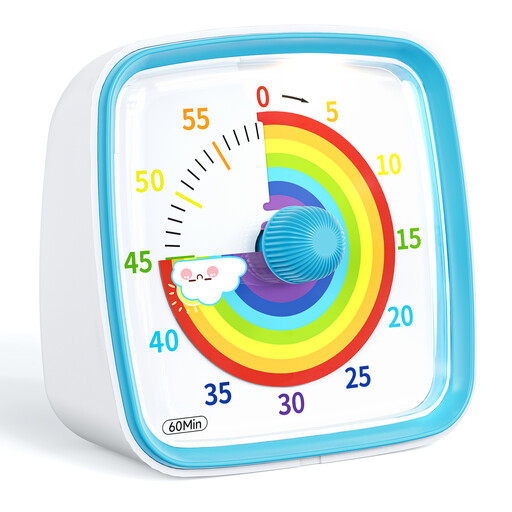
This visual countdown timer is an option if you prefer to see time passing while tea brews; check its short-interval setting if you need to time an infusion precisely.
 No image available
Yunbaoit Rainbow Visual Timer, 60-Minute, Blue Rainbow
For a short tea countdown, this model offers a visual disk and a stated 60-minute range.
Its description lists mute-flash, low and loud alert modes. Check whether its short-interval setting and any numeric readout meet your timing needs, and confirm how it can be placed in the cottage kitchen.
Check the battery type and compartment design before use, particularly if children may be present.
View on Joybuy
Questions about tea timers
How much countdown range do I need for tea?
A timer that can count down a few minutes covers the UK Tea & Infusions Association’s recommended 3–4-minute infusion for black tea. A 99-minute-59-second model has ample range for that task; consider longer timing only if you have other uses for it.
Is a loud alarm worth choosing for a holiday cottage?
A more prominent alarm is worth considering if you expect to leave the kitchen or have appliance noise nearby. In shared accommodation, check whether you can adjust the volume rather than relying on the word ‘loud’ in a model name.
Where can I put the timer while tea brews?
Place it somewhere dry and visible where you can hear its alert. A magnetic or freestanding model gives you options, but check the actual metal surface before relying on the magnet.
What should I check if children are staying in the cottage?
Check that the timer’s battery compartment is intact and secure, and keep spare and used button batteries out of children’s reach. The UK Office for Product Safety and Standards advises taking used button batteries to a collection point rather than putting them in household rubbish.


