Batch jam makers
If you weigh several ingredients into a large bowl or pan, allow capacity for the container as well as its contents. Tare or add-and-weigh can help you keep track as you add ingredients.


For most home jam batches, start with a digital kitchen scale with a stated capacity of at least 5 kg and a tare function, provided the bowl and ingredients together stay within that limit. Check that you can read the display behind your preserving bowl; consider a higher-capacity scale, a bowl scale or a battery-free design when your batch size, container or preferred operating routine calls for it.
If you weigh several ingredients into a large bowl or pan, allow capacity for the container as well as its contents. Tare or add-and-weigh can help you keep track as you add ingredients.
If you make jam occasionally, a scale that folds or stores with its bowl may be easier to put away between batches. Check that its capacity still covers your intended load.
A battery-free scale avoids battery replacement, but the operating routine matters: Brabantia’s dynamo-powered Tasty+ Kitchen Scales Plus requires you to turn a knob to generate power before weighing.
Start with the heaviest bowl-and-ingredient load you expect to weigh. Then check how you will zero the container, read the display and store the scale between batches.
| Concern | What to check | Who this matters to |
|---|---|---|
| Usable capacity | Compare the maximum load with the bowl and heaviest expected ingredient load together; leave room for additions. | If I use a large preserving bowl, I need the scale to accommodate the bowl as well as the fruit before I add more ingredients. Around 31% of consumers put capacity first. |
| Tare and display visibility | Confirm a tare or add-and-weigh function, and check whether your bowl would hide the display. | When I add fruit and sugar in stages, I want to reset the reading and still see it clearly behind the bowl. Around 31% of consumers prioritise that weighing workflow. |
| Storage and cleaning | Check stored dimensions or bowl nesting, alongside the exact model’s cleaning instructions. | With limited storage and only occasional jam batches, I want the scale to pack away and be practical to wipe down afterwards. For around 23% of consumers, storage and cleaning are the primary concern. |
| Power and operation | Check the battery requirements or how a dynamo-powered or mechanical model is operated. | If I would rather avoid replacing batteries, I need to be comfortable winding a dynamo or reading a mechanical dial. Around 15% of consumers put the power arrangement first. |
The container counts towards the maximum load, even after you reset the display to zero. A 5 kg limit may therefore be reached before you have added the full recipe quantity.
Estimate the weight of your empty container and choose a stated capacity that covers it together with the largest load you expect to weigh.
Maximum load, graduations, tare and display arrangements vary by model. A digital display alone does not establish that a scale has 1 g graduations or add-and-weigh.
Check those features for the exact model and variant, particularly if you intend to add ingredients in one bowl.
Brabantia’s dynamo-powered Tasty+ Kitchen Scales Plus needs manual power generation, while Judge’s cited traditional scale uses a sprung dial. Neither operates like a battery-powered digital model.
Decide whether winding a control or reading a dial suits the way you weigh ingredients, and check the power requirements of any battery-powered alternative.
GOV.UK states that domestic scales cannot be used to weigh goods intended for sale. This matters if you weigh jam for a sale, rather than making it for personal use.
Ask your local Trading Standards service about appropriate weighing equipment before using weights to sell jam.
Salter offers digital, bowl and mechanical kitchen-scale designs for comparing capacity and weighing functions.
OXO’s Everyday Glass Food Scale is a 5 kg digital option with tare and a backlit display.
The Tasty+ line includes both a battery-powered digital scale and a dynamo-powered alternative.
Judge has cited 5 kg models in both digital bowl and traditional mechanical formats.
Lakeland’s EasyStore Folding Scales are relevant where storage space is limited.
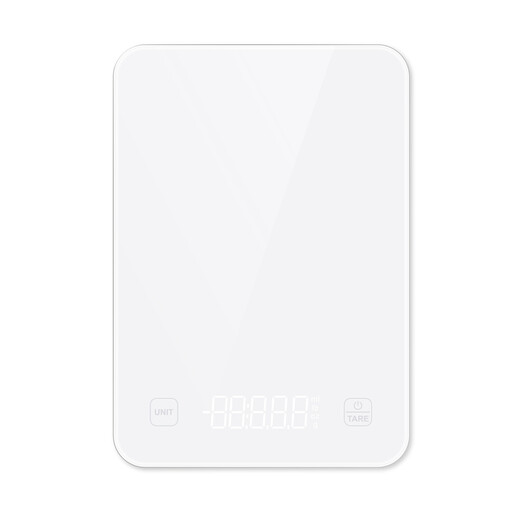
This scale has a stated 10 kg capacity for jam makers weighing a larger bowl-and-ingredient load. Check its weighing workflow against the way you prepare your batches.
 No image available
Consider its stated 10 kg capacity if your bowl and ingredients together need more than a 5 kg limit; the total load must still stay within 10 kg.
The product listing states 1 g precision, multiple weighing units, a tempered-glass surface and Bluetooth app integration. Check app compatibility if you plan to use that feature.
If you add ingredients in stages, confirm the tare function and check that the display remains visible with your bowl. Check its power requirements and stored size if those affect your choice.
A 5 kg scale can be enough if everything on it—the bowl and the ingredients already added—stays within 5 kg. Work from your largest expected combined load, not the weight of the fruit alone.
Tare lets you zero the bowl or reset the reading between additions, so you can weigh ingredients in stages without subtracting the container weight yourself. Confirm that the exact scale offers tare, zero or add-and-weigh.
Follow the instructions for your particular model. For the Haden White Digital Kitchen Scale listed by Joybuy, the care guidance says to wipe its glass surface with a damp cloth, without immersing the scale or using abrasive cleaners.
No: GOV.UK says domestic scales cannot be used to weigh goods intended for sale. If you plan to sell jam by weight, ask your local Trading Standards service about suitable weighing equipment; this is separate from weighing ingredients for jam you make for personal use.