
24/7 Customer Support

Free returns

Same-day & Next-day Delivery

Quality Guaranteed

Unlock Your Welcome Offers: FREE Delivery | Up to 80% OFF | Free 30-day JoyPlus trial
Download the APP
Bringing a new kitten home is an exciting time, but navigating the aisles of kitten food can be overwhelming. With so many brands making bold claims, it's easy to feel lost. As a new kitten owner, your priority is providing the right nutrition for healthy growth, but marketing jargon can often lead to confusion and poor choices.
At Joybuy, we help you cut through the clutter. This guide will highlight the common pitfalls to avoid when buying kitten food and break down the essential factors you need to check, ensuring you make a confident choice for your new companion.
Before you add anything to your basket, be aware of these frequent marketing traps that can mislead even the most careful shoppers.
grain free kitten food has become a popular buzzword, suggesting it is automatically a healthier option. While some kittens may have specific sensitivities, grains like rice and corn are not inherently bad. They can be valuable sources of energy and nutrients. The real focus should be on the overall quality and digestibility of the ingredients, particularly the protein source, rather than the simple presence or absence of grains.kitten milk, are designed to be given alongside a complete diet and lack the full nutritional profile for sustained health. Mistaking a complementary treat for a complete meal can lead to nutritional deficiencies.To ensure your kitten gets the right start in life, focus on these three non-negotiable factors when examining a product.
Kittens have immense energy and growth requirements. Their diet must be rich in high-quality protein to build strong muscles and organs.
dry kitten food: Look for a protein content of 30% or higher.wet kitten food: Aim for a protein content of 8% or higher.Fat is another crucial energy source and is vital for absorbing fat-soluble vitamins. Look for the inclusion of DHA (docosahexaenoic acid), an omega-3 fatty acid often found in fish oil, which is essential for brain and vision development.
The ingredients list is your most powerful tool. It is ordered by weight, so the first few ingredients make up the bulk of the food.
A food labelled simply "cat food" is not suitable for a growing kitten. Always choose a product specifically formulated as complete kitten food for growth, designed for kittens up to 12 months old. These formulas contain the higher levels of calories, protein, vitamins and minerals that kittens require. Many are also suitable for pregnant or lactating queens, who have similarly high nutritional demands.
To help you choose, we've matched some suitable products to common UK kitten owner profiles.
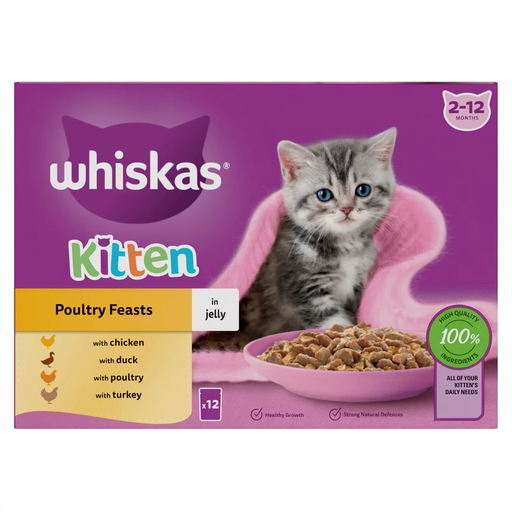
Why This Fits Their Persona: This is a widely available and affordable option that provides a complete and balanced diet. The multi-pack of kitten food pouches with different poultry flavours is great for discovering what your new kitten enjoys without a large initial outlay.
It is clearly labelled as a complete food for kittens, removing the risk of nutritional gaps. While it uses "meat and animal derivatives," it specifies the percentage of the named meat (e.g., 4% chicken), offering a degree of transparency at an affordable price.
Formulated with calcium for bone development and taurine for heart and eye health. The small, soft pieces in jelly are easy for young kittens to eat.

Why This Fits Their Persona: For owners who prioritise natural ingredients and high meat content, this selection is an excellent fit. It's made with UK-sourced meat and is free from grains, salt and sugar, making it a premium choice for a kitten's diet.
This food directly counters the "vague meat" trap by listing very high percentages of named meats (e.g., "UK Chicken Breast Slices 58.5%"). It provides total transparency, so you know exactly what you are feeding your kitten.
Features an impressive 14.5% protein content from high-quality sources. The inclusion of 4% salmon oil provides a rich source of DHA for cognitive and visual development.
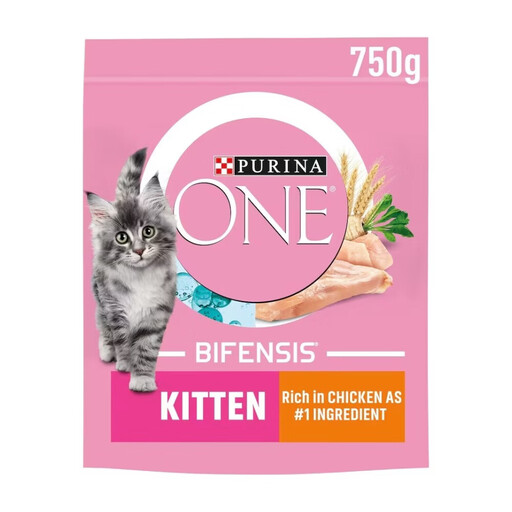
Why This Fits Their Persona: Ideal for owners who want to combine wet and dry food. This high-quality dry kitten food provides a nutrient-dense base that supports dental health through its crunchy texture, while also being convenient for free-feeding.
This product avoids the vague labelling trap by listing "Chicken (17%)" as its number one ingredient. It is also clearly positioned as a complete kitten food for growth, suitable for use on its own or as part of a mixed feeding routine.
An exceptionally high protein content (41%) fuels rapid growth. It also contains DHA, plus prebiotics and a gut flora stabiliser to support a healthy digestive system.
We have compiled a complete, real-time list of products that fully satisfy these strict selection criteria and UK safety regulations.
The correct amount depends on your kitten's age, weight and activity level, as well as the specific food you are using. Always check the feeding guide on the packaging for a starting point. Kittens have small stomachs and high energy needs, so it is generally advisable to feed them small meals several times a day.
No, you should never give a kitten cow's milk. Most cats are lactose intolerant, and cow's milk can cause severe digestive upset, including diarrhoea. If you need to supplement your kitten's diet, only use a specially formulated kitten milk substitute, such as Beaphar Lactol Kitten Milk, which has reduced lactose and is fortified with the right nutrients.
You should continue feeding your kitten a diet formulated for growth until they are around 12 months old. At this point, their nutritional needs change as they reach maturity. When you make the switch to adult food, do it gradually over 7-10 days by mixing increasing amounts of the new food with the old food to prevent any digestive issues.