Close-detail knitting tutors
If viewers need to follow individual stitches, yarn placement and hand movements, assess close focus and framing from your fixed overhead position rather than relying on the camera body’s resolution alone.


Choose the lens and overhead support around the space above your table before choosing a camera for its video resolution. Canon specifies a 15 cm minimum focusing distance at 30 mm for the RF-S 14-30mm PZ lens, making it a useful option to assess for stitch close-ups; Sony’s ZV-E10 II offers an interchangeable-lens route with 4K up to 60p, while Panasonic’s G100D offers 4K at 25p or 30p. Whichever route you consider, check that the exact lens can focus and frame both your hands and the knitting from your planned camera height.
If viewers need to follow individual stitches, yarn placement and hand movements, assess close focus and framing from your fixed overhead position rather than relying on the camera body’s resolution alone.
When you film without someone behind the camera, you need a mounting position and a way to check the shot that let you keep the work area in frame without repeatedly moving the setup.
If you plan to record demonstrations now and connect a camera to a computer later, check the exact model’s connection and streaming options before choosing a workflow.
Start with the distance available above the knitting: the lens must focus there and provide the views your demonstration needs. Then check how you will support, monitor and record with the assembled camera.
| Concern | What to check | Who this matters to |
|---|---|---|
| Close focus and framing | Compare the exact lens’s minimum focusing distance and the views it gives from your planned overhead height. Canon specifies 15 cm at 30 mm for its RF-S 14-30mm PZ lens. | If individual stitches disappear in a wide shot, I need a closer view without losing focus; around 36% of consumers put close detail and framing first. |
| Solo setup | Check the assembled camera’s fit against the overhead support’s rated payload and reach, and whether you can see the screen from the knitting position. | Filming alone at a small table, I need to check the shot without repeatedly moving the camera; roughly 29% of consumers prioritise a repeatable solo setup. |
| Recording and live use | Choose the recording mode you need, then confirm the exact model’s computer connection and power arrangements for a live session. | If I may teach live as well as record, I need a connection that works with my computer; for about 21% of consumers, that workflow is the primary concern. |
| Future lens choices | Confirm the lens mount and whether the included lens meets today’s close-focus and framing needs before considering other lenses. | I want to change my shot style later, but the lens I buy now must still work above this table; around 14% of consumers place future flexibility first. |
A camera cannot show sharp stitch detail from your chosen height if its lens cannot focus at that distance. Canon’s stated 15 cm minimum at 30 mm applies to the RF-S 14-30mm PZ lens, not to other kit lenses.
Measure the planned camera-to-knitting distance and decide whether you need a whole-table view, a detail view or both. Check the exact lens against those positions.
A different lens may be needed if the selected one cannot provide the required view.
A recording mode does not determine how large the stitches appear in the frame or whether the work area is evenly lit. Panasonic lists 4K at 25p or 30p for the G100D; Canon and Sony list 4K up to 60p for the EOS R50 V and ZV-E10 II.
Choose a frame rate for how you intend to use the footage, then check the view, focus and lighting from the mounted position.
In-camera recording and a computer-connected live feed are different workflows. Canon describes streaming methods for compatible cameras, so confirm the method supported by the exact model you intend to use.
Check its USB or HDMI connection, computer compatibility and continuous-power needs before planning a live lesson.
The chosen connection may call for additional cables, a capture device or a power accessory.
If assistants, students or customers can be identified in a public-facing recording, privacy considerations may differ from filming only your own hands. The Information Commissioner’s Office discusses responsibilities where identifiable images are processed outside purely personal, family or household use.
Keep unintended people out of shot where possible, and check which privacy arrangements apply to your filming activity before recording or publishing identifiable people.
The EOS R50 V with the RF-S 14-30mm PZ lens is an interchangeable-lens option to assess when stitch close-ups are central to the lesson.
The APS-C ZV-E10 II is an E-mount option for creators who want to consider other lenses as their filming setup changes.
The LUMIX G100D with a 12-32mm kit lens is a compact interchangeable-lens option to consider for recorded tutorials.
These cameras offer different ways to record a small-table demonstration, from interchangeable-lens kits to an action camera with a flip display. Check close focus, the view from your available height and overhead-mount fit for the particular camera you choose.
 No image available
Consider this APS-C interchangeable-lens kit if you want to adjust the view from a fixed camera position. The product title specifies a 16–50 mm f/3.5–5.6 power-zoom lens and 4K/60p recording. Check the lens’s close focus at your planned height, the support’s fit and the recording media you will need.
 No image available
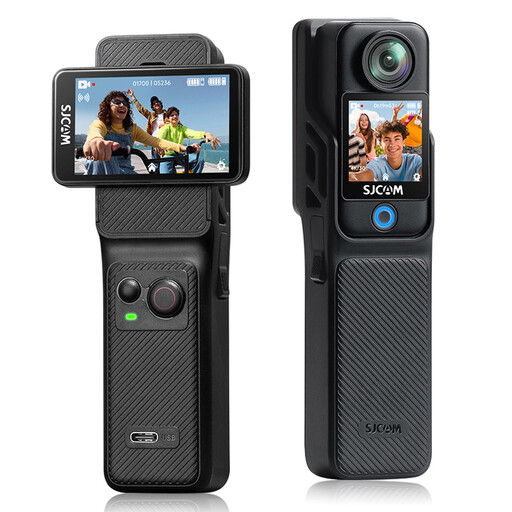
Consider this action camera if a flip display would help you check the shot while filming alone. Its product title specifies a 2.29-inch flip display. Before using it for stitch close-ups, check the lens’s focusing distance, the resulting tabletop view and how it attaches to your overhead support.
 No image available
This APS-C interchangeable-lens kit offers a zoom range for changing the view without moving a fixed camera. The product name specifies a 16–50mm power-zoom lens. Confirm its close-focus distance and the composition it gives from your overhead height; check support fit and any computer connection you intend to use.
 No image available
Consider this interchangeable-lens camera if you want zoom adjustment while recording from a fixed position. The product name identifies a 16–50mm power-zoom lens. Check whether that lens gives you both the table view and stitch detail you need, and confirm your mount and any live-connection requirements separately.
 No image available
This APS-C interchangeable-lens camera is an option if you want to check framing from a tilting screen. Confirm the lens supplied with this variant before choosing it: the product title gives 16–55mm, while other product information gives 16–50mm. Also check that lens’s close focus and the assembled camera’s fit on your overhead support.
Not necessarily: decide whether you need 60p footage before treating it as a requirement for a fixed, normal-speed demonstration. Panasonic lists 4K at 25p or 30p for the G100D, while Canon and Sony list 4K up to 60p for the EOS R50 V and ZV-E10 II; none of those modes replaces a lens and position that show the stitches clearly.
Assess the combination, starting with whether the exact lens can focus and frame the knitting from your overhead height. Canon specifies a 15 cm minimum focusing distance at 30 mm for its RF-S 14-30mm PZ lens; do not assume a different kit lens has the same specification.
You may be able to, but choose the camera against the connection you intend to use. Canon describes computer-connected streaming for compatible cameras; check the exact model’s USB or HDMI method, computer requirements and power needs before buying.
Use an overhead support whose stated payload and reach suit the assembled camera, lens and accessories. Secure it to a stable surface, keep cables from tugging on it and check stability and framing before working beneath it.
Keep unintended people out of the frame where possible and consider the privacy arrangements for anyone identifiable in a recording you plan to use publicly. The Information Commissioner’s Office discusses responsibilities for processing identifiable images outside purely personal, family or household use; which obligations apply depends on the filming activity.