Phone-first art organisers
If you make a few labels at a time for pens, paints or project supplies, designing them on a phone or tablet may suit you better than typing on the printer. Brother UK describes this app-led approach for its PT-P300BT.


Choose the way you will make labels before settling on a printer: a phone-led model suits occasional, visually styled labels, while a keyboard or computer-connected model suits repeated names for drawers and files. If larger boxes and shelves need prominent labels, check whether a wider tape is available. In every case, match the compatible tape to the container surface and the handling it will receive.
If you make a few labels at a time for pens, paints or project supplies, designing them on a phone or tablet may suit you better than typing on the printer. Brother UK describes this app-led approach for its PT-P300BT.
When drawers, folders and equipment need many straightforward names, a built-in keyboard can keep label entry on the device. The DYMO LabelManager 280 also offers computer connection, while Brother UK lists keyboard and connectivity options for the PT-D460BTVP.
For boxes and containers that are handled often, the tape and adhesive deserve as much attention as the printer. Check the compatible cassette, the container surface and likely exposure to moisture, sunlight or rubbing before labelling everything.
Start with how you will enter labels, then measure the smallest and largest places they need to fit. Choose a compatible tape material for the surfaces and conditions before committing to refills.
| Concern | What to check | Who this matters to |
|---|---|---|
| Adhesion and legibility | Confirm the printer’s tape family and choose a material for the container surface and expected handling. Test a label on the actual container. | If I frequently handle paint boxes or storage tubs, I need labels that stay attached and readable. Around 29% of consumers would put adhesion and durability first. |
| Phone-led design | Check app compatibility with your device and whether a width of up to 12 mm suits your smaller containers. | For small groups of art materials, I would rather design distinctive labels on my phone than type on a printer. Phone-led design would come first for around 29% of consumers. |
| Repeated text entry | Look for a built-in keyboard if you want standalone entry; check the stated computer compatibility if you plan to make layouts at your desk. | When I have many drawers and folders to name, I want to enter text without opening a phone app each time. Around 21% of consumers would prioritise that workflow. |
| Labels for larger storage | Measure the available flat area and compare the printer’s supported widths, including whether it accepts 18 mm tape. | A category name on my larger boxes or shelving needs to be easy to spot. Wider, more visible labels would be the primary need for around 21% of consumers. |
Similar-looking cassettes and rolls are not necessarily interchangeable. A printer may require a particular tape family, width or format.
Decide which label material and width you need, then check them against the exact printer model. Keep that model number for future refills.
An incompatible refill leaves you needing the correct cassette or roll before you can continue labelling.
Joybuy Insights notes that direct-thermal output can be affected by heat, sunlight, friction and some chemicals. Label life also depends on the material and where it is used.
For frequently handled art-supply containers, check whether a compatible laminated or permanent tape suits the conditions, then try one label on the actual surface.
Labels that become unreadable take time and tape to replace.
A phone-led model may suit decorative labels, but it puts every edit in the app. That may not fit a routine of repeatedly naming folders, drawers and boxes.
If text entry is the main task, compare a built-in keyboard and any computer connection with the phone-led workflow before choosing.
A width that works on a pen pot may not make a category name prominent on a storage box or shelf.
Measure the largest label area you plan to use. Brother UK lists up to 18 mm tape for the PT-D460BTVP, compared with up to 12 mm for the PT-P300BT; choose according to the space available.
Brother’s P-touch range includes the app-led PT-P300BT, which supports labels up to 12 mm, and the PT-D460BTVP, which supports up to 18 mm with a keyboard, Bluetooth and USB options.
The LabelManager 280 combines a built-in keyboard with optional PC or Mac customisation and accepts D1 labels in 6 mm, 9 mm and 12 mm widths.
Epson’s LabelWorks range includes office label makers. Its UK-listed LW-K400 had a QWERTY keyboard and supported widths from 6 mm to 18 mm.
These options cover portable labels for smaller art-material groups and a label printer to consider for desk-based filing. Check each model’s compatible labels against your containers before choosing.
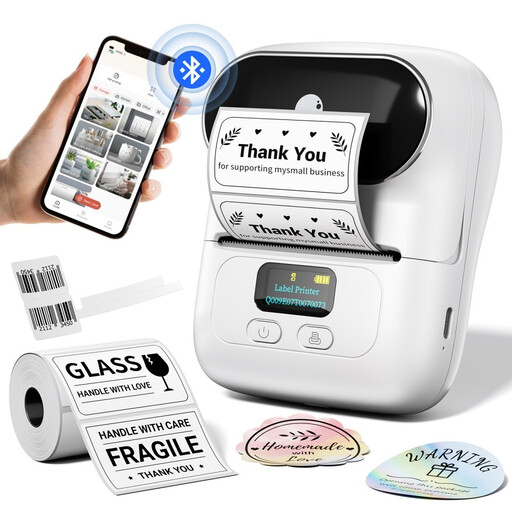 No image available
Consider this portable model if you are organising art materials alongside home-office folders or inventory labels.
One label roll is listed with the printer. Before labelling frequently handled containers, confirm which replacement labels fit and test one on the intended surface.
 No image available
This portable model is an option for labelling small art-material groups at home or in a craft room.
The product name specifies a 0.59-inch label width, not the widest tape the printer accepts. Check the supported widths and refills against your largest container, then test adhesion on its surface.
 No image available
Consider this model for desk-based filing labels if your art-material organisation also includes office folders.
Confirm which compatible rolls suit your containers and how their labels hold up to handling or light. Test a label on the intended surface before relying on it for long-term storage.
Match the width to the smallest container and the largest category label you need. Tape from 6 mm to 12 mm may suit pens, small jars and compact drawers; for larger boxes or shelves, consider whether 18 mm would be easier to read. Brother UK lists up to 18 mm for the PT-D460BTVP, while the PT-P300BT and DYMO LabelManager 280 support up to 12 mm.
It can, provided the tape suits the surface: DYMO says its D1 standard labels adhere to most clean, flat plastic surfaces. Check the exact tape’s compatibility with your printer, clean and dry the application area, and test one label on a textured or frequently handled box before making a full set.
Not necessarily: DYMO D1 labels use thermal-transfer printing without an ink or toner cartridge. Inkless printing does not make every label equally durable; Joybuy Insights notes that direct-thermal labels can be affected by heat, sunlight, friction and some chemicals.
No. Printers can require specific cassette families, widths or roll formats even when supplies look similar. Check the exact model and supported label series before buying refills; a matching width alone does not establish compatibility.