For occasional short bin labels made beside the shelving, start with a portable label maker; for many fixed bins that need repeatable formats or wider labels, consider a desktop or connected model. Choose the tape for the bin surface and workshop conditions before choosing the machine: a standard tape intended for clean, flat surfaces may not suit bins exposed to frequent rubbing, moisture or cleaning chemicals.
Who needs which setup?
Owners with hard-working workshop bins
If bins are handled, rubbed or cleaned regularly, focus on the compatible tape rather than design features alone. Brother UK describes its laminated TZe labels as resistant to water, abrasion and chemicals; check the tape specified for the machine you intend to buy.
Stock organisers labelling many fixed bins
If you need the same format across a rack or parts area, a model that accepts wider tape or lets you reuse label designs may be useful. Decide where labels must be readable from before choosing a maximum tape width.
Occasional on-the-spot labellers
If you make short bin names beside the shelves rather than at a desk, a portable machine can fit that workflow. Check whether it works without a connected computer and whether its tape suits the bins.
What matters when choosing?
Check the bin surface and exposure to cleaning or wear first, then decide how wide the labels need to be and where you will make them.
| Concern |
What to check |
Who this matters to |
| Label durability |
Match the compatible tape to the bin surface and its exposure to moisture, rubbing or cleaners. |
When bins are handled or cleaned often, I need their names to stay attached and readable. Around 42% of consumers would put label durability first. |
| Consistent labels for many bins |
Check maximum tape width and whether the machine can reuse label designs in your preferred workflow. |
For a rack of parts bins, I want labels I can read and reproduce without starting each one from scratch. For around 33% of consumers, consistent multi-bin labelling would be the primary concern. |
| Portability |
Check standalone operation, power method and the width available on a portable model. |
If I relabel bins as I move between shelves, I want to make short labels where I need them. Portability would come first for around 25% of consumers. |
Mistakes to avoid
-
Choosing the printer before the tape
DYMO UK describes standard D1 labels as adhering to most clean, flat surfaces, while Brother UK specifies resistance to water, abrasion and chemicals for its laminated TZe labels. Those tape descriptions address different conditions; neither makes every label suitable for every bin.
Inspect a representative bin and its cleaning routine, then choose a suitable tape family and a machine that accepts it. Try a label on the intended surface before labelling every bin.
-
Assuming a narrow label will be readable across the shop
According to Brother UK and DYMO UK, the Brother PT-E110VP and DYMO LabelManager 280 print labels up to 12 mm wide; Brother UK lists widths up to 18 mm for the PT-D460BTVP. Width matters when labels must be read from a rack rather than directly in front of the bin.
Measure the flat space on a bin and consider the intended viewing distance before settling on a machine’s maximum tape width.
-
Treating a contents label as a hazard label
A bin containing hazardous chemicals may need more information than an ordinary printed name. The Health and Safety Executive’s GB chemical-labelling guidance covers hazard statements, precautionary statements, signal words and pictograms.
Identify what the container holds and check the applicable Health and Safety Executive guidance before deciding how to label it; do not rely on a plain contents label where hazard information is required.
Brands to consider for workshop-bin labels
Brother
Brother’s P-touch range includes handheld and desktop approaches. Its TZe tape system is relevant when workshop bins face handling, moisture or cleaning.
- Brother UK states that laminated TZe labels resist water, sunlight, chemicals and abrasion under its stated product specifications.
- Tape width depends on the model: Brother UK lists up to 12 mm for the PT-E110VP and up to 18 mm for the PT-D460BTVP. Check the particular machine and tape combination rather than assuming all P-touch models take the same widths.
DYMO
DYMO’s LabelManager range offers a compact route for making bin labels, with different D1 tape choices for different surfaces and conditions.
- DYMO UK says standard D1 labels adhere to most clean, flat surfaces, including plastic and metal.
- DYMO UK lists a 12 mm maximum width for the LabelManager 280. Check whether the selected D1 cassette suits bins that are frequently handled or cleaned.
Epson
Epson’s LabelWorks tapes provide another tape-led option for equipment and workshop organisation.
- Epson United Kingdom describes its cited LabelWorks tape as resistant to water, scratching, chemicals and temperature changes.
- Check the tape width and compatibility with the exact LabelWorks printer before choosing a machine for your bins.
Joybuy label makers for workshop bins
These choices offer a portable way to make labels beside bins and a printer to consider for a fixed labelling station. For either approach, check compatible label stock against the bin surface and workshop conditions.
 No image available
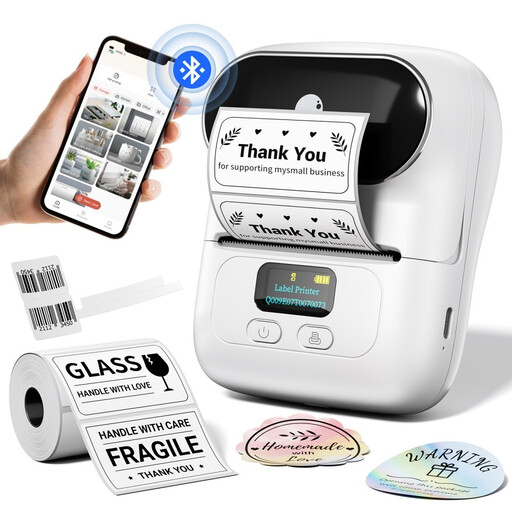
Phomemo M110 portable label maker with 1 label roll
Consider this portable model if you want to make bin labels beside the shelves. Before labelling workshop bins, check which compatible label stock suits their surfaces and any exposure to rubbing, moisture or cleaners; keep the printer itself away from moisture and extreme temperatures.
View on Joybuy
 No image available
Brother QL-600B label printer
Consider this model if you make repeated labels at a fixed workstation rather than carrying the printer between bins. Plan for its wired setup, and check that the compatible DK label stock suits the bin surface, handling and cleaning conditions.
View on Joybuy
Common questions
What label width should I choose for workshop bins?
A 12 mm label may work for short names read close to a bin; consider a machine accepting wider tape if you need to read labels from a shelf or rack. Brother UK lists up to 18 mm for the PT-D460BTVP, compared with up to 12 mm for its PT-E110VP, while DYMO UK lists up to 12 mm for the LabelManager 280. Check the flat area available on your bins as well as the viewing distance.
How should I label plastic workshop bins?
Apply machine-compatible tape to a clean, flat area and check that the tape suits the bin’s conditions. DYMO UK describes standard D1 labels as adhering to most clean, flat plastic surfaces; for bins exposed to rubbing, moisture or cleaners, check the chosen tape’s stated properties and try one label on the intended surface first.
Can a printed bin name replace a hazardous-chemical label?
Do not assume a plain bin name provides the hazard information needed for a container of hazardous chemicals. The Health and Safety Executive identifies hazard statements, precautionary statements, signal words and pictograms in its GB chemical-labelling guidance; check which requirements apply to the contents and container before printing labels.


