For short classroom tray names, a standalone label maker that takes up to 12 mm tape is a practical starting point; measure a tray front before deciding whether you need a wider label. A connected model is more useful when staff prepare repeated class sets than when they print occasional names at the trays. For handled or wiped plastic trays, check the compatible tape as carefully as the machine and try one label before making a full set.
Who needs which approach?
Teachers labelling one classroom set
If you mainly need short names or subject labels, a self-contained machine lets you work at the trays without setting up software. Brother UK Store lists the PT-D210VP with support for tape up to 12 mm wide; check whether that gives you enough space for text at the distance from which pupils will read it.
Staff standardising labels across classes
Repeated names and matching layouts make advance preparation more useful. DYMO UK describes PC/Mac use for the LabelManager 280, while Brother UK Store lists PC input for the PT-D450VP. Check compatibility with the devices staff can use.
Staff replacing labels on frequently handled trays
Focus on the tape and the tray surface, not just the machine. Brother describes resistance properties for its laminated TZe tapes, and DYMO describes D1 Permanent tape for plastic; neither claim establishes how a label will behave on every tray finish or with every cleaning product.
What matters when choosing?
Start with the space and text needed on the tray front, then decide how staff will prepare the labels and which compatible tape suits the surface.
| Concern | What to check | Who this matters to |
|---|
| Legibility and fit |
Measure the flat tray front and plan the text before checking the machine’s maximum tape width and cassette family. Brother UK Store lists up to 12 mm for the PT-D210VP and 18 mm for the PT-D450VP. |
When a tray must be read at a glance, I need a clear name that fits without crowding the front. Around 40% of consumers put legibility and fit first. |
| Repeatable preparation |
Decide whether staff will print at the trays or prepare class sets in advance. For a connected model, check its supported devices and software. |
If I label several classes, I want to prepare matching names without laying out each one again. Roughly 30% of consumers prioritise a repeatable workflow. |
| Durability on plastic |
Check printer–tape compatibility, the tape’s stated surface suitability and the school’s cleaning routine; try one label if the finish is textured or later removal matters. |
Where trays are handled or wiped regularly, I need labels that stay readable and attached on the actual surface. About 30% of consumers make durability their primary concern. |
Mistakes to avoid
-
Choosing the machine before planning the label
A machine’s maximum tape width limits the space available for text, while cassette families differ between models. A short name may fit on 12 mm tape; a larger or multi-line label may call for another width.
Measure a tray front, sketch one label and check the exact cassette family before choosing a machine.
Using different widths, colours or adhesive types may require different compatible tape cassettes.
-
Assuming every tape will withstand cleaning
Brother’s resistance claims for laminated TZe tape and DYMO’s plastic-surface claims for D1 Permanent tape do not guarantee the same result on every tray finish or under every cleaning routine.
Choose a compatible tape intended for the surface and try one label on a tray before labelling the whole set.
-
Choosing connectivity for mostly one-off labels
Computer or phone-based preparation can help with repeated layouts, but connection alone does not make a simple tray name more legible or its adhesive more suitable.
If staff usually print individual labels at the storage area, prioritise the needed width, tape and standalone input. Check device and software compatibility before relying on a connected workflow.
A connected workflow also takes staff time to set up and manage.
Brands to consider
Brother
Brother’s P-touch range includes the 12 mm PT-D210VP for straightforward labels and the 18 mm PT-D450VP, which Brother UK Store lists with keyboard or PC input.
- Brother describes its laminated TZe tapes as resistant to water, abrasion, chemicals and temperature extremes.
- Check tape width and cassette compatibility for the specific machine; wider tape or PC input need not help with a small set of short names.
DYMO
DYMO UK lists the LabelManager 280 for PC/Mac label preparation with D1 tape in 6 mm, 9 mm and 12 mm widths.
- DYMO describes its D1 Permanent tape as suitable for plastic surfaces and water resistant.
- The LabelManager 280’s stated maximum is 12 mm; compare wider-tape machines if the planned tray label needs more space.
Epson
Epson LabelWorks provides another tape-based system. Epson United Kingdom lists a 12 mm matte tape for the LW-C410 and LW-C610.
- Epson describes that tape as intended for durable labels.
- Epson United Kingdom marks the LW-C410 as discontinued. Confirm a current compatible machine, support and tape supply before choosing this system.
Joybuy product choices
These label printers offer different starting points for classroom tray labels, from computer-prepared formats to portable machines. Check the exact media and your tray surface before settling on one.
 No image available
Brother QL-600B Label Address Printer
Consider this printer if you plan to prepare tray labels at a computer rather than type them at the storage area.
Check the exact compatible roll’s size, adhesive and suitability for the tray material and cleaning routine.
View on Joybuy
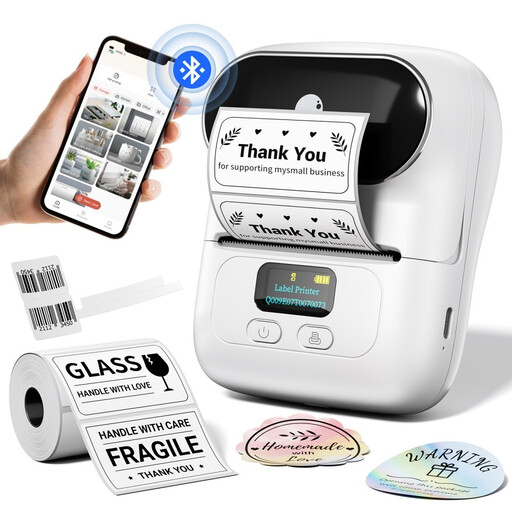 No image available
Phomemo M110 Portable Label Maker with one label roll
Consider this portable machine if staff want to prepare labels away from a fixed workstation.
One label roll is named in this variant. Check which compatible roll sizes, materials and adhesives suit the trays before making a class set.
View on Joybuy
 No image available
Phomemo D30 Portable Label Maker, 0.59 inch label width
Consider this portable model for compact tray labels if its mobile-device workflow suits the devices staff can use.
The named label width is 0.59 inch. Confirm the exact compatible media and its suitability for the tray surface and cleaning routine.
View on Joybuy
Questions about classroom tray labels
What tape width should I choose for classroom trays?
Choose after measuring the usable flat area and deciding how much text each tray needs. Brother UK Store lists the PT-D210VP for tape up to 12 mm and the PT-D450VP for tape up to 18 mm; a wider option is worth considering when the planned label needs more space.
Will label tape stick to plastic classroom trays?
Choose tape intended for the surface, but do not assume it will behave the same way on every plastic finish. DYMO describes D1 Permanent tape as adhering to plastic, while Brother describes resistance properties for laminated TZe tape. Check printer compatibility and try a label on the actual tray, particularly if it is wiped regularly or later removal matters.
Do I need a computer, app or Bluetooth connection?
Not for occasional names printed at the trays; standalone input can cover that task. Connection becomes more useful when staff prepare and reuse layouts for class sets. Check the school’s devices and software requirements before choosing a connected model.
Does a school label maker need a PAT test every year?
Do not assume every portable appliance needs an annual PAT test: the Health and Safety Executive specifically cautions against that blanket approach in low-risk environments. Follow the school’s electrical-equipment maintenance arrangements and check the label maker, plug and cable for visible damage before use.


