Who needs which setup?

Staff creating a full tray-labelling system

If you need consistent wording, categories or symbols across many trays, a computer-based layout workflow may matter more than carrying the machine between rooms. Brother describes batch label creation in P-touch Editor.

Staff replacing labels during activities

If you usually make only a few labels in different classrooms or storage areas, a rechargeable machine that works on its own may be more useful than a wider tape option. DYMO lists these features for the LabelManager 280.

Centres with frequently handled or wiped trays

Choose the label material as carefully as the machine. Brother and DYMO describe different properties for particular laminated or permanent-plastic tapes; check the cassette against the actual tray surface and cleaning routine.

What matters when choosing?

Decide where and how many labels you will make, then check the tape width and material against the trays.

Concern What to check Who this matters to
Labels on shared plastic trays Check the machine’s cassette family and the selected tape’s stated properties for plastic and cleaning exposure. Try one label on a tray. When trays are handled and wiped regularly, I want labels that remain legible and attached; around 42% of consumers put this need first.
Consistent labels for many trays Check computer connectivity and whether the label-design workflow supports reusable layouts or multiple labels. If I am organising a full set of trays, I need wording and layouts I can repeat without starting each label again. Roughly 33% of consumers prioritise that production workflow.
Relabelling between rooms Check standalone operation, the battery arrangement and supported tape widths. For a few changes during room setup, I need to make labels away from a desk; about 25% of consumers place that flexibility first.

Buying pitfalls to avoid

  • Choosing a printer before checking its tapes

    The Brother PT-D410 takes compatible TZe tapes, while the DYMO LabelManager 280 uses D1 cassettes. Tape width and material must be checked for the exact machine.

    Measure the tray front, decide what contrast and adhesive type you need, and confirm the cassette family before ordering.

    Replacement cassettes are an ongoing supply to plan for.

  • Assuming every compatible tape suits wiped trays

    Brother’s resistance claims concern its laminated TZe labels; DYMO distinguishes permanent-plastic D1 tape from other D1 options. Compatibility alone does not establish how a label will perform on a particular tray.

    Choose tape with stated properties suited to the intended exposure, then try it on the actual tray and with the centre’s cleaning routine before labelling the full set.

    Labels that lift may need reprinting and reapplying, taking staff time.

  • Making a discontinued model the new standard

    Epson lists the LabelWorks LW-K400 as discontinued. Its listed tape-width range does not, by itself, settle whether equipment and supplies will remain practical for a new centre-wide setup.

    If the centre already uses LabelWorks, check current machine availability, support and compatible tape supply before extending that setup.

  • Assuming electrical safety means an annual PAT test

    The Health and Safety Executive says electrical equipment must be maintained safely, but the law does not require annual portable appliance testing or set one fixed testing frequency.

    Follow the centre’s risk-based electrical-maintenance procedure, including visual checks and inspection or testing where appropriate.

Relevant brands for reference

Brother P-touch

Brother’s PT-D410 is a keyboard-equipped, PC-connectable option for creating a planned set of labels. Brother lists tape widths up to 18 mm for this model.

  • Brother lists USB connectivity and compatible laminated TZe tapes for the PT-D410. It says laminated TZe labels resist water, chemicals and abrasion.
  • That durability statement concerns the tape, not a tested result on your classroom trays. Check the cassette for the exact PT model.

DYMO LabelManager

The rechargeable LabelManager 280 can make labels on its own or connect to a computer, making it relevant to smaller jobs across different rooms.

  • DYMO lists 6 mm, 9 mm and 12 mm D1 label widths for the LabelManager 280. Its permanent-plastic D1 tape is described as suitable for plastic and water resistant.
  • D1 tape types differ. Check the selected cassette’s adhesive and stated properties rather than treating all compatible tapes alike.

Epson LabelWorks

LabelWorks may be relevant to a centre maintaining equipment it already owns.

  • Epson lists 6 mm to 18 mm thermal-transfer tape support for the LW-K400.
  • Epson identifies the LW-K400 as discontinued. Check machine availability, support and compatible tape supply before building a new system around it.

Joybuy label-maker options

These options cover portable tray-labelling and a printer to consider for a planned labelling session. Whichever workflow you choose, match the label supply to the tray front and test it against routine handling and cleaning.
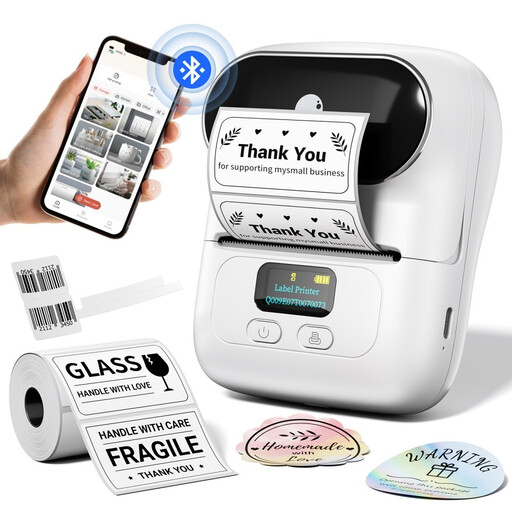
Phomemo M110 portable label maker with one label roll

Phomemo M110 portable label maker with 1 label roll

For staff making labels in different rooms, this is a portable option supplied with one label roll.

Check whether the chosen labels fit the tray fronts and how their adhesive performs on the tray material with routine wiping before making a full set.

View on Joybuy

Brother QL-600B address label printer

Brother QL-600B address label printer

For a planned run of tray labels, check whether its label-layout workflow suits the wording and layouts you need.

Confirm the compatible roll’s adhesive properties and try a label on the actual tray before printing the full set.

View on Joybuy

Phomemo D30 portable label maker with 0.59 inch label width

Phomemo D30 portable label maker, 0.59 inch label width

For occasional relabelling between rooms, check that the stated 0.59 inch label width accommodates your wording on the usable tray-front space.

Confirm that the chosen labels suit the tray material and cleaning routine before producing a full set.

View on Joybuy

Frequently asked questions

Should I choose a 12 mm or 18 mm label maker for classroom trays?

Choose a tape width that fits the flat part of the tray front and the wording you need. DYMO lists widths up to 12 mm for the LabelManager 280, while Brother lists widths up to 18 mm for the PT-D410; measure a tray and try a layout rather than assuming the wider option is necessary.

Do label makers need ink or toner?

DYMO says its D1 permanent-plastic labels use thermal-transfer printing and need no ink or toner. You will still need compatible cassettes, and tape types differ in adhesive and stated durability.

Will classroom-tray labels cope with wiping and frequent handling?

That depends on the selected tape and its performance on the actual tray. Brother describes its laminated TZe labels as resistant to water, chemicals and abrasion, while DYMO describes its D1 permanent-plastic tape as water resistant and suitable for plastic; try the chosen cassette with the centre’s cleaning routine before labelling every tray.

Does a community centre have to PAT-test a label maker every year?

No annual portable appliance testing interval is required by law, according to the Health and Safety Executive. Electrical equipment must be maintained safely, so follow the centre’s procedure for checks suited to the equipment and how it is used.