Small-batch craft organisers
If you have a manageable set of project, pattern or paperwork folders, direct typing and clear, compact labels may matter more than design options.


For a small set of file folders, start with a standalone label maker with a physical keyboard and tape that fits your tabs. If you want to prepare repeated designs on a phone, consider a connected model; if the same machine will also label boxes or shelves, check its wider-tape options. In every case, confirm the exact tape family, usable width and power arrangement before buying.
If you have a manageable set of project, pattern or paperwork folders, direct typing and clear, compact labels may matter more than design options.
If you organise materials by project, colour, season or category, you may want repeatable layouts and the option to prepare designs on a phone. Brother UK describes keyboard and Bluetooth options for its PT-N25BT.
If your filing system will extend to boxes, drawers or shelves, allow for those larger label surfaces when choosing a machine’s tape widths. Brother UK lists tape up to 24 mm wide for the PT-D600VP.
Measure a folder tab first, then decide how you want to make repeat labels and which replacement tapes suit the way your folders are handled.
| Concern | What to check | Who this matters to |
|---|---|---|
| Fit and readability | Measure the usable flat area of a tab or spine; check the machine’s supported tape widths and text layout. | If a title needs to sit neatly on a narrow tab, I want to read it without the label extending past the edges. Around 33% of consumers would put fit and readability first. |
| Repeat-label workflow | Choose between direct keyboard typing and phone or computer editing; check for stored designs if you will reuse layouts. | When I am naming many folders in the same style, I would rather reuse a layout than rebuild each label. Repeat-label convenience is the main concern for around 25% of consumers. |
| Tape and handling | Confirm the exact compatible tape family and the material’s stated suitability for your folder surface and handling conditions. | If folders are handled frequently or kept near messy craft supplies, I need to choose the label material as carefully as the machine. Around 25% of consumers would prioritise tape suitability and replacement supplies. |
| Room to expand | Check the maximum tape width and whether the machine can make labels for your planned boxes, drawers or shelves. | If my folder system will grow into larger storage labels, I do not want to choose solely for today’s tabs. Wider-use capacity would come first for around 17% of consumers. |
Tape families are not interchangeable merely because cassettes look similar. Brother UK specifies Btag labels for the PT-N25BT, while DYMO identifies D1 tapes for particular DYMO machine lines.
Identify a compatible everyday tape in the width you need before choosing a machine. Check any colour or specialist tape separately.
A width intended for a box or drawer may extend beyond a narrow folder tab. Conversely, a machine limited to narrower tape may not serve a later storage-labelling project.
Measure a representative tab and spine, then compare those dimensions with the widths supported by the exact model.
Material claims apply to the named tape range. Epson describes its cited matte tape as resistant to water, scratching, chemicals and temperature changes; that does not establish the same properties for other cassettes.
Match the specified tape material to the folder surface and likely exposure, and confirm that the cassette fits your chosen printer.
Brother UK offers keyboard, Bluetooth-capable and wider-tape models relevant to different folder-labelling workflows.
DYMO markets D1 tape for file and binder organisation with specified compatible machines.
Epson offers matte and decorative tape choices for LabelWorks users who want to distinguish craft-room categories.
These choices include a desk-based option for repeated folder labels and portable options for planning labels on a mobile device. Check each model’s compatible label format against your folder tabs before choosing.
 No image available
Consider this for repeated folder labels at a desk if its computer workflow suits you. Confirm the compatible roll format and the label size needed for your folders.
 No image available
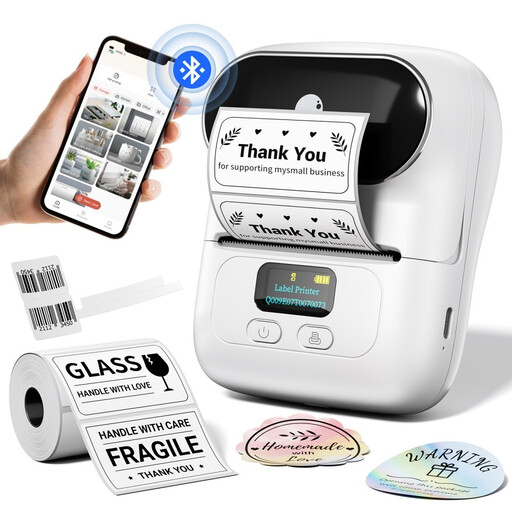
Consider this if you want to prepare repeated folder labels using a phone. Check the compatible roll and whether its labels fit your tabs; the named bundle includes one label roll.
 No image available
Consider this for mobile-device label design if that workflow suits your craft-room filing. The product name specifies a 0.59-inch label width; check the usable print area, compatible supplies and fit on your folders.
Choose a width that fits the usable flat area of your folder tab or spine. A 9 mm or 12 mm option is a starting point for short titles, while wider tape is worth considering if you also plan to label boxes or shelves. Check the final text layout against the folder itself.
That depends on the machine and its supplies. DYMO says its D1 thermal-transfer labels need neither ink nor toner, but they do require compatible replacement tape; check the consumables for the exact model you intend to buy.
Do not assume it will suit every surface or storage condition. DYMO describes standard D1 labels for clean, flat surfaces, including paper; check the chosen tape’s stated use and try the intended folder material before making a large batch.
A physical-keyboard model may be more straightforward when you only need a few short titles. Consider phone-connected editing if you expect to reuse layouts or prepare decorative labels; Brother UK’s PT-N25BT offers both an onboard keyboard and Bluetooth-based phone editing.