Frequent small-parts organisers
If you regularly sort beads, findings, fasteners or blades into drawers and tubs, focus on readable labels, a tape suited to handling and a layout you can repeat as categories grow.


Choose a tape family and label width that suit your containers before deciding between a keyboard and connected layout tools. For frequently handled storage, consider the resistance properties Brother states for its laminated TZe tape; a standalone machine supporting up to 12 mm may suit occasional small labels, while larger labels or repeatable layouts may call for a connected model.
If you regularly sort beads, findings, fasteners or blades into drawers and tubs, focus on readable labels, a tape suited to handling and a layout you can repeat as categories grow.
If you only need to mark a few boxes, drawer fronts or bags, direct keyboard entry may be more useful than setting up labels on a phone or computer.
If you mark both tiny packets and larger bins, check the available tape widths and layout options before settling on a consistent naming system.
Start with the surfaces and sizes you need to mark, then decide whether you will make labels one at a time or in batches.
| Concern | What to check | Who this matters to |
|---|---|---|
| Lasting legibility | Check the exact tape family and its stated resistance properties for the conditions your containers face. | I handle and move parts drawers often, so I want the text to remain legible as the containers are used. Around 36% of consumers put lasting legibility first. |
| Width and layout | Measure a small packet and a large bin front; check supported widths and available label formats. | My packets need short labels, but larger bins need room for clearer category names. Roughly 29% of consumers chiefly need a format that works across container sizes. |
| Repeatable batches | Check compatibility with your device and whether the model offers the templates or variable-text tools you need. | When I add several parts categories at once, I want to keep their names and layouts consistent. Around 21% of consumers make repeatable labelling their main priority. |
| Quick direct entry | Decide whether you want a physical keyboard or device-based editing, and check the power method. | I want to mark a newly opened packet at the worktable without preparing a batch. For about 14% of consumers, immediate label entry comes first. |
Label tapes are not interchangeable by default. DYMO publishes machine-to-tape compatibility charts, and Epson specifies dedicated LK tape for its LW-C610.
Note the exact model and compatible tape-family code, then check the widths, adhesive type and text and background colours you need.
Spare rolls that do not fit your machine may be unusable.
Brother states that its laminated TZe tape resists water, abrasion, chemicals and temperature extremes. That statement applies to the named tape family, not every label tape.
For frequently handled boxes and drawers, check the resistance properties stated for the exact compatible tape you intend to use.
Brother specifies a 12 mm maximum for the PT-D210VP, and DYMO specifies 12 mm for the LabelManager 280. Brother's P-touch CUBE Plus supports tape up to 24 mm.
Measure both your smallest packet and largest bin front before choosing a machine's supported width range.
Connected editing can help when you reuse layouts or prepare batches, but a physical keyboard lets you enter an immediate label without opening a phone or computer tool.
Choose the workflow you will use most often, and check device compatibility if you want connected editing.
Brother's P-touch range includes direct-entry and connected approaches. Brother UK specifies tape up to 12 mm for the PT-D210VP and up to 24 mm for the P-touch CUBE Plus.
The LabelManager 280 offers standalone QWERTY entry as well as an optional PC or Mac workflow, according to DYMO.
Epson's LabelWorks LW-C610 illustrates a mobile-editing route with several tape widths, but Epson identifies that model as discontinued.
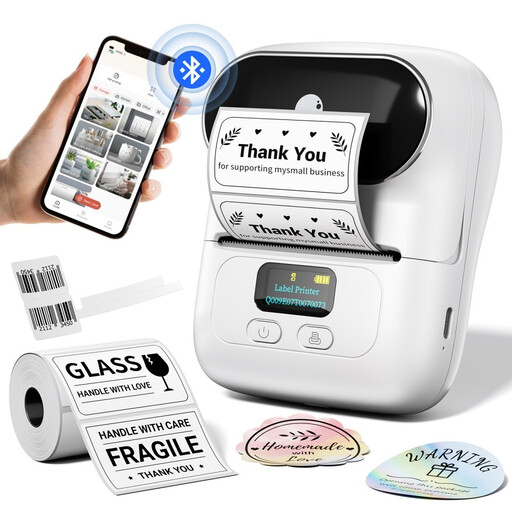
These choices cover a portable label maker and an address-label printer. Compare their compatible label formats and working arrangements with the packets, drawers and boxes you plan to mark.
 No image available
Consider this portable model if you want to make labels around the craft room rather than at one fixed spot.
The product name includes one label roll. Check that compatible labels fit your smallest packets and that their adhesive suits frequently handled containers.
 No image available
Consider this address-label printer for storage labels if its formats fit your boxes and drawers.
Check its connection requirements and compatible rolls before choosing it, particularly if labels will be handled often.
No. Tape compatibility depends on the machine and tape family. DYMO provides compatibility charts, while Epson specifies dedicated LK tape for the LW-C610; check your exact model and tape-family code before ordering spare supplies.
Choose according to your available label space and how much text needs to be readable. Brother UK specifies up to 12 mm for the PT-D210VP and up to 24 mm for the P-touch CUBE Plus; wider capability can give you more layout room on bins, but may be unnecessary for short packet labels.
Not if you choose a suitable standalone keyboard model: the Brother PT-D210VP and DYMO LabelManager 280 offer direct entry. Consider connected editing when you need reusable layouts or batches, and check that the particular model works with your device.
Check that the electrical model and its safety information are appropriate for where you will use it. For disposal in Oxfordshire, Oxfordshire County Council says electrical equipment must not go in general waste; check your local council or retailer for the collection options available where you live.