Owners labelling handled hard cases
You need an identifier that remains legible as cases are handled. Check the tape’s stated resistance and adhesion against the actual label area, rather than choosing a decorative layout first.


Choose the label stock for the case surface before choosing a printer. A compact keyboard model that accepts tape up to 12 mm can suit short names, while a wider desktop model offers more room for multi-line labels and repeatable designs. On leather, fabric, coated or unknown finishes, test a label discreetly before using permanent adhesive; if clean removal matters most, consider a less permanent way to identify the case.
You need an identifier that remains legible as cases are handled. Check the tape’s stated resistance and adhesion against the actual label area, rather than choosing a decorative layout first.
You may need short names on some cases and longer contents labels on others. Brother UK’s PT-D210VP and PT-D600VP specifications illustrate the choice between tape up to 12 mm and a wider, multi-line system.
If a case is leather, fabric, coated or of unknown material, do not assume that a permanent label will adhere safely or come away cleanly. Test both placement and removal on a concealed area first.
Start with the surface and available label area, then decide how much text you need and whether you will reuse layouts across several cases.
| Concern | What to check | Who this matters to |
|---|---|---|
| Surface and removal | Check the tape’s stated surfaces and test adhesion and removal in a concealed spot. | If I need to protect a coated or unfamiliar finish, I cannot assume a permanent label will come away cleanly. Around 42% of consumers put surface compatibility and reversibility first. |
| Readable identification | Match tape type, width and text contrast to the available space and expected handling. | When my cases are handled regularly, I want their names to stay easy to read without covering fittings or edges. Readable, durable identification is the primary need for around 33% of consumers. |
| Repeatable labelling | Decide whether short single-line names suffice or saved layouts and wider, multi-line labels would help. | If I am marking several cases, consistent names and layouts can make the work easier to repeat. Around 25% of consumers prioritise that labelling workflow. |
DYMO UK describes D1 Permanent tape as adhering to most plastic, paper, metal, wood and glass surfaces. That does not establish safe adhesion or clean removal on every instrument-case covering.
Identify the surface, try a small label out of sight and test any removal method discreetly before applying it to a visible area.
An unsuitable adhesive can leave residue or require cleaning that risks the finish.
Printer width alone cannot tell you whether a compatible cassette has the adhesion, appearance or resistance your case needs.
Settle on the wording and label area, then check the exact cassette’s width, printer compatibility and stated use.
A supplied cassette that does not suit the case may mean obtaining a different one.
Epson United Kingdom identifies the LabelWorks LW-C610 as discontinued. Its specifications can help identify compatible tape, but they do not establish that the machine is currently available to buy.
Confirm the availability of both a machine and its compatible tape before committing to that system.
GOV.UK advises taking unwanted electrical products and batteries to appropriate recycling collection points rather than putting them in household rubbish.
Use an appropriate electrical-waste route for the label maker and a battery collection route for removable batteries.
Brother’s P-touch range includes compact and larger desktop label makers; tape width and the need to save layouts help distinguish the cited models.
DYMO’s D1 tape variants are worth comparing when adhesion and exposure matter more than label layout.
Epson LabelWorks offers tape finishes to consider alongside machine compatibility.
These label printers offer different starting points for making case identifiers. Before using any of them on an instrument case, check the exact label stock against the surface and the space available.
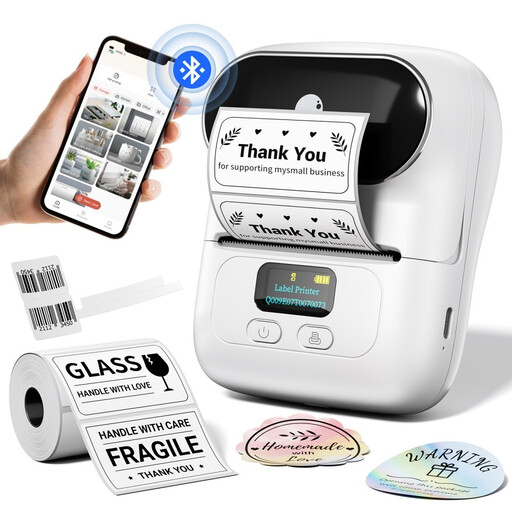 No image available
For a set of case identifiers, check whether this printer’s label format fits your wording and each case’s usable label area.
The listed bundle includes one label roll; test the chosen stock on a concealed area before marking a visible surface.
 No image available
For a planned set of case or contents labels, check that the label format suits your wording and the space on each case.
Confirm the required connection and the exact label stock before choosing this printer for an instrument-case finish.
 No image available
For short case identifiers where a portable maker appeals, check that the available label format fits both the text and the case.
Confirm compatible label media and test it on a concealed part of the intended surface.
No: the tape’s stated surface compatibility does not cover every case finish. DYMO UK names most plastic, paper, metal, wood and glass surfaces for D1 Permanent tape; test a concealed area first if the case is leather, fabric, coated or otherwise unfamiliar.
It can be enough for short identifiers if the label fits a suitable area on the case. Brother UK lists widths up to 12 mm for the PT-D210VP; its PT-D600VP accepts tape up to 24 mm and can print up to seven lines when the wording needs more space.
DYMO describes the cited D1 tape systems as thermal-transfer systems that do not need ink or toner. You still need compatible tape cassettes, and the tape variant determines which stated adhesion and resistance claims apply.
Take the electrical product to an appropriate recycling collection point rather than putting it in household rubbish. GOV.UK also advises using an appropriate collection route for unwanted batteries; remove them from the label maker where possible.