Staff making routine storage labels
If you label individual craft tubs, drawers, folders and shelves as needed, entering short text directly on a device may suit your workflow.


For occasional labels on craft tubs, drawers and folders, a standalone maker that prints up to 12 mm tape is a practical starting point. If staff need repeated layouts or wider shelf labels, consider a connected model that supports 18 mm tape; for storage that is frequently handled or wiped, check the compatible tape and adhesive as carefully as the printer.
If you label individual craft tubs, drawers, folders and shelves as needed, entering short text directly on a device may suit your workflow.
For containers that are moved or wiped regularly, the tape material, adhesive and storage surface deserve attention alongside the printer.
If several staff use the same wording or layouts, label memory or computer and phone input may help them maintain a consistent format.
Start with how staff will enter labels, then check the space available on the storage and the tape suited to its surface.
| Concern | What to check | Who this matters to |
|---|---|---|
| Immediate labels | Check for a built-in keyboard and display, and confirm the supported tape widths. | When a new craft tub needs a short label straight away, I want to make it without finding a computer. Around 36% of consumers put immediate, direct-on-device labelling first. |
| Handled or wiped storage | Check the compatible tape material and adhesive against the surface and expected wiping. | If containers are moved and cleaned often, I need labels that remain useful on those surfaces. For around 29% of consumers, tape suitability is the primary concern. |
| Repeated layouts | Check label memory or template options and whether school devices can use the required connection and software. | When colleagues make the same labels repeatedly, I want a consistent layout without re-entering everything. Repeatable labelling comes first for around 21% of consumers. |
| Label size and location | Measure representative drawers and shelves; check maximum tape width and where staff will use the device. | I need labels that fit small drawers while remaining readable where people look for supplies, and I may label items away from one desk. Around 14% of consumers prioritise label placement and size. |
Labels for different surfaces or purposes may call for different compatible cassettes.
Identify the widths, colours and adhesive types the office expects to use, then check the exact cassette family for the chosen model.
Tape cassettes are recurring consumables.
A maximum width of 12 mm may suit a drawer but not the label size preferred for a larger shelf front; an 18 mm-capable machine is not necessary for every office.
Measure representative label areas and confirm the machine supports the widths you intend to use.
Resistance to handling or wiping depends on the compatible label material, adhesive and surface. Brother describes resistance properties for its laminated TZe tapes, not for every tape.
Match the tape to the storage surface and expected exposure, and check compatibility with the exact printer.
The UK Health and Safety Executive says annual portable appliance testing is not a legal requirement; inspection and testing arrangements depend on the equipment and its environment.
Follow the school's electrical-equipment maintenance procedure for a plug-in machine.
Brother's P-touch range includes the standalone PT-D210VP, which supports tape up to 12 mm, and the USB- and Bluetooth-connected PT-D460BTVP, which supports up to 18 mm.
DYMO presents its LabelManager range for school and office organisation, including desks, filing cabinets and staff offices.
Epson's LabelWorks range is another label-printer ecosystem to consider when assessing formats and specialist functions.
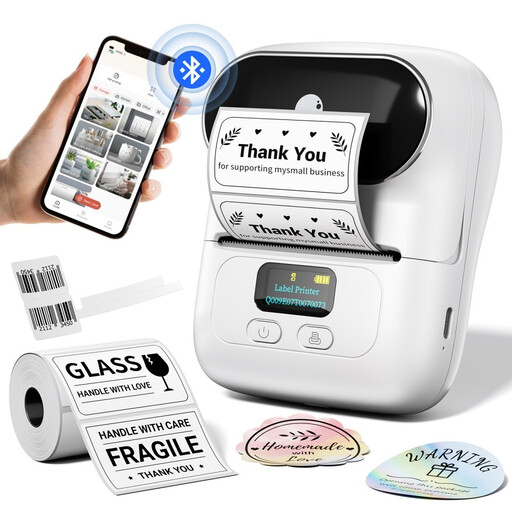
These choices include portable label makers and a printer to consider for repeated office labels. Match each device's input method and compatible labels to the school's workflow and craft-storage surfaces.
 No image available
For labelling craft containers in more than one location, check whether its label sizes suit both tubs and smaller drawers.
Confirm that staff can use the intended mobile app and that compatible labels suit surfaces that are handled or wiped.
 No image available
For repeated labels made at a shared office desk, check that staff can use the intended computer and printing software.
Confirm the compatible roll formats, label dimensions and adhesive for the craft-storage surfaces before ordering.
 No image available
For labels made around the office rather than at one desk, check whether staff can use the required mobile device and app.
Measure the intended label areas against the stated 0.59-inch width, and check compatible label adhesive for handled or wiped storage.
DYMO says its thermal label makers do not need replacement ink or toner. Compatible labels or cassettes remain consumables, so check what the chosen device uses.
Up to 12 mm may be sufficient for folders, small drawers and close-range labels; consider an 18 mm-capable machine if the available shelf or container space calls for a wider label. Measure representative surfaces and confirm the machine accepts your chosen width.
The compatible tape and its suitability for the tub surface are the key checks, rather than the printer alone. Brother describes resistance to water, abrasion and chemicals for its laminated TZe tapes; confirm the exact tape and adhesive suit the intended handling and cleaning.
No fixed annual PAT interval is required by law, according to the UK Health and Safety Executive. Electrical equipment must be maintained safely; follow the school's procedure for the equipment and environment.
Check the compatible cassette or roll family, width, length and adhesive type before selecting a machine. That matters especially if the office expects to label many containers or needs different labels for drawers and frequently handled tubs.