Quick storage organisers
If you regularly rename drawers, jars or supply boxes, a label maker you can use beside the storage area may matter more than elaborate layouts.


Choose a standalone tape label maker if you mainly need quick, readable names for craft drawers, jars and storage boxes; check its cassette system and supported widths before choosing the machine. An existing compatible Cricut offers a route to shaped or designed labels, but involves design software, tools and material preparation. For containers that are handled or cleaned often, choose the label material for the surface rather than assuming every tape behaves alike.
If you regularly rename drawers, jars or supply boxes, a label maker you can use beside the storage area may matter more than elaborate layouts.
If containers are handled or cleaned often, consider the label material and the surface it will stick to as well as the printer.
If you already own a compatible Cricut, shaped labels or drawn designs may justify a more involved workflow than typing a name on tape.
Decide whether you want to make labels at the storage area or design them with a cutting machine. Then check the label size and material against your containers.
| Concern | What to check | Who this matters to |
|---|---|---|
| Quick, repeatable labels | Check whether a phone or computer is needed, how the device is powered and whether its tape is wide enough for your storage labels. | When I am relabelling drawers and supply boxes, I want to make the next name where the supplies are kept. Around 44% of consumers put quick, repeatable labelling first. |
| Fit and surface suitability | Measure the usable label area; check the exact cassette width, adhesive guidance and application conditions. | If my boxes are handled often or have awkward surfaces, I need labels suited to those containers. For around 33% of consumers, label fit and surface suitability are the primary concern. |
| Custom shapes and designs | Check cutting-machine compatibility, required software and tools, and whether the material suits the container. | I may accept extra setup when a shaped or drawn label matters more than a quick bin name. Custom design comes first for around 23% of consumers. |
Tape cassettes are not interchangeable across all printers. Brother directs buyers to check supported tape formats and widths; the DYMO LabelManager 280 uses specified D1 cassette types and widths.
Work out which widths and finishes your containers need, then check compatibility with the exact model.
DYMO describes D1 Standard labels as suitable for most clean, flat surfaces, while Brother lists separate strong-adhesive options for rough or textured surfaces.
Check the chosen tape’s surface guidance and try a label on the actual container before committing to more cassettes.
Cricut writable-label projects involve a compatible machine, Design Space, tools and material handling. The cited writable paper has permanent adhesive that may leave residue when removed.
If you mainly need repeated storage names, compare that setup with a standalone tape label maker before choosing.
Brother’s handheld P-touch models and tape range offer options for storage and decorative craft labels.
DYMO’s LabelManager range includes standalone labelling and models with computer-based customisation.
Cricut is a custom-label route for someone who already has a compatible cutting machine.
These portable label makers are choices for naming craft supplies around a room. Check how each makes labels and which supplies fit it; neither product should be treated as a substitute for a cutting-machine workflow.
 No image available
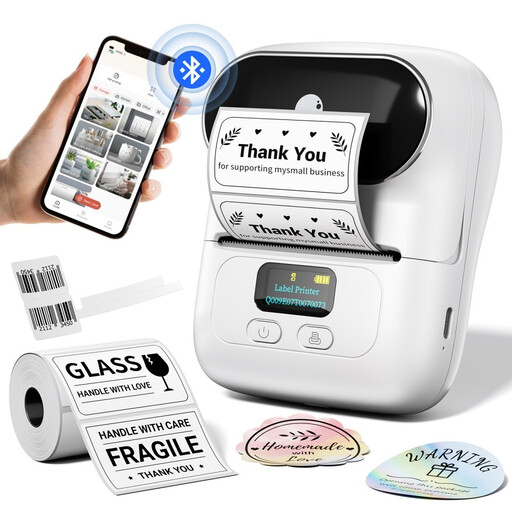
Consider this for labels made beside craft-room storage when a 0.59-inch label width suits the container. Printing requires a phone or tablet connected through Bluetooth and the app; check compatible labels and their guidance for your storage surfaces.
 No image available
Consider this for repeated craft-supply labels if its app-based workflow suits you. Printing uses the Print Master app and Bluetooth with an iOS or Android device; check compatible rolls and their adhesive guidance for your containers.
Measure the flat area of the containers you want to label, then choose a machine and compatible cassette that fit it. Brother lists the PT-H200 and DYMO lists the LabelManager 280 with maximum label widths of 12 mm; wider tapes elsewhere in Brother’s TZe range do not automatically fit the PT-H200.
DYMO describes its D1 Standard labels as adhering to most clean, flat surfaces, including plastic and glass. For a rough or textured container, check whether your printer accepts a tape specified for that surface rather than assuming a standard cassette will suit it.
Yes, if your Cricut model is compatible with the chosen label material and you want a designed or shaped label enough to use a design-and-cut workflow. Check the required Design Space setup and tools; the cited writable paper goes onto a clean, dry surface, is not for standard printers and may leave residue when removed.