Mixed-stock art-shop organisers
If you label paint jars, pen pots, drawers and storage boxes, focus on whether the available tape widths fit each surface and whether the chosen tape suits routine handling and cleaning.


Choose a tape label maker for assorted jars, drawers and storage boxes when narrow labels and a compatible durable tape matter most. Choose a desktop roll-label printer for repeated, wider labels or barcodes made at a computer, but check the roll material before using its labels on containers that are wiped or exposed to art materials. If you supply hazardous chemical products in Great Britain, printing a physical label does not replace the applicable GB CLP labelling workflow.
If you label paint jars, pen pots, drawers and storage boxes, focus on whether the available tape widths fit each surface and whether the chosen tape suits routine handling and cleaning.
If you regularly prepare shelf, product-information, barcode or dispatch labels at a computer, a desk-based roll printer may suit the repeated layout better than typing each label on a portable machine.
If your business places hazardous paints, solvents, adhesives or other chemical mixtures on the Great Britain market, distinguish stock-organisation labels from any product labelling duties that apply to your supply-chain role. The Health and Safety Executive says those duties depend on that role.
Decide whether most jobs involve individual containers around the shop or repeated labels prepared at a desk; then check the media that fits those jobs.
Choose for: Individual labels on mixed containers, drawers and storage locations, especially when a compatible durable tape suits the surface.
Trade-off: Tape widths may be too narrow for larger product-information panels or signs; confirm the machine accepts the width and tape family you need.
Choose for: Repeated, consistent shelf labels, barcodes or temporary signs prepared at a computer.
Trade-off: A desk-based workflow is less convenient for labelling items as you move around the shop, and roll material still needs to suit its intended exposure.
| Concern | What to check | Who this matters to |
|---|---|---|
| Labels on handled containers | Check the compatible tape material and adhesive against the handling, moisture and cleaning the label will face. | If I regularly handle or wipe labelled jars and boxes, I need the label to remain readable and attached. Around 33% of consumers put durable container labels first. |
| Fit and legibility | Measure the usable label area on small items and shelves, then check the machine's compatible media widths. | When my stock ranges from small pots to shelf locations, I need text that fits each space without becoming hard to read. About 25% of consumers prioritise label fit and presentation. |
| Repeated printing | Check roll width, connection and software functions for the layouts or barcodes you intend to produce. | If I print the same product or shelf layout repeatedly, I want to prepare it at a desk rather than enter every label separately. Roughly 25% of consumers make repeat-printing workflow their primary concern. |
| Chemical-product labelling | Establish your supply-chain role and the market where the product is placed before relying on a printed hazard label. | If my shop imports, repacks or relabels hazardous art materials, I need to establish which product-labelling duties apply before printing. Around 17% of consumers put that compliance question first. |
A label maker that does not accept the required width or durable tape family may not cover the shop's smallest containers and widest shelf labels.
Measure those label areas and confirm compatible widths and media on the manufacturer's product information before buying.
Brother's and DYMO's resistance claims concern particular laminated or durable tapes, not every tape or direct-thermal roll they offer.
Choose the exact media for the surface and exposure; check roll material and adhesive separately if labels will face wiping, moisture or art materials.
The Health and Safety Executive says GB CLP duties for chemicals placed on the Great Britain market depend on the business's supply-chain role. A printer does not determine the required hazard information.
If you supply applicable chemical products, establish your role and use the relevant official guidance and product information before preparing their labels. Check Northern Ireland requirements separately where relevant.
A machine suited to one-off container labels may be awkward for batches of wider, consistent shelf or product labels.
Work out which task occupies most of your labelling time, then compare a tape maker with a computer-based roll printer on that task.
Its P-touch tape machines and QL desktop roll printers address different shop jobs: container organisation and repeated desk-printed labels.
LabelManager tape machines address item and shelf organisation; LabelWriter desktop printers address repeated retail and product-information labels.
LabelWorks tape options may interest shops that need to consider label finish alongside organisation.
These choices address desk-based repeat labels and portable stock labelling. Check the exact roll material and compatibility against the containers or shelves you plan to label.
 No image available
Consider this desk-based printer for repeated shelf or product labels prepared at a computer.
Brother lists labels up to 62 mm wide for the QL-600B. Check the chosen DK roll material and adhesive before using its labels on containers exposed to wiping, moisture or art materials.
 No image available
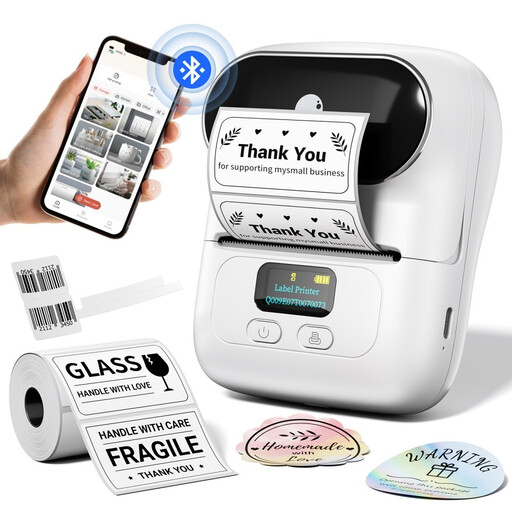
Consider a portable printer if you need to prepare labels while working around the shop rather than at a fixed desk.
This variant names one label roll. Check compatible roll sizes, material and adhesive against your intended labels and surfaces before buying.
Choose a width that fits the item while leaving the text readable. Measure the flat area on small containers and shelves before choosing a machine: Brother lists 3.5 mm to 18 mm tape support for the PT-D460BT, while DYMO lists 6 mm to 24 mm for the LabelManager Executive 640 CB.
Prioritise a compatible durable or laminated tape when labels will be handled, rubbed, splashed or wiped. Brother and DYMO describe resistance properties for specific TZe and D1 Durable tapes respectively; check the exact tape and its stated conditions rather than relying on the printer brand alone.
A desktop roll-label printer makes more sense when you repeatedly prepare uniform, wider shelf labels or barcodes at a computer. Brother lists labels up to 62 mm wide for its QL-600B; for individual labels applied as you move around the shop, a portable tape machine may be more convenient.
A label maker can print a physical label, but it cannot establish the required hazard information or your business's duties. The Health and Safety Executive says GB CLP regulates chemicals placed on the Great Britain market and that duties depend on the supply-chain role. Establish the applicable requirements and product information before printing; chemicals placed on the Northern Ireland market fall under a different EU CLP framework.