Who needs which workflow?
Where labels are made affects the printer choice as much as the wording on the tray.
School-office batch label makers
Staff preparing consistent labels for many classroom trays from one computer need room for legible wording and a repeatable layout. Brother UK describes its QL desktop range as using die-cut or continuous rolls for lower-volume printing.
Classroom-side organisers
Staff replacing short labels near the trays may prefer a compact tape maker rather than returning to an office workstation. The available tape width still has to accommodate the longest class name or contents description.
Facilities and asset-labelling teams
When tray labels are also part of equipment or shelf identification, the choice of label material and printer configuration becomes more important. Zebra positions its ZD421 for asset and shelf labelling, with direct-thermal and thermal-transfer configurations; the required configuration and media should be specified before purchase.
What matters when choosing?
For classroom trays, settle the label layout and printing location first. A shared connection or a more specialised printer is useful only when the school-office workflow calls for it.
Desktop roll-label printer
Choose when: An office computer will produce repeated sets of labels and the tray fronts have space for a broader layout.
Trade-off: The printer needs a desk-based workflow and compatible rolls. Brother UK describes its lower-volume QL range as suited to up to 25 labels per day; check the intended model if daily demand will be substantially higher.
Tape label maker
Choose when: Staff need short tray-edge labels or want to make replacements away from the office desk.
Trade-off: A narrow tape leaves less room for long wording. Brother UK attributes resistance to water, chemicals and abrasion specifically to its P-touch laminated labels, not to every tape or printer.
Thermal-transfer desktop printer
Choose when: Tray labels form part of a wider asset, shelf or facilities-labelling system with specified media requirements.
Trade-off: Routine tray labels alone may not call for this configuration. Zebra offers the ZD421 in direct-thermal and thermal-transfer versions, so confirm the version, supplies and accessories needed for the intended labels.
| Concern |
What to check |
Who this matters to |
| Legibility and repeat printing |
Measure the flat tray-front area, then test the longest wording at a readable text size. Check printable width and whether the roll format supports the label lengths needed. |
If I am preparing labels for several classrooms, I need a layout I can read and reproduce without retyping every tray name. Around 40% of consumers put clear, repeatable labels first. |
| Durability on handled trays |
Check the compatible label material and adhesive against the tray surface and its cleaning routine; printer technology alone does not establish resistance. |
When trays are handled or wiped regularly, I want labels that remain suitable for that surface. For around 30% of consumers, durability is the primary concern. |
| Shared or portable printing |
Decide whether labels come from one computer, several authorised devices or near the classroom. Confirm the selected model’s connections and any school IT requirements. |
I may need another staff member to print a replacement without using the office computer, or I may need to make one beside the trays. That access is the main priority for around 30% of consumers. |
Brands and product lines to consider
These product lines illustrate different labelling workflows; the features and media requirements depend on the model and configuration.
Brother
Brother’s QL range covers desktop roll labels, while its P-touch range offers tape-label options.
- Brother UK lists the QL-800 with labels up to 62 mm wide. Connections vary across the QL models: the QL-810W offers USB and Wi-Fi, while the QL-820NWB also offers Ethernet and Bluetooth.
- Brother UK describes its lower-volume QL range as suited to up to 25 labels per day. Check the intended model’s workload and distinguish P-touch laminated-label claims from the properties of other media.
DYMO
DYMO’s LabelManager tape makers and LabelWriter desktop printers serve different label formats, including office and education uses identified by DYMO UK.
- DYMO UK lists 6 mm, 9 mm and 12 mm D1 label widths for the portable, rechargeable LabelManager 280.
- DYMO UK says the LabelWriter 550 works exclusively with DYMO-branded labels and specifies LabelWriter labels made after April 2020. Check that its consumable format fits the planned tray labels.
Zebra
Zebra’s ZD421 is a desktop option to examine when classroom-tray labels sit within a broader asset or facilities-labelling task.
- Zebra lists direct-thermal and thermal-transfer ZD421 configurations and positions the line for uses including asset and shelf labels.
- Specify the required ZD421 configuration, media and accessories; a capability listed for one configuration should not be assumed for every variant.
Joybuy products for tray labelling
These choices cover an office-based label printer and portable makers for labels prepared closer to the trays. Compare the label space and working location before choosing; the label material still needs to suit the tray surface.
 No image available
Brother QL-600B label printer
Consider this model for sets of tray labels prepared in the school office. Before committing to an office workflow, confirm the compatible rolls, the devices staff will use and whether the chosen label material suits the trays.
View on Joybuy
 No image available
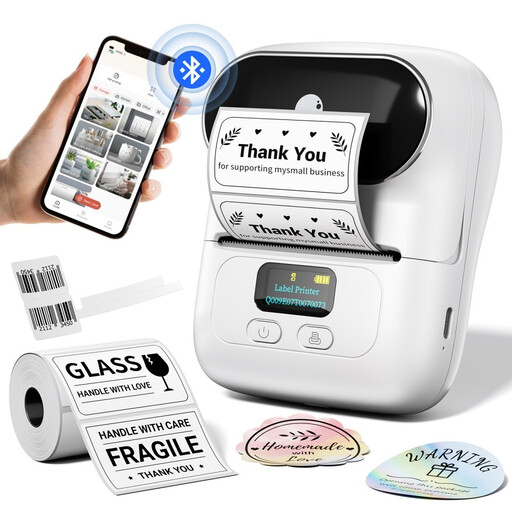
Phomemo M110 portable label maker with 1unit label roll
Its portable format is worth considering if staff make labels away from the office desk. Check how the intended printing device works with it, and confirm the compatible roll and adhesive for the tray surface.
View on Joybuy
 No image available
Phomemo D30 portable label maker, 0.59 inch, 1pcs
Consider this portable model for short wording on a measured tray edge. Its stated label width is 0.59 inch; check that the longest wording remains readable and that compatible label material suits the tray surface.
View on Joybuy
Frequently asked questions
Is a tape maker or a desktop roll-label printer more suitable for classroom trays?
A desktop roll-label printer suits repeated, computer-designed labels when the tray front has room for a broader layout; a tape maker suits short tray-edge wording or labels made away from the office. Measure the usable space and test the longest label text before deciding.
Does a direct-thermal label printer need ink or toner?
The direct-thermal printers described by Brother UK and DYMO UK do not use ink or toner. They still need compatible label supplies, so check the required roll or cassette format for the particular printer.
Can several school-office staff print from one label printer?
Yes, if the chosen model has the required connections and the school permits the setup. Brother UK lists USB and Wi-Fi for the QL-810W, and USB, Ethernet, Wi-Fi and Bluetooth for the QL-820NWB; confirm device and network requirements with the school’s IT team.
What should a school do with an old label printer?
Use the school’s established electrical-equipment collection or recycling route when replacing it. GOV.UK identifies the Waste Electrical and Electronic Equipment Regulations 2013, as amended, as the underpinning UK legislation; check the school’s disposal procedure for the arrangement it uses.


