Who needs which kind of label?

Owners who handle cases frequently

If a case has a textured exterior or its label will face rubbing, sunlight or changing temperatures, focus on compatible label materials and test one on the case. Brother describes different P-touch TZe tapes for durability and stronger adhesion; the printer alone does not provide either property.

Case and inventory organisers

If you give several cases consistent names or identifiers, a computer or mobile design workflow can help you repeat a layout. Check the software functions you need as well as the printer’s connection and tape width; Brother UK Store lists both USB computer use and Bluetooth mobile use for the P-touch CUBE Plus PT-P710BT.

Occasional home-office labellers

If you only need a few short case names, a compact phone-led workflow may be sufficient. DYMO UK positions the LetraTag 200B for phone or tablet use with 12 mm LetraTag tapes; check whether that tape format and its available materials suit your cases.

What should you check before buying?

Start with the available label area and its surface, then choose the tape and printer together. Decide how you will create the text only after checking that the label can fit and stay attached.

ConcernBuying checkWho this matters to
Adhesion and legibility Identify the case finish and handling conditions; check compatible laminated or strong-adhesive tape and test a label on the surface. If my case is textured or handled often, I need its name to remain attached and readable. Around 33% of consumers put case-surface adhesion and label survival first.
Repeatable identifiers Check the design software and connection you will use for consistent layouts; confirm the chosen tape width fits the case. When several cases need consistent IDs, I want to avoid recreating each layout. Roughly 25% of consumers prioritise repeatable, detailed labels.
Phone-led labelling Confirm phone or tablet compatibility and the available tape widths and materials. For just a few short names, I would rather design labels on my phone than set up a computer. Around 25% of consumers place compact phone-led use first.
Simple setup Check that the cassette system covers the label materials and widths you are likely to use, even if your first labels are short. If my cases need only straightforward names, I do not need an elaborate design workflow. Approximately 17% of consumers chiefly want a simple, limited-scope setup.

Mistakes to avoid

  • Assuming every tape sticks to every case

    DYMO specifies D1 tape for clean, flat surfaces, while Brother UK Store describes TZe-S221 strong-adhesive tape for smooth, rough, textured and powder-coated surfaces. Neither description guarantees adhesion to an individual case finish.

    Identify a suitable label area, check that the intended tape fits the printer, and try one label before marking the full set of cases.

    A label that lifts also takes time to replace and may require another cassette type.

  • Choosing a printer without checking its cassette system

    DYMO UK lists 12 mm LetraTag tapes for the LetraTag 200B; Brother UK Store lists tape widths up to 24 mm for the P-touch CUBE Plus PT-P710BT. Tape systems are not interchangeable simply because both devices print labels.

    Check the exact cassette type, material and width alongside the printer, allowing for both the case’s flat label area and the amount of text you need.

  • Choosing phone convenience for a repeat-label task

    A few case names and a collection of consistently formatted identifiers call for different design workflows. The LetraTag 200B uses a phone or tablet, while the PT-P710BT also offers USB use with a PC or Mac, according to their manufacturers.

    If you expect to reuse layouts or include detailed identifiers, check the printer’s software functions on the device you intend to use.

    Without a suitable repeat-label workflow, recreating layouts for each case can take extra time.

  • Putting an old electrical label printer in household rubbish

    UK guidance from the Office for Product Safety and Standards says electrical products and batteries should not go into household rubbish when they are no longer wanted.

    Follow your local electrical-waste and battery collection instructions when replacing a printer.

Relevant brands to consider

Brother

The P-touch range is relevant when compatible tape materials and a choice of label-design workflows matter.

  • Brother UK describes laminated P-touch TZe labels as resistant to water, sunlight, chemicals, abrasion and temperature extremes. Brother UK Store specifies TZe-S221 strong-adhesive tape for smooth, rough, textured and powder-coated surfaces.
  • These are tape-specific manufacturer descriptions, not a guarantee for every case finish. Confirm the cassette fits the exact printer and test it on the case.

DYMO

LetraTag and LabelManager provide different tape-based approaches to straightforward home-office labelling.

  • DYMO UK lists phone or tablet operation and 12 mm LetraTag tapes for the LetraTag 200B.
  • DYMO describes D1 tape for clean, flat surfaces. D1 and LetraTag are distinct tape systems; check the media for the exact printer rather than assuming either will grip a rough or curved case.

NIIMBOT

NIIMBOT’s catalogue includes portable direct-thermal lines and a separate M-series thermal-transfer line.

  • Those product-line distinctions give consumers another way to compare printer and consumable formats.
  • Check the exact model’s compatible labels, case-surface suitability and available support before treating it as an alternative for instrument-case identification.

Joybuy label printers for this task

These printers offer portable case-name labelling or a computer-based address-label workflow. Before choosing one for an instrument case, check its compatible label material against your case surface; the Brother QL model shown here should not be confused with a P-touch TZe tape printer.
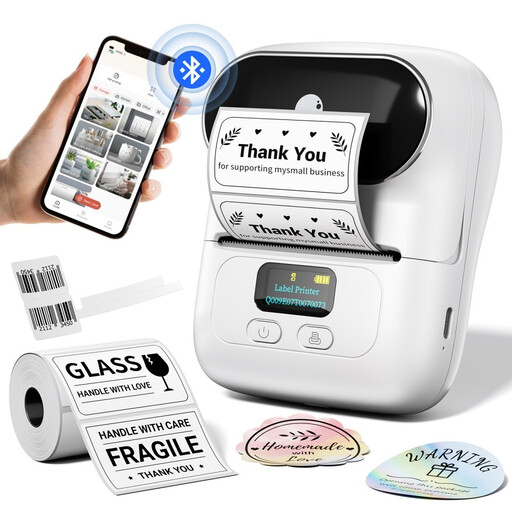
Phomemo M110 portable label maker with one label roll

Phomemo M110 portable label maker with one label roll

A portable option to consider for case identifiers when you prefer a compact printer.

The product name includes one label roll. Check the compatible replacement material and test a label on your case before marking the whole collection.

View on Joybuy

Brother QL-600B label and address printer

Brother QL-600B label and address printer

Consider this address-label model if you plan to make case identifiers in a computer-based workflow.

Check which DK labels fit the QL-600B and whether their material will adhere to your cases. P-touch TZe tape claims do not establish what this QL model’s labels can withstand.

View on Joybuy

Phomemo D30 portable label maker, 0.59-inch label width

Phomemo D30 portable label maker, 0.59-inch label width

A portable option to consider for short case names where a narrow label fits the available space.

The product name states a 0.59-inch label width. Confirm the exact compatible media and try a label on the case surface before committing to a full set.

View on Joybuy

Frequently asked questions

Should I choose the tape or the printer first?

Choose the tape requirements first, then find a printer that accepts the appropriate cassette. DYMO describes D1 tape for clean, flat surfaces, while Brother UK Store specifies its strong-adhesive TZe-S221 for surfaces including textured and powder-coated ones; test the chosen label on your actual case.

What label width works for an instrument case?

Use a width that fits a suitable flat area while leaving the case name readable. DYMO UK lists 12 mm tape for the LetraTag 200B, whereas Brother UK Store lists widths up to 24 mm for the P-touch CUBE Plus PT-P710BT; confirm the exact cassette width accepted by whichever printer you choose.

Do I need a computer-connected label printer?

Not if you only need a few short case names and a compatible phone-led setup suits you. For repeated layouts or detailed identifiers, check the design software before buying; Brother UK Store lists PC and Mac use over USB, as well as Bluetooth mobile use, for the PT-P710BT.

Can an old battery-powered label printer go in household rubbish?

No. UK guidance from the Office for Product Safety and Standards says electrical products and batteries should not go into household rubbish when they are no longer wanted. Follow local instructions for collecting electrical waste and batteries.