Household album organisers
If you are adding names, dates or event titles to family albums, a compact machine with straightforward text entry may cover the job. Check the tape width against the spine before choosing colours or layouts.


For ordinary albums, choose a label maker whose tape width fits the spine or cover: a compact machine that accepts 12 mm tape suits short titles, while a wider desktop model gives more room for longer labels and repeated projects. For valuable or irreplaceable photographs, keep ordinary adhesive labels off the prints; The National Archives recommends identifying a print on the back with a soft 2B pencil or labelling its Melinex pocket.
If you are adding names, dates or event titles to family albums, a compact machine with straightforward text entry may cover the job. Check the tape width against the spine before choosing colours or layouts.
For old, valuable or irreplaceable prints, decide where identification will go before choosing a printer. The National Archives describes labelling a Melinex pocket or using a soft 2B pencil on the back of a print, rather than applying an ordinary adhesive label to its surface.
If you are identifying many albums, boxes or dividers, wider labels and repeatable layouts may matter more than a compact machine. Check the particular printer’s tape range and input options against the labels you plan to make.
Decide where labels will be placed, then measure the available space and choose a printing workflow that suits the number of albums.
| Concern | What to check | Who this matters to |
|---|---|---|
| Contact with photographs | For valuable prints, plan to label the album, enclosure or Melinex pocket instead of attaching an ordinary adhesive label to the photograph. | If a print is irreplaceable, I need to identify it without putting an ordinary adhesive label on it. Roughly 33% of consumers put preservation-first placement above their other album-labelling needs. |
| Readable exterior labels | Measure the spine or cover; check the printer’s supported tape widths and the tape intended for that surface. | When albums are handled or shelved, I want exterior titles that remain legible and fit the available space. For around 27% of consumers, that exterior-label need comes first. |
| Simple occasional use | Choose whether you want to type on the machine or use a connected device, and check the compatible tape. | For just a few family albums, I would rather make a short title without setting up a larger labelling project. Ease of occasional use is the main concern for roughly 20% of consumers. |
| Repeated labels | Check layout options, supported widths and cutting features if you have many albums, dividers or boxes to identify. | With a collection to catalogue, I need titles and identifiers to stay consistent across many items. Around 20% of consumers place that repeated-labelling need first. |
Brother’s claims about TZe tape resistance to water, sunlight, chemicals and abrasion concern label durability, not archival suitability on a print. The National Archives instead describes labelling a Melinex pocket or marking the back of a print with a soft 2B pencil.
Put machine-printed identification on the album exterior, divider, enclosure or protective pocket when the photograph is valuable.
DYMO offers D1 tape in widths up to 24 mm, but its LabelManager 280 accepts 6 mm, 9 mm and 12 mm D1 tape. Brother’s PT-D610BTVP accepts tapes up to 24 mm; tape availability across a brand does not establish compatibility with every model.
Measure the label area, then check both the exact printer’s width limit and its compatible tape family before ordering refills.
Preservation Equipment Ltd warns against using its archival-quality self-adhesive labels directly on valuable artwork. The description of a label material does not, by itself, establish that a photographic print is a suitable surface.
Use a suitable enclosure or supporting material for the label, and check which label stock works with your printer.
Brother’s P-touch range includes compact machines for short household labels and desktop models that accept wider tape.
DYMO’s D1 continuous tape offers a choice of label widths for compatible LabelManager machines.
Phomemo lists portable label makers, including the A30, alongside other compact models with different printing approaches.
These label makers and printers offer options for occasional or repeated album organisation. Match each model’s label format to your covers, spines or dividers, and keep ordinary adhesive labels off valuable prints.
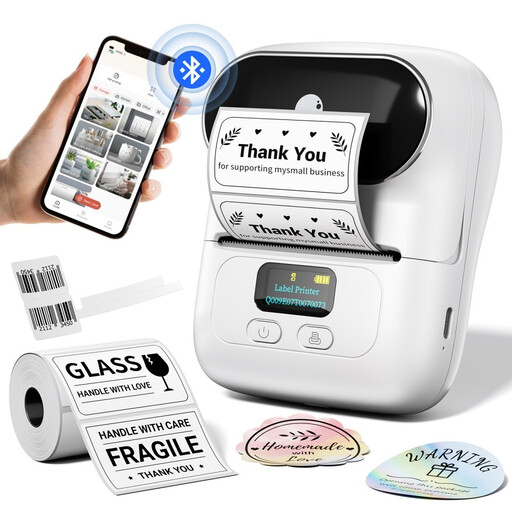 No image available
For repeated album titles or divider labels, check which compatible rolls fit the surface and space you intend to label. Keep the adhesive off valuable photographs.
 No image available
For filing labels across several albums, check the compatible roll dimensions against your covers or dividers. Its described wired USB set-up also needs to suit where you plan to create labels; do not apply ordinary labels directly to valuable prints.
 No image available
For occasional album titles, compare the stated 0.59 inch label width with your spine and check the compatible label format before choosing supplies. Place labels on the album or its enclosure, not directly on valuable photographs.
Do not assume an ordinary adhesive label is suitable for direct contact with a valuable print. The National Archives describes labelling a Melinex pocket or writing on the back of a print with a soft 2B pencil; an album exterior or enclosure also provides a separate place for printed identification.
Choose a width that fits the measured spine and leaves enough room for the title. Brother’s PT-N25BT and DYMO’s LabelManager 280 accept tape up to 12 mm, while Brother’s PT-D610BTVP accepts tape up to 24 mm for projects needing a wider label.
No: Brother’s PT-N25BT has a built-in keyboard and can also use a Bluetooth-connected smartphone. DYMO’s LabelManager 280 can be used on its own or connected to a PC or Mac when you want to compose labels there.