For a community centre that makes most labels at one shared-store desk, consider a printer that accepts wider tape and supports repeat labelling. If staff label supplies in several rooms, a rechargeable handheld model may be more convenient, provided its maximum label width suits the boxes and shelves. Where materials have hazardous properties, ordinary organisation labels cannot replace the applicable hazard information or the centre’s COSHH process.
Who is labelling the materials?
Shared-store organisers
Staff and volunteers labelling drawers, shelf bins, boxes and equipment in one art store need readable labels and a practical way to repeat common formats. Brother UK describes tape options intended to remain legible through regular use.
Mobile session coordinators
People moving between workshop rooms or activity tables may prefer a rechargeable printer they can use away from a fixed computer. The available tape width still needs to fit their storage labels.
Safety-conscious material custodians
People organising paints, solvents, adhesives or cleaners need to distinguish storage labels from hazard information. For materials with hazardous properties, the Health and Safety Executive’s guidance on hazard labels and COSHH is relevant to the centre’s labelling process.
What matters when choosing?
Start with the largest label the centre needs, then decide whether most printing happens at one desk or around the building. Check the chosen tape on the actual containers before adopting it throughout the store.
| Concern |
What to check |
Who this matters to |
| Readable, lasting labels |
Maximum tape width and the intended tape’s suitability for the container surface and handling. |
Shared-store organisers want labels on frequently handled drawers and boxes to remain easy to read; around 36% of consumers put lasting readability first. |
| Repeatable printing |
Keyboard operation, saved formats and whether the centre can use any required computer or app. |
Teams making the same labels for several storage areas want a consistent format without retyping it each time; around 29% of consumers prioritise that shared workflow. |
| Printing between rooms |
Rechargeable operation, standalone use and whether the tape is wide enough for the intended labels. |
Session coordinators who relabel supplies at different tables need to take the printer with them; portability comes first for around 21% of consumers. |
| Hazard information |
Whether any material has hazardous properties, and what its supplier information and the centre’s COSHH process require. |
Material custodians dealing with potentially hazardous supplies need to settle the required label content before choosing a layout; around 14% of consumers put this distinction first. |
Mistakes to avoid
-
Choosing a handheld printer before checking tape width
DYMO specifies 6 mm, 9 mm and 12 mm D1 tapes for the LabelManager 280, while Brother lists tape options up to 24 mm for the PT-D610BT and PT-E560BT. A label that fits a small pot may not leave enough room for a larger box or shelf-front layout.
Write out the longest label and check the largest storage surface before settling on a printer and tape width.
-
Assuming durable tape will stick to every container
Brother describes resistance to water, abrasion, chemicals and temperature extremes for compatible TZe tape. That claim does not establish how a label will adhere to the centre’s particular containers.
Try the intended tape on representative clean, dry surfaces and observe it during normal use before labelling the whole store.
Labels that lift can mean using more tape and spending time relabelling containers.
-
Using an inventory label in place of hazard information
For chemicals with identified hazardous properties, the Health and Safety Executive explains that hazard labels use specified pictograms and supporting wording. An improvised text-only storage label does not establish that those requirements have been met.
Check the supplier label and safety data sheet, and follow the centre’s COSHH process before decanting or relabelling a potentially hazardous material.
Relevant brands to consider
Brother
Brother’s P-touch tape-printer range includes desktop and handheld approaches to shared-store labelling.
- Brother UK lists tape widths up to 24 mm for the PT-D610BT desktop model and PT-E560BT handheld model.
- Brother’s resistance claims concern compatible tape, not proven adhesion to every art-material container. The PT-E560BT’s electrical and network labelling functions may also be unnecessary for an ordinary art store.
DYMO
The LabelManager 280 offers a rechargeable handheld approach to occasional labelling across rooms.
- DYMO lists compatible D1 tapes in 6 mm, 9 mm and 12 mm widths.
- Its 12 mm maximum is worth checking against larger box labels and shelf-front layouts.
NIIMBOT
NIIMBOT describes portable, desktop and thermal-transfer product lines that may be relevant to different labelling workflows.
- The brand describes its M-series as using thermal-transfer technology.
- Choose an exact model only after checking its label format, compatible refills and suitability for the centre’s containers.
Joybuy products for this task
These choices cover a printer to consider for labels made at a shared-store desk and a portable label maker to consider for work across rooms. Check the required label format and refill before choosing either one.
 Image unavailable
Brother QL-600B Label and Address Printer
Consider this for repeated labels made at a shared-store desk rather than while moving between rooms.
Check compatible rolls for the labels you plan to make, and trial their adhesion on representative containers.
View on Joybuy
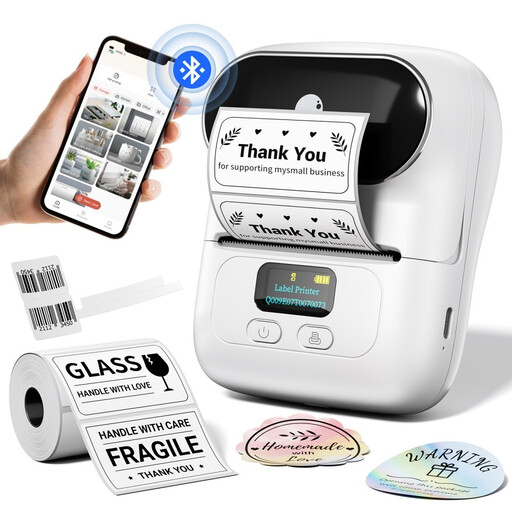 Image unavailable
Phomemo M110 Portable Label Maker with 1 Label Roll
Consider this for relabelling supplies in different rooms.
Before relying on it for shared sessions, check the required phone and app setup, compatible replacement rolls and label adhesion on frequently handled containers.
View on Joybuy
Common questions
What tape width works for art-material storage?
Match the width to the largest label and the distance from which it needs to be read. DYMO lists 6 mm, 9 mm and 12 mm D1 tapes for the LabelManager 280; Brother UK lists widths up to 24 mm for the PT-D610BT and PT-E560BT. Check the intended text on a shelf-front or box layout before choosing.
Should a community centre choose a desktop or handheld printer?
A desktop model is worth considering when most labels are made in batches at one storeroom desk; a rechargeable handheld model suits labelling in several rooms. Check tape width separately, because portability does not tell you how much text a label can hold.
Can an ordinary storage label be used on hazardous art materials?
An ordinary organisation label must not be treated as a substitute for required hazard information. In Great Britain, the Health and Safety Executive explains that labels for chemicals with identified hazardous properties use specified pictograms and wording. Check the supplier label, safety data sheet and the centre’s COSHH process before decanting or relabelling.
Which replacement tapes should we check before choosing?
Check the selected printer’s tape family, available widths and cartridge length against the labels the centre makes regularly. For example, Brother UK lists a compatible 12 mm, 8 m tape for the PT-D610BT; a different printer or label format may require different supplies.


