Occasional home or small-office filer
You mark a few folders or binders each year and would rather type labels directly on a compact device than set up a batch-printing workflow.


For a few folders at a time, a keyboard label maker that accepts a suitable narrow tape lets you print years without setting up a computer. For a repeated archive run, consider a computer-connected model for reusable layouts; wider tape and an automatic cutter matter chiefly when the folder size and volume call for them. Check the exact tape family before buying, and keep externally visible labels consistent with your organisation’s rules if folders contain personal information.
You mark a few folders or binders each year and would rather type labels directly on a compact device than set up a batch-printing workflow.
You prepare a sequence of yearly folders or boxes and want to reuse a consistent layout instead of recreating each label.
You need labels that remain readable when folders are handled or stored for years. If the records contain personal information, you may also need an agreed format for what appears on the outside.
For yearly folders, start with the number of labels you make and where you make them. Then check the space available on the folder and whether its contents call for a controlled exterior label.
| Concern | What to check | Who this matters to |
|---|---|---|
| Quick labels for a few folders | Look for an on-device keyboard and cutter; check that a compatible tape width fits your folder tab or spine. | If I only label a handful of folders, I want to type the year where I file them, without setting up a computer. Around 33% of consumers put quick, standalone labelling first. |
| Repeatable archive labels | Check compatibility with the computer or phone you use and whether you can reuse a layout. | For a run of yearly folders, I want each date format to match without re-entering the design. Roughly 25% of consumers prioritise repeatable layouts. |
| Readable, lasting labels | Measure the usable label area, then check the exact compatible tape and test it on the folder material. | I expect to retrieve these folders after storage, so I need the years to remain easy to read on the spines. Around 25% of consumers make long-term readability their main concern. |
| Controlled exterior wording | For folders containing personal information, check the agreed labelling and retention procedures before creating a shared template. | If a folder can be seen by others, I want its label to identify the filing period without revealing more than our procedure allows. Approximately 17% of consumers put controlled exterior labelling first. |
Brother’s cited P-touch models and the DYMO LabelManager 280 use different tape systems. A cassette of the right width is not necessarily compatible with both.
Choose a width and finish that suit the folder, then check the exact printer-to-cassette pairing before ordering refills.
Moving to a different tape family may also mean replacing spare cassettes.
A label that overhangs a narrow spine can wrinkle or obscure information already on the folder. Brother UK lists a 12 mm maximum for the PT-D210VP and a 24 mm maximum for the PT-P700.
Measure the flat area of the spine or tab and try one label before printing an archive run.
Brother’s descriptions of TZe tape and DYMO’s descriptions of D1 tape concern those tape ranges; the result on a folder also depends on its surface and storage conditions.
Use tape specified for your printer and test it on the intended folder material, particularly if the folders will be handled often or stored in damp conditions.
The Information Commissioner’s Office explains that UK GDPR can cover personal data in a manual filing system and recommends procedures for labelling physical information.
Where folders contain personal information, agree an exterior format before batch-printing. Use a year and neutral reference or category where your organisation’s procedure calls for it.
Brother’s P-touch range includes office labellers for folders and archive-related work, from keyboard models to computer-connected devices.
DYMO’s LabelManager line includes devices for files and binders that use D1 labels.
Epson describes handheld and desktop office labelmakers, as well as app-supported LabelWorks label design.
These choices cover a desk-based printer for planned folder labels and portable options for creating labels as you file. Check each model’s label format against the space on your folders.
 No image available
Consider this desk-based option for planned runs of year labels. Check its connection requirements and compatible label rolls, then test the chosen label on your folder material.
 No image available
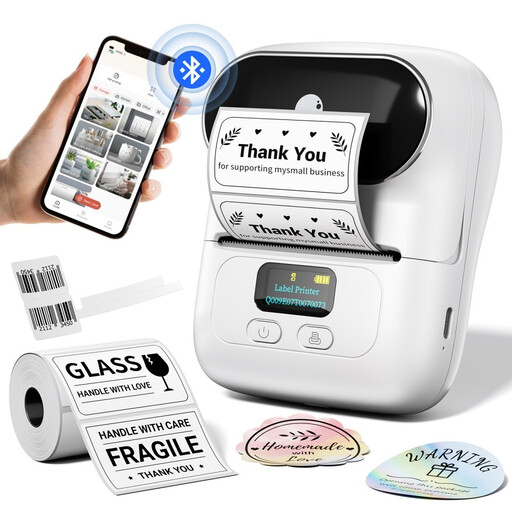
A portable choice to consider for custom folder tags, including a repeated set of years. Measure the tab or spine and confirm which replacement rolls fit; one label roll is listed with this variant.
 No image available
Consider this portable model for occasional year labels made from a mobile device. Check whether its stated 0.59 inch label width fits your folders and confirm the compatible consumables before ordering more labels.
Start by measuring the flat area of the folder spine or tab. A 9 mm or 12 mm label may suit a short year or tax-year range, but choose a wider format only if the folder has room for it. Brother UK lists widths up to 24 mm for the PT-P700 and PT-D610BTVP; the cited PT-D210VP and DYMO LabelManager 280 reach 12 mm.
A keyboard model suits individual year labels made where you file; a computer-connected model is worth considering when you need to reuse a layout across a longer run. Brother UK describes the PT-P700 as a USB-connected model, while DYMO UK says the LabelManager 280 can work either on its own or with a PC or Mac.
It can matter if the label identifies a person and the personal data forms part of, or is intended to form part of, a manual filing system. The Information Commissioner’s Office recommends a procedure for labelling physical information. Check your organisation’s agreed format for visible labels; a year alone does not necessarily identify someone, but other wording and the filing context may do so.
The printed year does not set the retention period. The National Archives advises retaining information for as long as it is needed for business, legal or historical purposes and applying a retention policy. Follow the schedule for your organisation and the type of record in the folder.