Choose a desktop roll-label printer if you regularly make batches of stock, shelf, price or barcode labels from a computer. A tape-label maker is worth considering when labels must fit narrow drawers, containers or equipment; check the tape against the surfaces you use. Whichever format you choose, place shop-applied labels so they do not obscure required product or safety information.
Who needs which labels?
Batch stock-and-price labellers
For shops preparing repeated shelf, price, product-name or barcode labels from a computer, desktop roll labels offer a relevant format. Brother UK describes pre-sized and continuous-roll options for its QL-800; DYMO UK positions its LabelWriter 550 for retail and barcode labelling.
Durable storage organisers
For drawers, racks, containers and equipment, the label needs to fit the available space and suit the surface. Epson United Kingdom lists LabelWorks tapes in several widths and finishes for this kind of organisation.
Safety-information-conscious sellers
For shops selling art materials that include hazardous substances or mixtures, an internal stock or price label is not a substitute for required product information. The Health and Safety Executive sets out labelling duties for distributors placing chemicals on the Great Britain market.
What to check before choosing
Start with the labels your art-material shop makes most often, then check the printer workflow and the exact roll or tape you would use.
| Concern | What to check | Who this matters to |
|---|
| Stock and price-label batches |
Check computer and software compatibility, barcode or database workflow, and whether available roll sizes fit your products and shelves. |
When I change stock details or prices, I need to produce repeated labels without entering each item separately; around 40% of consumers put batch stock-and-price labelling first. |
| Fit and durability |
Measure the narrowest label area, check supported widths and materials, and try a label on the actual storage surface. |
I need labels that fit drawers and containers and remain practical on handled equipment; roughly 30% of consumers prioritise storage-label fit and durability. |
| Product-information placement |
Decide whether a label is for internal use, a price or product information; keep required warnings and supplier information visible. |
If I sell an art material with safety information, I need my shop label to leave that information intact; about 30% of consumers make accurate product information their primary concern. |
Mistakes to avoid
-
Choosing print speed before measuring the space
A broad label may not fit a pen or narrow drawer, while tape can be awkward for a batch of shelf or price labels.
Measure your smallest and largest label areas, then check which formats the printer accepts. Consider separate systems only if both workloads justify them.
-
Assuming similar-looking rolls are interchangeable
Brother’s QL system uses DK rolls, while DYMO specifies particular LabelWriter labels for the LabelWriter 550. Check compatibility for the exact model rather than judging by roll appearance.
Identify the rolls or tapes needed for your regular labels before choosing a printer.
Buying incompatible stock can leave rolls unused.
-
Using an ordinary label for every storage surface
Brother describes DK labels as intended for short-term applications, whereas Epson lists durable tape variants. The material and handling conditions matter when labelling jars, tubs or equipment for longer use.
Try the intended label on the surfaces in your shop before obtaining rolls or cartridges in quantity.
Labels that detach or become unreadable take staff time to replace.
-
Covering product warnings with a shop label
A tidy price or stock label can still hide important supplier information. GOV.UK says product labels must not be misleading, while the Health and Safety Executive describes duties for distributors of substances and mixtures on the Great Britain market.
Keep required warnings and other product information visible. If your shop imports, repackages, reformulates or relabels a hazardous product, check the duties that apply to that activity rather than treating an internal label as sufficient.
Relevant brands to consider
Brother
A reference point for computer-connected roll labelling: Brother UK describes the QL-800 as using pre-sized or continuous labels up to 62 mm wide.
- Brother says the QL-800 can create barcode and database-based labels and cut continuous labels to length.
- Brother describes DK labels as designed for short-term applications; check the exact roll material for handled packaging or long-term storage.
DYMO
DYMO positions the LabelWriter 550 for desktop retail, barcode and organisational labels.
- DYMO says the LabelWriter 550 identifies the loaded label size and type and shows how many labels remain.
- DYMO specifies LabelWriter labels manufactured after April 2020 and describes the range as working exclusively with DYMO-branded labels. Check the compatible rolls before committing to this model.
Epson
A reference point for tape-based storage labels: Epson United Kingdom lists LabelWorks tape options in 12 mm, 18 mm and 24 mm widths, including clear, matte and coloured variants.
- Epson lists durable tape choices for organising items where width and finish affect the fit.
- Check tape compatibility against the printer you intend to buy. Epson lists the researched LW-K400 printer as discontinued, so its compatibility should not be assumed for another model.
Joybuy product choices
These choices include a desktop roll-label printer for repeated shop labels and portable label makers for mobile or occasional tasks. Check the media for each exact model; a portable label maker should not be assumed to use the same tapes as a dedicated tape-label system.
 No image available
Brother QL-600B label printer
Consider this model for recurring stock and barcode-label batches prepared at a shop workstation.
Before choosing rolls, check that the exact label size and material suit your packaging, handling and storage period.
View on Joybuy
 No image available
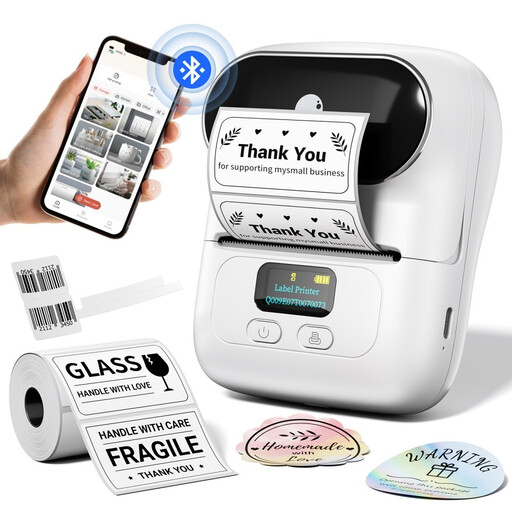
Phomemo M110 portable label maker with 1 label roll
For price and inventory labels prepared away from a fixed workstation, this portable model is a candidate.
Check the compatible replacement rolls and whether their label material suits your product packaging and storage surfaces.
View on Joybuy
 No image available
Phomemo D30 portable label maker, 0.59-inch label width
Consider this portable model for occasional labels created from a phone or tablet.
Check whether its stated 0.59-inch label width fits the intended location, and confirm the compatible media and adhesive for that surface.
View on Joybuy
Common questions
Should I use roll labels or tape for an art-material shop?
Use desktop roll labels for repeated stock, price, shelf or barcode labels made from a computer; consider tape for narrow storage areas and equipment. Measure where each label will go and check the exact printer’s supported media before choosing.
Do direct-thermal label printers need ink or toner?
The Brother QL-800 and DYMO LabelWriter 550 do not use ink or toner, according to their manufacturers. They still require compatible label rolls, and those rolls differ between systems.
Can I make labels from a product list?
Yes, if the printer’s software supports the file and workflow you use. Brother says P-touch Editor can print QL-800 labels from a database and include barcodes; check the exact model and software before relying on that workflow.
Can my shop label replace the safety label on paints or solvents?
No: a shop-applied stock or price label should not replace or obscure required safety information. In Great Britain, the Health and Safety Executive says distributors placing substances and mixtures on the market must ensure they are correctly labelled and packaged; the duties relevant to importing, repackaging or changing a product need separate assessment. Check Northern Ireland requirements separately where applicable.


